












Safe training with ACE industrial shock absorbers
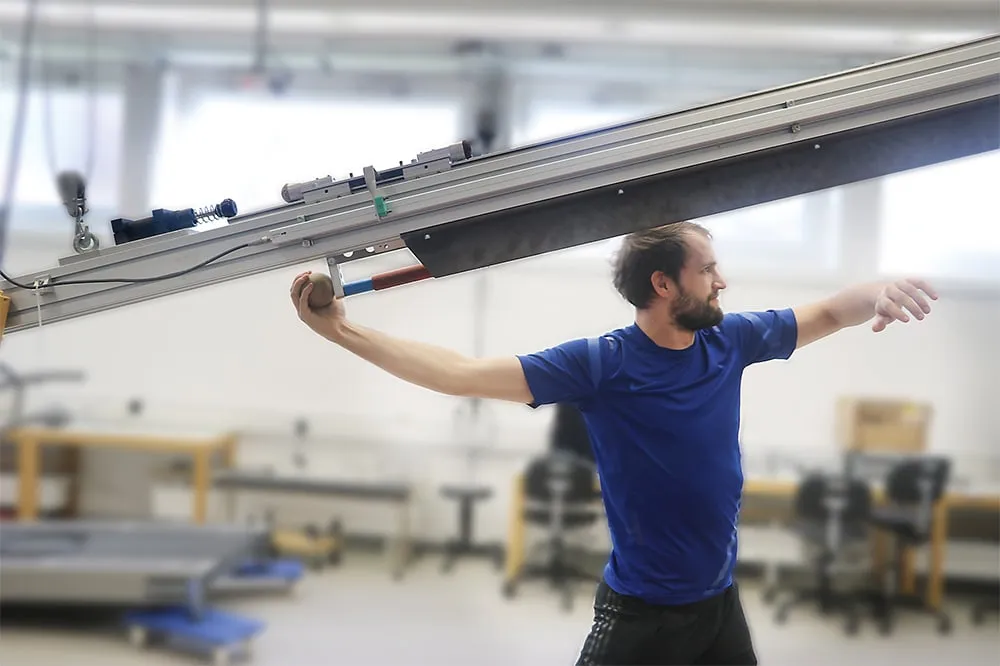
When analysing movement using test equipment, sports and exercise scientists sometimes use hydraulic machine components. This is particularly the case when analysing acceleration force in certain training and test equipment. As high forces can occur at the end positions, the Institute of Sport Science at the University of Tübingen uses adjustable industrial shock absorbers from German company ACE Stoßdämpfer to protect people and equipment.
More than 50 academics in Tübingen conduct research into sport and athletic performance, health and education. Their work ranges from talent development and the organisation of sporting competitions to promoting individual health. A team led by Professor Dr Veit Wank focuses in particular on biomechanics and the science of movement and training. This includes analysing and optimising movement patterns in sport. Research into training science centres on diagnosing the forces involved in individual sports. Talented athletes from athletics associations and teams also receive support with performance diagnostics.
Measuring movement technique and acceleration force
The university develops a range of training equipment for this purpose, including equipment for javelin throwing and handball. When throwing, athletes actively use the push-off force of the rear leg. During the throwing phase, the hip on the throwing-arm side moves forwards, putting the upper body under tension. This process, followed by the successive use of the shoulder, elbow and throwing hand, optimises acceleration. This technique maximises the final speed of the throwing equipment or sled. Simultaneous video observation of the athletes’ movements and positions, together with the corresponding sled position, speed and acceleration values, makes it possible to assess movement technique and physical abilities accurately, particularly the throwers’ acceleration force. The training equipment in Tübingen is used mainly for testing. Professor Wank and his team use it to record combined speed and force values. The sports scientist explains: “For athletes who have been part of a team for a long time, we can also use this to check whether their training over the past weeks and months has been effective. As the throwing movements repeatedly generate high inertial forces during measurements with the test equipment, we need suitable damping solutions to bring the equipment to a stop at the upper and lower end positions. This allows us to ensure the equipment can be used for a long time while providing test subjects with the greatest possible protection.”
Versatile shock absorbers for an inclined plane
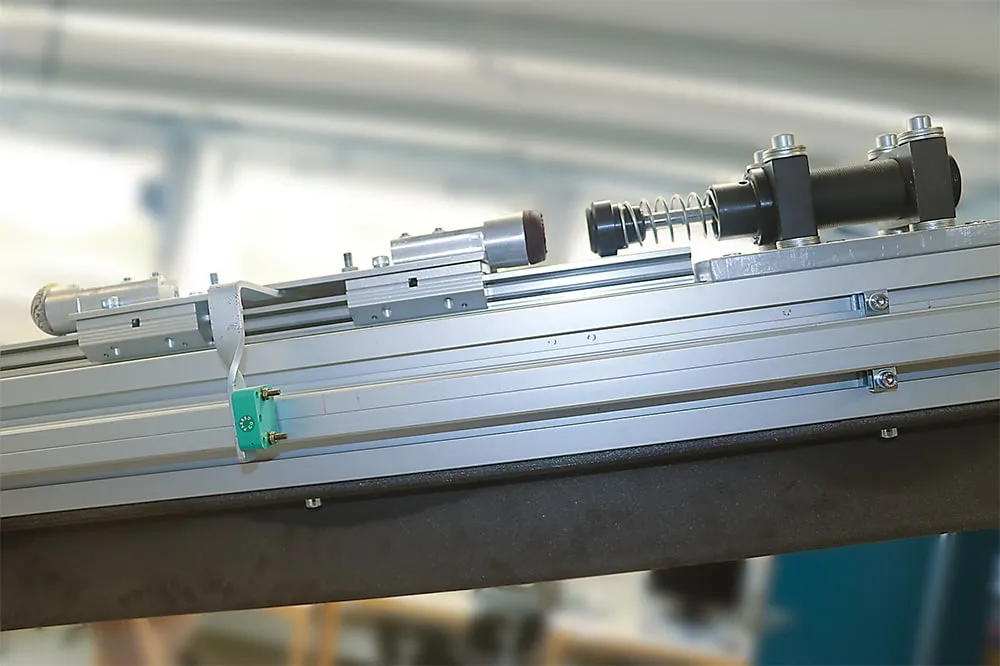
The university had previously used an ACE damping solution for test and training equipment to measure the performance of the thigh muscles. When developing the training equipment for the throwing exercise, the university once again contacted the damping specialist. “I had requested information for a modified leg press used for isometric and dynamic leg extension movements. At the end position of the leg press, masses of 25 kg to 200 kg, moving at speeds of approximately 3 m/s to 5 m/s, had to be slowed to an impact speed of approximately 0.5 m/s. Although the MA64150 shock absorber we tested at the time is theoretically not suited to this range, in practice the deceleration works well. When it came to damping the forces during the throwing exercise, I called ACE to confirm this,” says Wank. The test equipment essentially consists of an inclined plane with linear rails and a linearly guided sled. A javelin or ball can be mounted on it. The aim is to maximise the acceleration of the sled, either from a stationary position or from motion, as in competition. The sled travels a distance of 4.5 metres. Just before reaching the highest point of the structure and when returning to the starting position, the accelerated sled, which slides back down the inclined plane, is slowed by an industrial shock absorber. What makes the design in Tübingen distinctive is its inclined plane, which can be adjusted to angles between 0 degrees and 35. Handball, for example, requires a flat throwing angle, while javelin throwing calls for an angle of up to 35 degrees. Compared with other solutions, such as steel springs or rubber buffers, ACE components are significantly higher quality and last longer.
The adjustable shock absorbers also work well for slowing the throwing movements. “We installed a second shock absorber in our design to slow the sled as it returns. It is slightly oversized, but cheaper solutions using something like a doorstop do not work, hence the greater investment, which also helps ensure the safety of test subjects. It has proved to be a good decision. We have had to make very few changes to the settings, and the shock absorbers were soon working without any problems.
Long service life assured
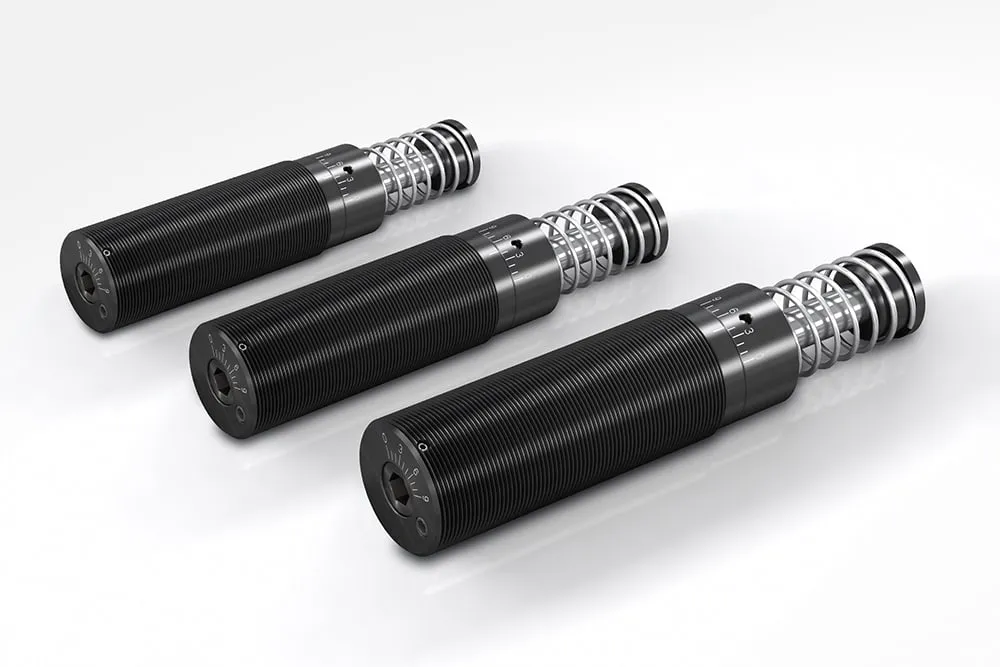
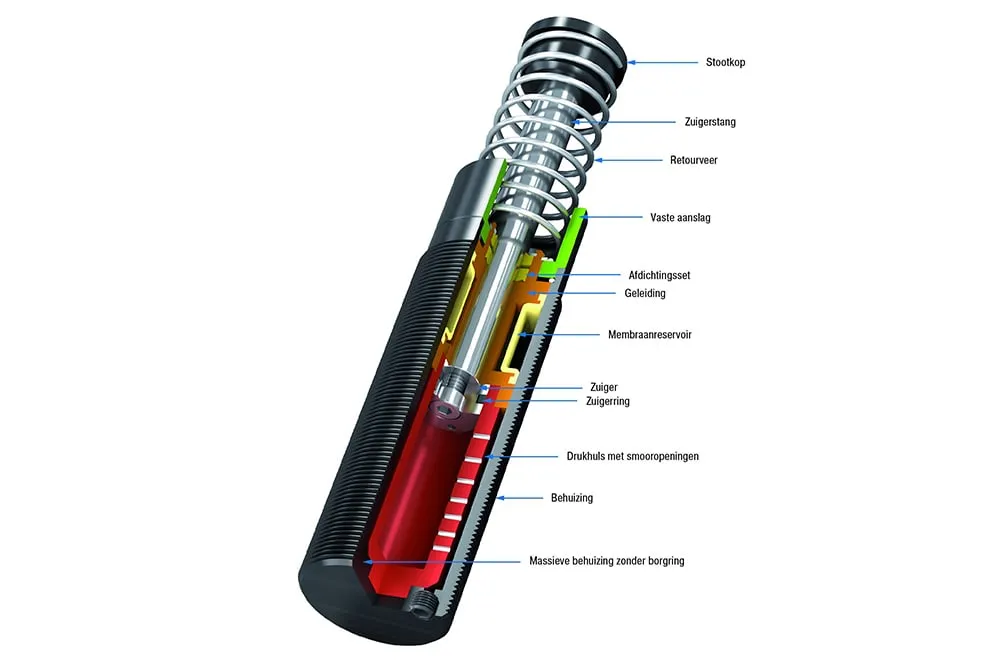
The industrial shock absorbers used in Tübingen are part of ACE’s MAGNUM series. Since its launch in 2000, the series has been regarded as the benchmark in the medium-size range of industrial shock absorption. These hydraulic machine components slow the forces generated by moving masses over the entire stroke in the shortest possible time. They then convert the kinetic energy into heat, which is dissipated to the outside. The shock absorbers are suitable for continuous industrial use. Thanks to a sophisticated seal package, hardened guide bearings and an integrated fixed stop, they are also robust and long-lasting. Their compact dimensions and greater mass range compared with earlier solutions give engineers more design flexibility and help make optimum use of the machine. A special feature of the series is that the shock absorbers are available either as self-adjusting or adjustable versions, with M33, M45 and M64 threads. The University of Tübingen also benefited from the adjustability at the front and bottom of the MA4575EUM shock absorbers. Given the total moving weight of 1.7 kg to a maximum of 25 kg and accelerations of up to 13 m/s, only adjustable types were suitable.
In addition to the membrane-reservoir sealing technology, the one-piece solid housing makes the shock absorber robust, preventing leaks and enabling it to absorb up to 50 per cent more energy. The fact that MAGNUM types are even more compact than earlier ACE models is an advantage, particularly for the increasingly smaller machines used in automation. With a stroke length of 73.9 mm, these shock absorbers are suitable for decelerating effective masses of between 70 kg and a maximum of 15,000 kg. Their energy absorption for deceleration without rebound and linear deceleration per stroke reaches up to 1,300 Nm. A wide range of accessories and mounting hardware makes them easy to integrate into existing designs and suitable for a broad range of applications. In Tübingen, MAGNUM shock absorbers with special impact heads are used. This reduced noise during testing by up to 7 dB.
Have a business enquiry for ACE Stoßdämpfer GmbH? Get in touch
Companies in this story

Keep following this
Get an email when a new story is published. No account needed.
- SubjectNews
- CompanyACE Stoßdämpfer GmbH







