












Robot-guided transfer system developed by Fontys in collaboration with IXON
Fontys is the largest university of applied sciences in the south of the Netherlands, with more than 25 institutes in 10 different cities. One of these is in Eindhoven, on the high-tech Brainport Industries Campus (BIC).
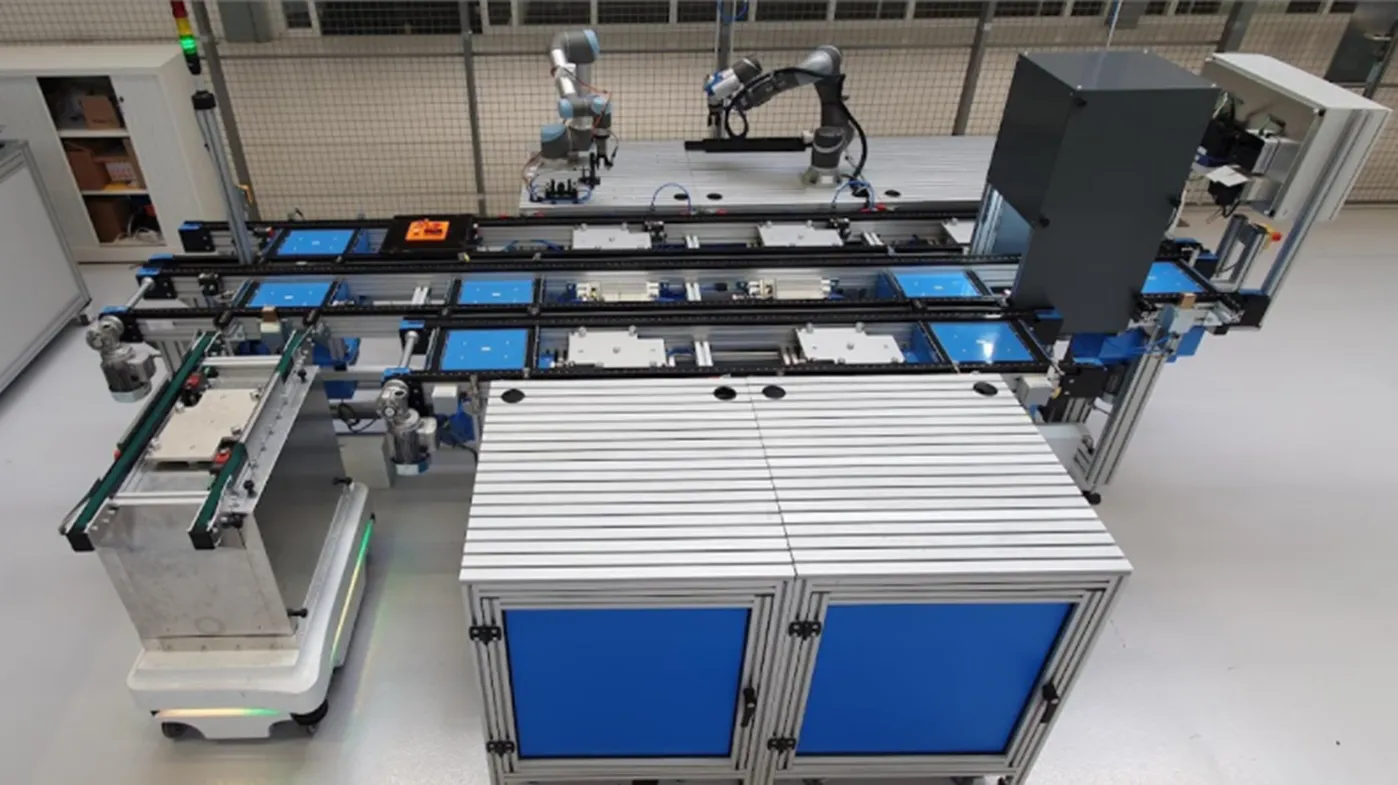
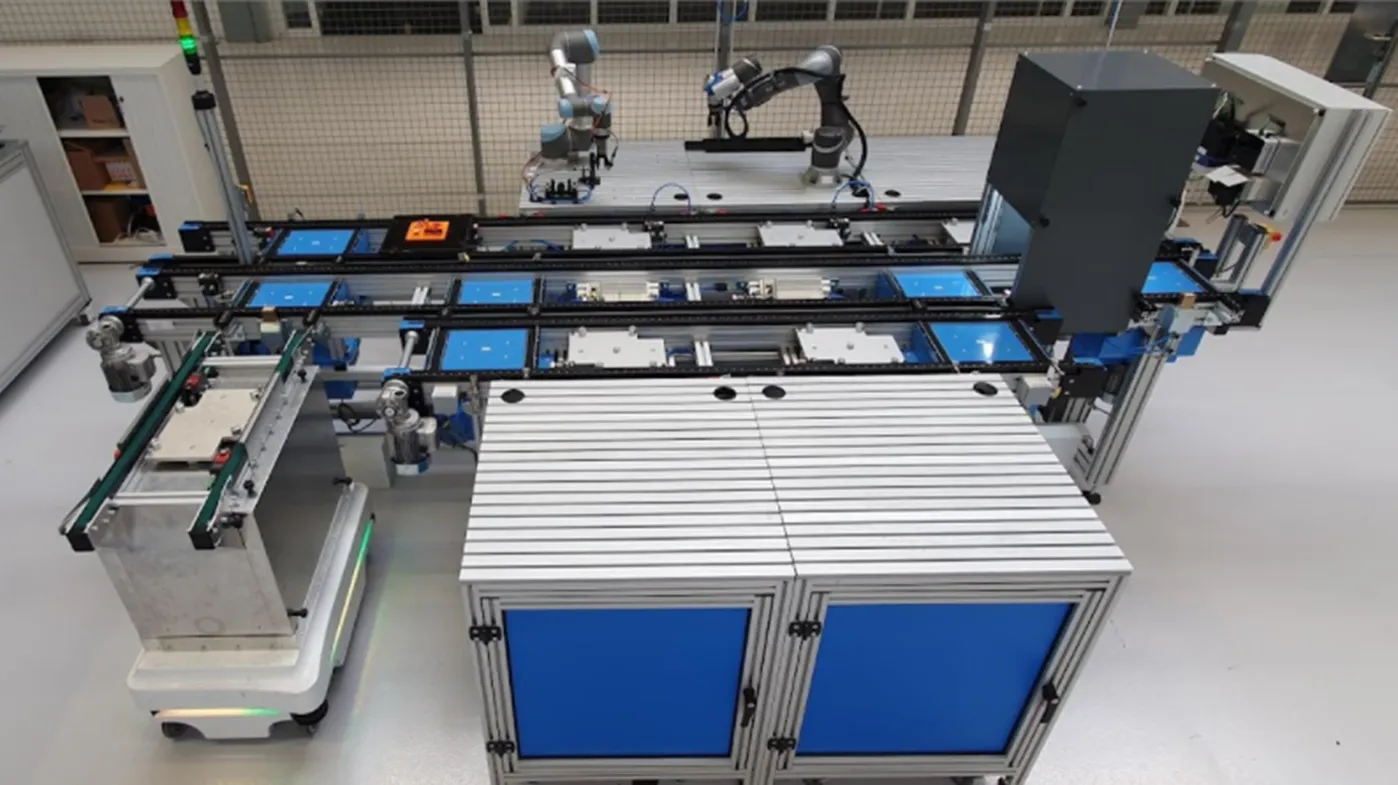
A group of researchers, lecturers and students from Fontys University of Applied Sciences’ School of Engineering developed a way to improve the efficiency of an existing robotic production line using IXON Cloud and IXrouter. The solution: a robot-guided transfer system for the manufacturing industry.
We spoke to Randy Kerstjens, lecturer and researcher in Mechatronics and Robotics at Fontys, to find out more about the project and its real-world applications.
Could you give us a brief overview of your project?
“The manufacturing industry is becoming increasingly automated, and factories are getting smarter as robots take on more tasks. With project FLUFFY, we took things a step further: (the) FLexible aUtomated Future FactorY.
We built a production line and then upgraded it by adding several robots that not only assemble components, but also place them in designated positions. This combination creates a more efficient and flexible production system that can, for example, be used in the processing industry.
The innovative aspect is the combination of robots working together to supply and move components or finished products to a transfer system with multiple workstations.”Randy Kerstjens, lecturer and researcher in Mechatronics and Robotics at Fontys
Why did you choose to work with IXON?
“With projects like this, the aim is always to work closely with industry. For project FLUFFY, we needed a remote access solution that was easy to use and provided a reliable bridge between the network activity of students and lecturers, enabling them to collaborate during a period when we could not meet in person.
I had already used IXON at my own company, Concept Robotics, so I was familiar with its quick set-up, intuitive platform and straightforward collaboration features. I asked whether we could use its all-in-one IIoT platform for the project. IXON was keen to get involved. They understand how supporting research projects like this helps shape innovative solutions for the future.”
How did you test the concept?
“For this project, I worked with two students from the Adaptive Robotics minor within the Mechatronics department. The automated production system was developed and installed at Brainport Industries Campus (BIC) in Eindhoven, where innovative, high-tech concepts for the manufacturing industry are developed. The concept, from delivery of the individual components through to assembly and final quality control, had to be tested using a Lego Formula 1 car.
We built a small-scale production line with several workstations and set up a system in which a top loader was mounted on an Autonomous Mobile Robot (AMR). The top loader picked up the components for the Lego Formula 1 car from one workstation and placed them at the assembly station, where a robot arm put them together. This process was monitored by a camera application developed as part of a separate graduation project on quality control.”
”If an error occurs on the production line, the camera detects it and sends the defective component to another production line where it can be repaired.”
Randy Kerstjens
Lecturer and researcher in Mechatronics and Robotics at Fontys
What role did IXON play?
“In this case, we used the IXON module as a remote access solution. We quickly set up a VPN connection to our system and started monitoring it remotely, debugging it when necessary. Using user management, we could add all project participants to the platform and provide role-based access control. This enabled us to make changes remotely and collaborate efficiently with colleagues and students, whether they were working from home or on site.
In the near future, we plan to implement data logging as well. This will allow us to collect and monitor a range of crucial data points, then analyse them later to optimise production.
If an error occurs on the production line, the camera detects it and sends the defective component to another production line where it can be repaired.”
What are the real-world applications of this project?
“Applied research like this gives students the opportunity to combine learning with working on projects that have a real, demonstrable impact on industry.
Demand is growing in the manufacturing industry for advanced systems capable of handling a wider range of subsequent tasks. Our flexible robotic assembly system can automate a large part of the assembly and manufacturing process for a wide range of products, such as mobile phones, small electronic assemblies and pill boxes.
As a result, companies are looking towards the new production line of the future, with added operational value such as increased efficiency, more flexible production and fewer human errors, as well as commercial value through new opportunities for collaboration within the manufacturing industry.”
That sounds promising! What are your plans for this result?
“Of course, this is not the end of the project. We learn from new developments in the field and other research being carried out, and implement those lessons in our own project. This allows us to develop and improve FLUFFY further, and to continue contributing to innovative solutions in the field, with strong partners like IXON by our side.”
Question about this story? Ask your question
Companies in this story

Keep following this
Get an email when a new story is published. No account needed.
- ThemeRobots on the shop floor
- SubjectNews
- CompanyIXON B.V.







