












RFID as the eyes and ears of Industry 4.0 systems

Long before Industry 4.0 became a buzzword, RFID tags were already putting it into practice. Today, this technology is emerging as an ideal way to provide Industry 4.0 systems with eyes and ears. After all, anyone looking to take the next step in automation will need to integrate more data at the various stages of the production process. RFID tags are the perfect solution for tracking products throughout the entire flow through the factory, and even into shops.
RFID stands for radio frequency identification. It uses radio waves to identify objects. The technology was developed to store and read information remotely using so-called RFID tags. Today, RFID tags can be found on a wide variety of products. Jeans, medicines and even cars are fitted with them so they can be identified unambiguously during shipping. The principle is very straightforward. An RFID tag is essentially a transponder. When it passes a receiver, an RFID reader, the tag is activated and the information stored in its memory is revealed. This benefits everyone in the supply chain. The manufacturer knows exactly when the product has left the factory, the shipper can track its progress throughout the journey, and when it reaches its destination, a signal can be sent to confirm that it has been received.
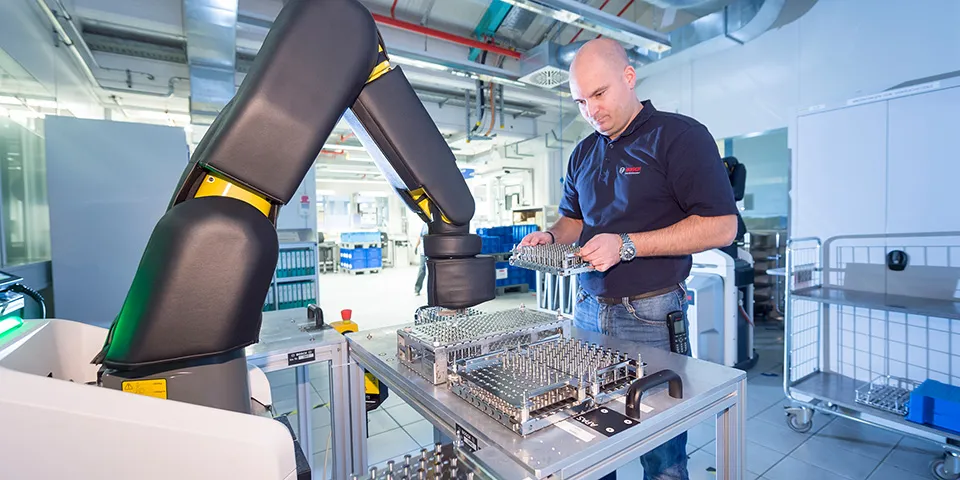
The tags can store a wealth of information that machines need to determine which processing step is required for the workpiece in question.
Controlling operations based on tags
In the past, RFID systems were limited to storing data. The high cost of performing this relatively simple task was a major barrier to the technology’s widespread adoption. Applications were generally confined to high-value products that could justify the cost. Manufacturers could be sure that their valuable products reached the customer, with perfect traceability if required. With the advent of Industry 4.0, however, RFID tags can take on a new and broader set of tasks within the factory itself. Data now needs to be captured at every stage of the production process and drive the entire operation to create the factory of the future. In this context, RFID technology enables the next level of automation. The tags can store a wealth of information that machines need to determine which processing step is required for the workpiece in question. The technology has also become more powerful, with more memory for storing more data, and cheaper, thanks to higher production volumes. This is further accelerating its adoption in the factory of the future.

Today, RFID tags can be found on a wide variety of products: jeans, medicines and even cars.
No external power supply required
In this role, RFID has several important advantages over more traditional methods, such as barcode-based identification. First, RFID tags do not require an external power source, as the power supply is built into the chip or reader. This is what distinguishes active from passive RFID tags. Active tags have a transmitter and their own built-in power supply or battery. Passive RFID tags have no built-in battery or power source, but draw power from the RFID reader, which emits electromagnetic waves. These waves induce a current in the tag’s antenna, enabling two-way communication. Semi-active RFID tags, in turn, use a battery to power the integrated circuit on the tag, but draw the power required for communication from the RFID reader.
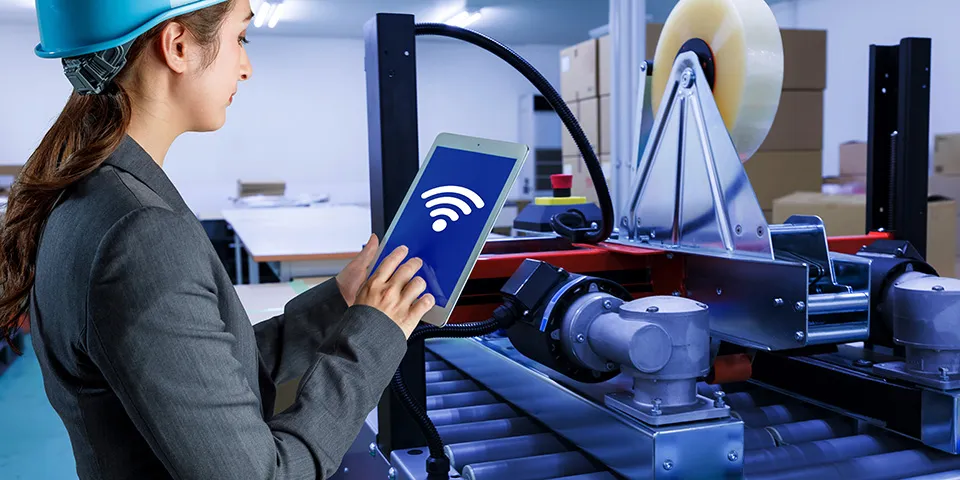
RFID stands for radio frequency identification. It uses radio waves to identify objects.
No direct contact required between transmitter and receiver
The second key advantage is that the transmitter and receiver do not need to be in direct contact or within line of sight of each other. Communication takes place via radio waves. Depending on the requirements of the application, various frequency ranges are available, and these also affect the positioning of the RFID reader. LF (low-frequency) RFID systems operate in the 125 to 134 kHz range. They are characterised by a limited read range (around 10 cm), but provide a reliable and reasonably fast solution for most standard RFID applications. HF (high-frequency) RFID systems operate at 13.56 MHz and offer medium to high read speeds. They are adversely affected by metal environments, but are largely unaffected by moisture and water. They are mainly used in ticketing and payment systems, as well as data transmission applications. UHF (ultra-high-frequency) RFID systems operate in the 865 to 928 MHz frequency bands. They offer a very long read range (up to 15 m) and high read speeds. They are also highly cost-effective. This is the system most widely used in fast-paced factories.
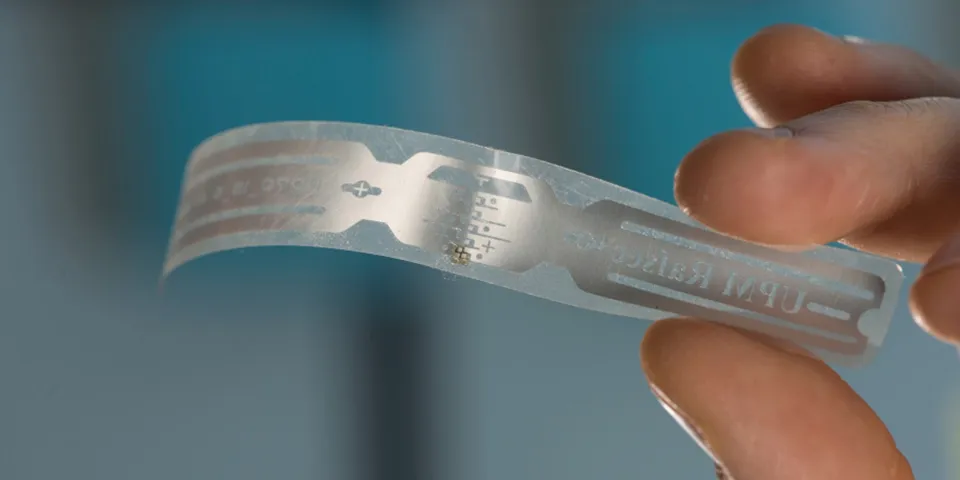
In the future, RFID tags will need to be paper-thin and even more compact than they are today.
Updating information on the move
A third major advantage is that data on RFID tags can be updated as they move around the factory. Their memory capacity has now increased to several kB, opening up a wide range of additional possibilities. In other words, tags can carry extra information, such as the production requirements or assembly plan for the workpiece in question. An RFID scanner on the machine can read what needs to be done and send the corresponding instruction to the robots or logistics systems, positioning the workpiece correctly for the processing machine. Once the operation is complete, further information about the work carried out can be added to the tag. It can also store all the information about production conditions, such as temperature, vibration, energy consumption and distance. RFID systems can help companies take the step towards mass-producing customised products. This approach will become increasingly common in the future.
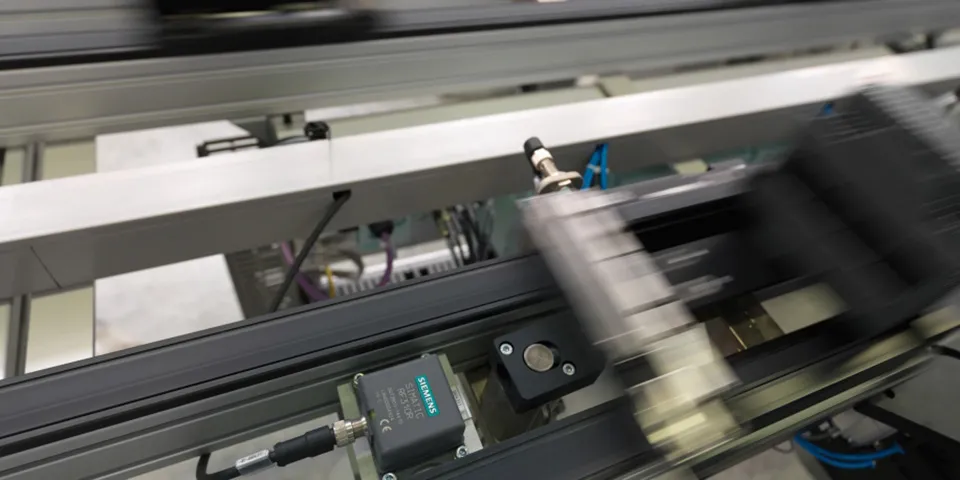
UHF (ultra-high-frequency) RFID systems operate in the 865 to 928 MHz frequency bands. They offer a very long read range (up to 15 m) and high read speeds.
Challenges
Two major challenges still need to be overcome before this becomes a reality. First, the industry needs a uniform radio standard that applies worldwide. This would help RFID gain wider adoption. Work is also under way on new ways to power the tags. In the future, they will need to be paper-thin and even more compact than they are today. Current power supply technology will then no longer be adequate. Researchers are currently investigating whether electromagnetic field synthesis can generate energy from radio frequency fields to power the tags. This could allow tags to be powered as they move through the factory.
The second key advantage is that the transmitter and receiver do not need to be in direct contact or within line of sight of each other.
RFID tags can be divided into active, passive and semi-passive tags.
Question about this story? Ask your question
Keep following this
Get an email when a new story is published. No account needed.
- ThemeSmart manufacturing and logistics
- SubjectNews







