












Reverse engineering: how to recreate a part that can no longer be sourced
How can I get a part that is no longer in production? This is a problem you may face if you have an old pump system. Our spare parts experts at KSB have answered a series of questions to tell you all about reverse engineering, the process of reproducing a part from the original.
Reverse engineering is a method of producing a part that is exactly the same as the original. It makes it possible to overcome product obsolescence while retaining the manufacturer’s quality guarantee. The newly manufactured part replaces the old one. It is a solution when no other options are available!
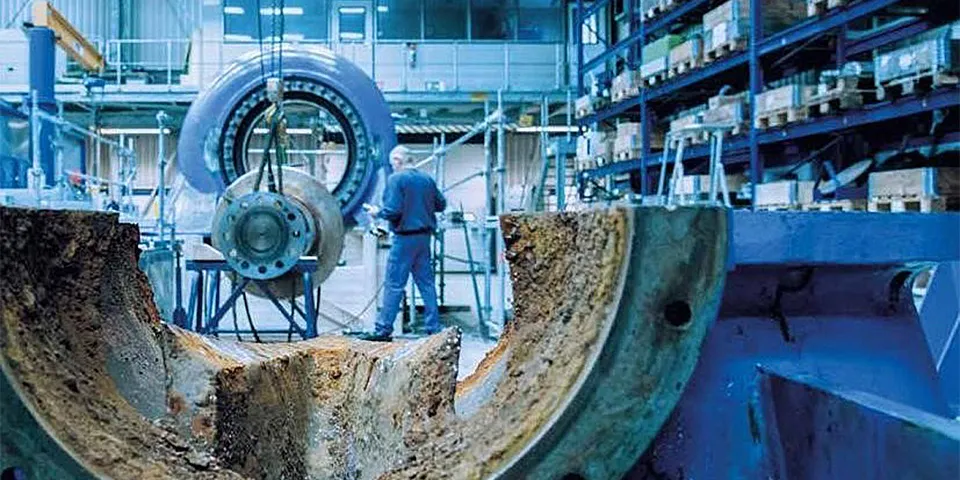
How is the reverse engineering process organised?
To manufacture a part using reverse engineering, several types of information need to be gathered. First, information about the materials, but also about the fluid being transported and the environment in which the part is used. Reverse engineering is a process that starts with a 3D scan. This makes it possible to determine the exact dimensions of the damaged part or the model part to be reproduced. A scan to obtain a point cloud can also be used. In this way, KSB guarantees the highest possible accuracy when reproducing the part. All the information gathered enables the pump specialist to create a CAD model. This model provides an overview of the finished part and is needed to create the mould that makes it possible to machine the part identically. This method allows all parts to be manufactured, even the most complex ones. Parts can also be 3D printed in a wide range of materials, such as bronze, cast iron, stainless steel or any other type of steel!

Which parts are involved?
This applies to all kinds of parts, such as pump components, valves and all other parts for rotating machinery. Reverse engineering applies to both KSB products and third-party products. In addition to components for valves and rotating machinery, KSB can also manufacture other parts or prototypes to meet your requirements. The possibilities for replication are unlimited. This means that you can have any number of parts custom-made to meet your needs. This is not a one-off production run, which makes the process even more ingenious and necessary in some cases.
When do we use reverse engineering?
Reverse engineering is used when the original part can no longer be produced because of changes to the process, missing drawings, the loss of the casting pattern, or the need for optimisation. In other words, the original part is modified to improve its efficiency by changing the materials or design. This approach ensures that an exact, ready-to-use replica of the product in question can be produced quickly, without compromising KSB’s uncompromising quality.
Question about this story? Ask your question
Keep following this
Get an email when a new story is published. No account needed.
- ThemeFrom design to flexible machine
- SubjectNews







