












Rapid development of a face mask machine
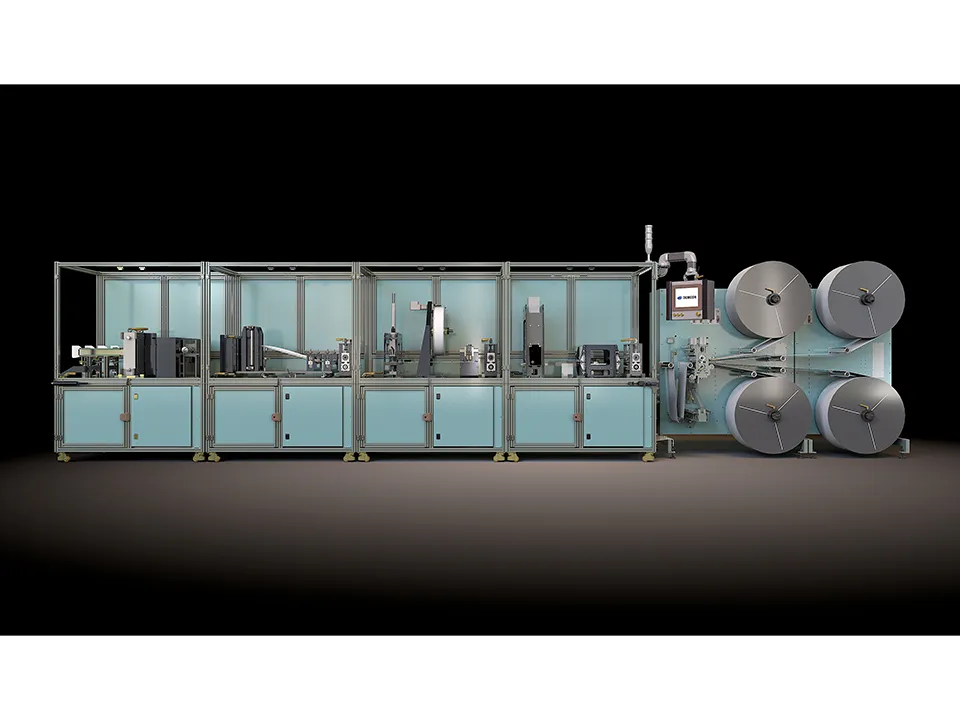
Shortly after the Covid-19 pandemic broke out, every country was urgently seeking face masks. Demcon Industrial Systems decided to take responsibility and develop a machine for the rapid production of FFP2 medical face masks.
It took just a few months to develop the modular machine and deliver it to Sneek. A Festo vision system checks a specific quality control step in the final stage of the production process.
March 2020 will always be remembered as the period when the Covid-19 pandemic dominated the news. Its impact on people and businesses was immense, as was the uncertainty about the future. Yet the first initiatives to contain the coronavirus as quickly as possible and limit its effects were soon under way. Demcon also took the initiative. Thijs Rupert, managing director of Industrial Systems, explains: “The management decided that we could take responsibility by developing a machine capable of rapidly producing medical FFP2 face masks. We wanted to design our own innovative machine to solve the problems other manufacturers were facing at the time. That meant producing high-quality face masks that would not be rejected, with the shortest possible cycle time (3 to 4 seconds) and lead time, so that we could make a substantial contribution towards addressing the shortage.”
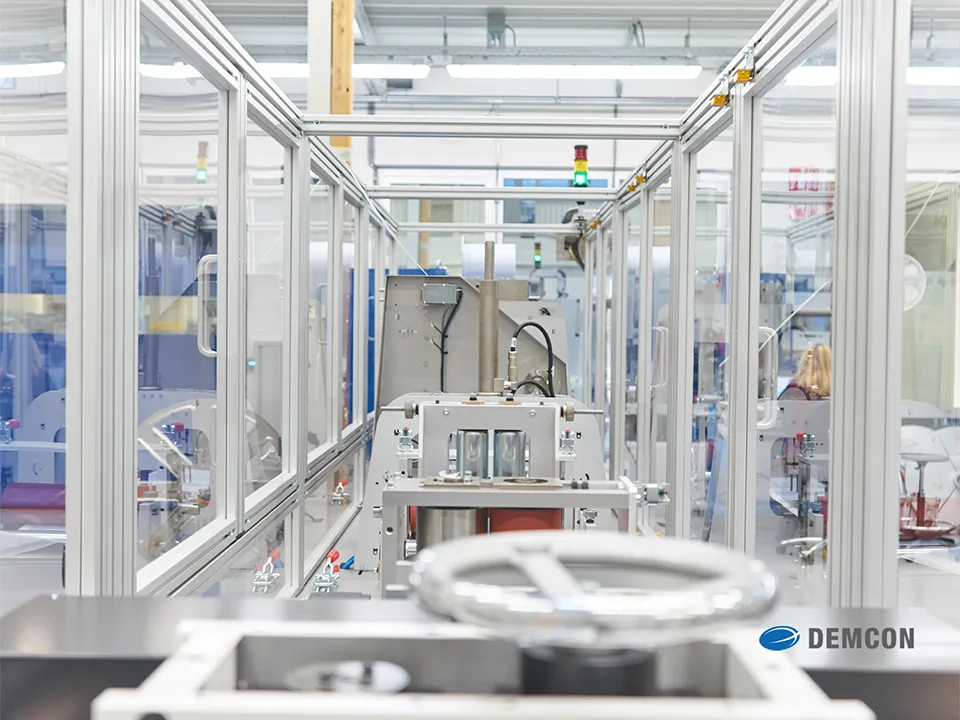
Modular design
The final design is modular. The process starts on the right, where material is fed from rolls. The fabric from the rolls is brought together and passed through a feed roller. The rolls turn at a speed that feeds the fabric continuously towards the roller. A dancer roller downstream acts as a buffer. In the following stations, the component parts are processed while stationary (start/stop). The buffer ensures that as soon as the products move on to the next station, enough fabric is immediately available to feed in. At the first station after the dancer roller, an aluminium nose clip is fed in, cut to length and placed between two layers of fabric. The outer contour is also ultrasonically welded. At the second station, the elastic headband is fitted and the mask is printed. The semi-finished products are then folded at the third station, after which the fourth and final station secures the folds with an ultrasonic weld. At the last station, the mask is also cut out of the fabric and discharged.
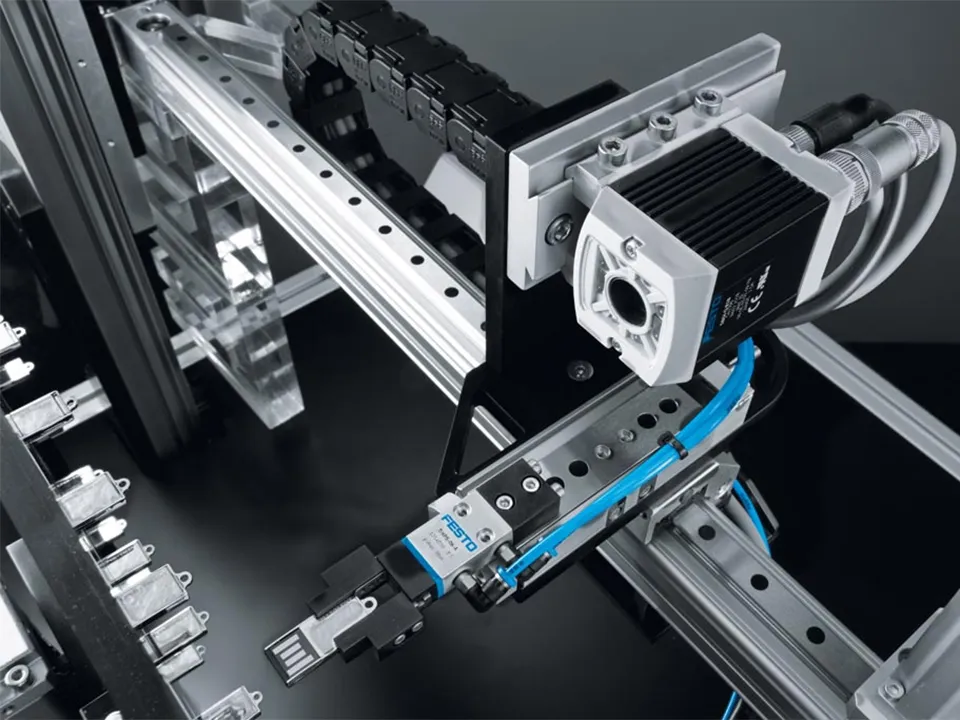
Inspection with a Festo vision system
Before the masks are cut out, they are checked using a vision system with a configurable SBSI Smart Sensor. The system first checks that the nose clip and headband are in the correct positions. If they are not, the cutting unit could be damaged. This check is therefore specifically intended to protect the machine and prevent downtime. The vision system also checks whether the pattern is correct and whether the intended cutting line matches the previously made weld line. If not, this means that something has shifted somewhere in the machine, a phenomenon known as ‘pattern drift’. Detecting this at an early stage makes it possible to adjust the settings straight away, preventing unnecessary rejection of face masks.
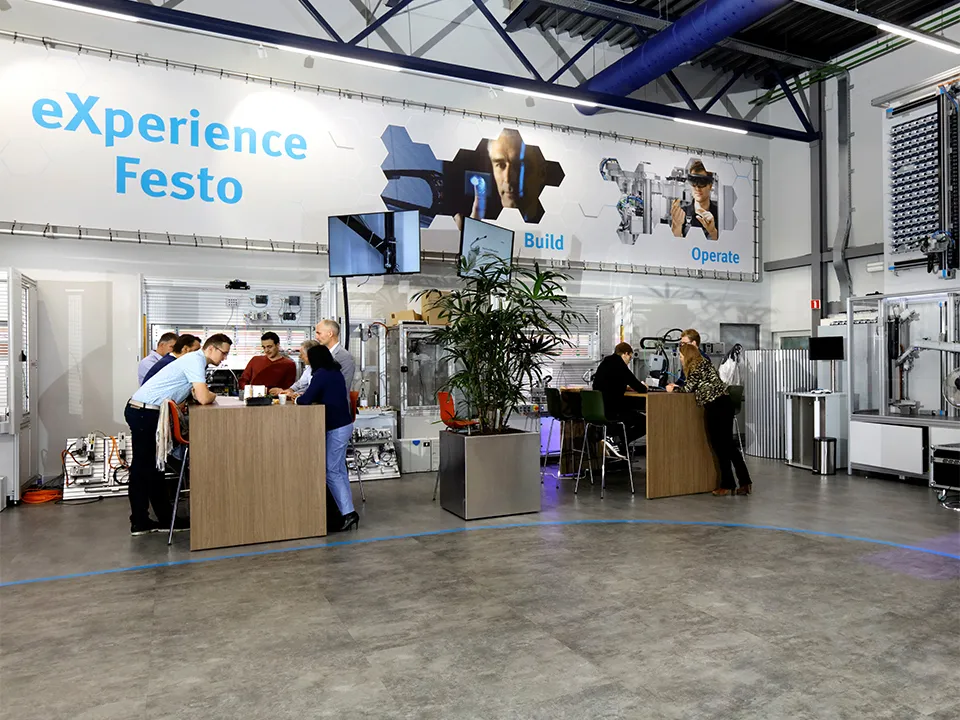
Expertise and a high-quality product range
Demcon chose Festo for the vision system as well as the pneumatic drive technology. “It is a company with enthusiastic employees who not only know their stuff but are also willing to think things through with us. In that respect, we are a good match. Festo also has a comprehensive, high-quality product range, which means we can source many components from a single partner. Before this project, we visited its impressive Experience Center, where we took part in various training courses. Festo employees also came to our site to provide our engineers with specialist training, enabling them to make the most of the software for the SBSI cameras. This vision system is particularly suitable not only because of its high accuracy, but also because we can configure the sensors ourselves and therefore use them flexibly for a range of functions. It is also a proven product that was available off the shelf. In that respect, we were better prepared for the project than anyone. When we started, all the hardware, software and expertise were in place.”
Question about this story? Ask your question
Companies in this story

Keep following this
Get an email when a new story is published. No account needed.
- SubjectNews
- CompanyFesto







