












Process industry: ready for digitalisation

Even when the world seems to stand still, the process industry keeps running and looking for innovation.
On 17 and 18 September, Siemens held the first virtual edition of the Process Industry Summit. There was plenty to discuss, as digitalisation is now making its mark in the process industry too. Siemens has developed the first digital process twin for the pharmaceutical industry.
Text Valérie Couplez | Images Siemens
The Siemens Process Industry Summit was originally due to take place in March. Then the coronavirus pandemic struck. The virtual event held in September was made possible by the digital acceleration now being felt in the process industry. Senior Vice President Digital Industries Eddy Nelis explains: “The term Industry 4.0 was first used in 2011, with a strong focus at the time on discrete manufacturing. These production processes, which mainly involve movement, are easier to automate and digitalise than the complex web of chemical, physical and mechanical processes found in the process industry. Now, almost ten years later, major strides are being made in the process industry too. Digitalisation is a way to reduce or even eliminate every kind of waste, whether in quality, speed, time or cost. The process has been accelerated further by the coronavirus pandemic and the need for remote solutions.”
It is no coincidence, then, that Siemens has achieved this world first with a digital process twin right here in Belgium.
Digital process twin
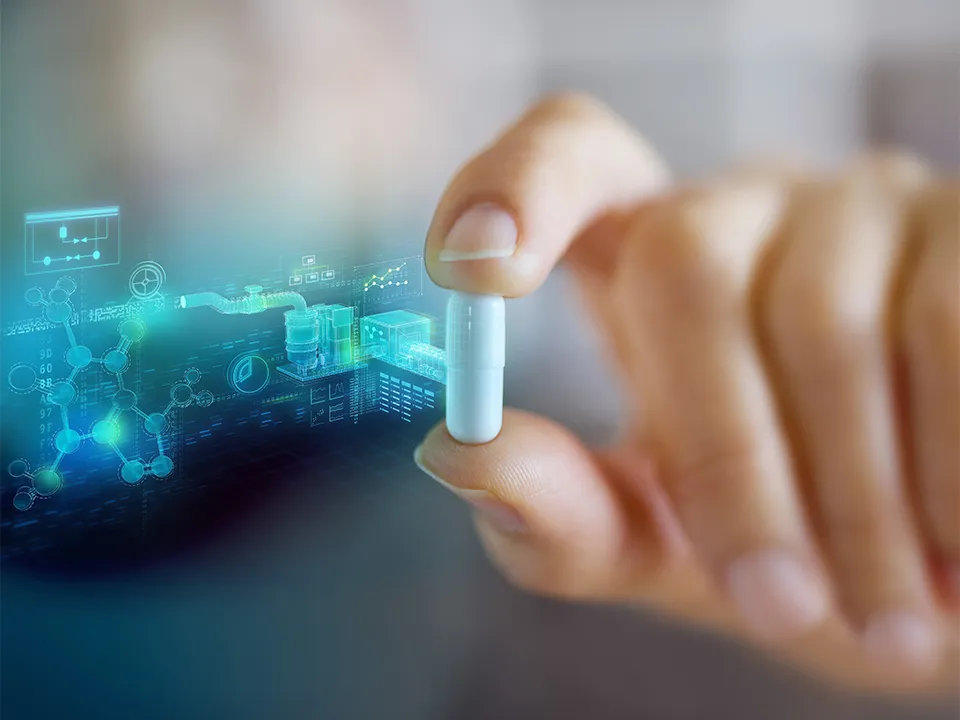
There is no doubt that Siemens had plenty to talk about at the Process Industry Virtual Summit. Earlier this year, it announced a major world first. Together with ATOS, Siemens succeeded in creating a digital process twin. An industrial process could be fully recreated and simulated virtually. Nelis says: “This opens up huge opportunities for the process industry to optimise existing processes and bring new ones to market faster. Everything can be tested virtually before any investment is needed. This supports the responsiveness now required of the pharmaceutical sector in response to Covid-19. We are doing everything we can to help companies in their search for a vaccine and in its production.” A crucial step in developing the digital process twin was adding machine learning to the simulation software. “Artificial intelligence will be a game changer in the years ahead,” Nelis stresses. “By running thousands of simulations, AI learns, for example, how to optimise the injection of different liquids into a process while keeping quality within the specified limits. The first step is to build databases of information. The more data there is, the more connections AI can make and the better the system will ultimately perform.”

Eddy Nelis: “The digital process twin opens up huge opportunities for the process industry to optimise existing processes and bring new ones to market faster.”
Belgian success
The great thing about this development is that it was a genuine Belgian achievement. “Belgium is an attractive region for pharmaceutical companies, partly thanks to government initiatives that keep R&D affordable here. With our own Centre of Competence for Pharma (established in 2000), we have a team with strong technical expertise and a thorough understanding of the challenges facing the process industry. It is no coincidence that we managed to achieve this world first with a digital process twin right here”, says Nelis proudly. Antwerp is now home to the world’s second-largest cluster of chemical companies. “If we want to stay at the front of the pack, now is the time to invest. What we demonstrated at the Process Industry Virtual Summit is that there are references showing the added value that can already be achieved in practice today”, says Nelis.

Digitalisation is a way to reduce every kind of waste, whether in quality, speed, time or cost. The process has been accelerated further by the coronavirus pandemic and the need for remote solutions.
Question about this story? Ask your question
Keep following this
Get an email when a new story is published. No account needed.
- ThemeData from shop floor to decision
- SubjectNews







