












Predictive maintenance, beyond the hype

The use of big data analytics in predictive maintenance is one of the most talked-about topics in maintenance and asset management. PwC and Mainnovation jointly surveyed 268 companies in Belgium, the Netherlands and Germany about predictive maintenance. They wanted to find out how far companies had already implemented it on the shop floor, what has changed since the previous survey in 2017 and what their plans are for the near future. The findings show that big data analytics for predictive maintenance is much more than a hype. For the companies surveyed, it is a powerful new technology that delivers excellent results and creates added value.
PwC and Mainnnovation used four maturity levels to assess predictive maintenance. The amount of data used to detect machine stoppages or failures defines the boundary between each level. The first level involves visual inspection. Levels two and three cover instrument inspection and real-time condition monitoring, while at level four, big data analytics drives decision-making. This is where the digital revolution and the world of maintenance meet. Achieving this level requires machine learning technology to identify relevant patterns in large volumes of data and generate practical insights to improve the availability of
installations. When stoppages that were previously unpredictable can now be identified in advance, this is predictive maintenance 4.0.

In the study, PwC and Mainnovation set out a detailed approach for integrating the technical components associated with predictive maintenance 4.0, step by step.
Maturity level unchanged
The survey found that 4% of companies are currently at level 4, the same figure as in 2017. This means that companies’ plans and ambitions to move to predictive maintenance 4.0 have yet to be put into practice. Nevertheless, there are clear signs that companies are becoming increasingly ambitious about improving their maturity in predictive maintenance. 60% of survey participants said they had very concrete plans and intentions to roll out predictive maintenance 4.0 in their company in the near future. That is an increase of 11% compared with the 2017 result. The main aim is to increase uptime. The primary reason for not yet taking action is a lack of budget.

More companies are already making use of external data, an essential component of big data analytics.
More ambition, more action
Companies also appear to be making greater efforts to improve the maturity of their maintenance activities. It is not just talk. The foundations are being laid to ensure they have the right capabilities and resources for predictive maintenance 4.0. More companies are already making use of external data, an essential component of big data analytics. The ways in which companies collect data are also becoming increasingly sophisticated: sensors that gather information about the environment, production control systems and maintenance information systems. They are also using advanced data software, platforms and connectivity solutions. There have also been marked changes in staffing since 2017. More and more companies are involving data scientists, IT specialists and reliability engineers in their maintenance activities.
It is clear that everyone recognises the potential of predictive maintenance 4.0 to improve existing practices, but the industry is still exploring this technology.

The survey found that 4% of companies are currently at level 4, the same figure as in 2017. This means that companies’ plans and ambitions to move to predictive maintenance 4.0 have yet to be put into practice. (Image: Morel fotografie)
Does it work as well in practice as it does in theory?
The survey also examined whether predictive maintenance 4.0 lives up to its promises. A remarkable 95% of companies already using predictive maintenance 4.0 in practice say that it has helped them improve at least one of the distinguishing factors in their maintenance policy. 60% of respondents saw an improvement in uptime, with an average increase of 9%. A similar proportion of respondents reported lower costs and reduced health, safety and environmental risks thanks to the introduction of predictive maintenance 4.0. The service life of their machines and components also improved. These results reinforce the view that using big data analytics is the next step in maintenance.
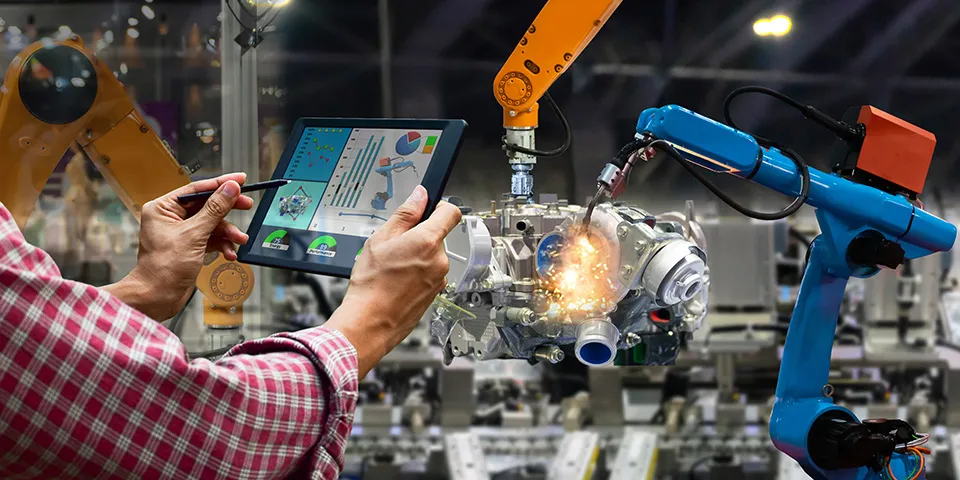
At level four, big data analytics drives decision-making. This is where the digital revolution and the world of maintenance meet.

The amount of data used to detect machine stoppages or failures defines the boundary between each level. (Image: Morel fotografie)
How should predictive maintenance be approached and implemented?
In the study, PwC and Mainnovation set out a detailed approach for integrating the technical components associated with predictive maintenance 4.0, step by step. It covers, among other things, the required IT architecture and components. Organisational aspects are also considered, with a view to building a genuine digital culture within the company. Above all, however, both partners want to emphasise that predictive maintenance 4.0 can only succeed in companies that are able to drive change, foster a digital culture and are willing to develop and attract the right skills. It is not simply a matter of choosing the right technology, although that is, of course, important. Success is not determined by specific sensors, algorithms or analysis programmes, but by the people on the shop floor. Getting the human factors right may be the biggest challenge in implementing predictive maintenance 4.0.
Question about this story? Ask your question
Keep following this
Get an email when a new story is published. No account needed.
- ThemeLess downtime through maintenance
- SubjectNews







