












Precise dosing
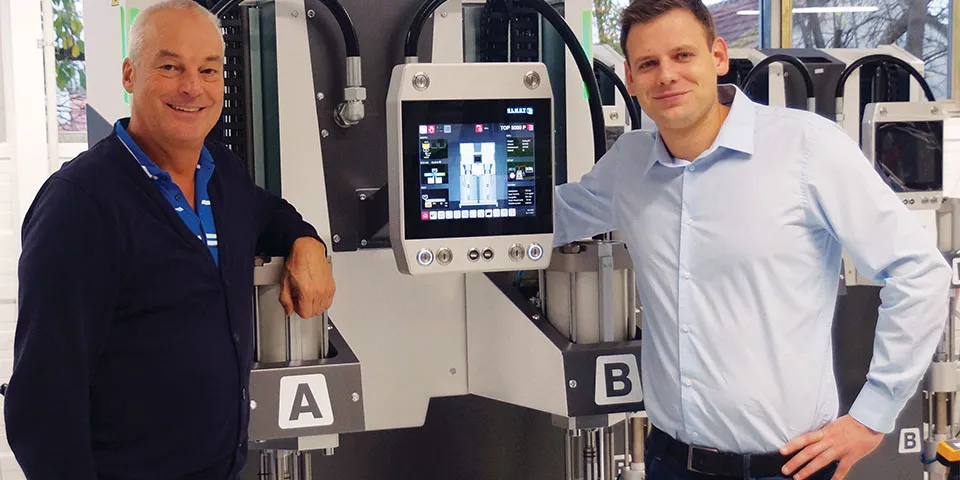
Transparent silicone is gaining ground. Austrian company Elmet specialises in plastics injection moulding and offers all the components required for so-called LIM production cells, as well as complete turnkey systems optimised for silicone products. Its tools and machines meet the highest quality standards required worldwide. One of the secrets of its success is an extremely precise dosing system, which ensures the exact mixture of silicone components and additional additives. To control the complex process technology, Elmet relies on SIGMATEK hardware and software, in particular components from the S-DIAS control system family and the Multi Touch ETT 1233 panel as the user interface, programmed with the LASAL engineering and visualisation software package.
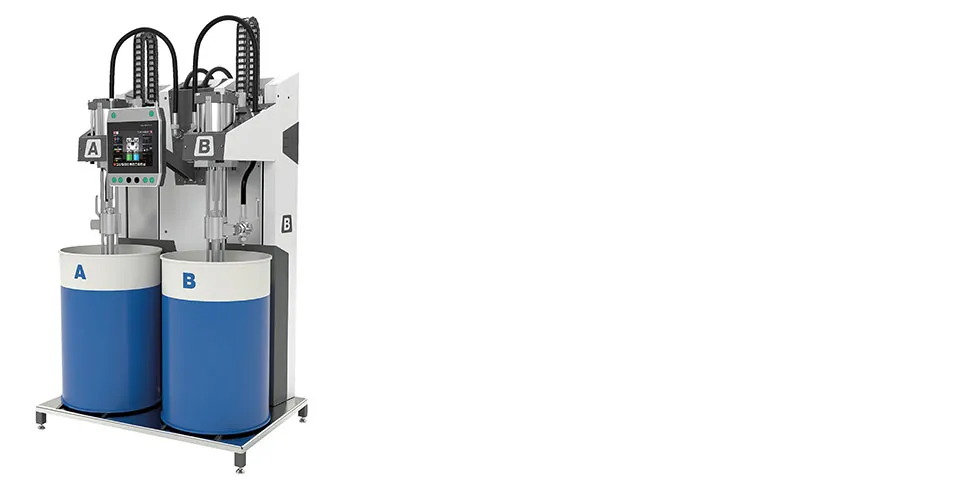
For mixing silicone components, Elmet uses SIGMATEK hardware and software to manage the complex process technology.
Seals for pacemakers, teats for baby bottles and optical lenses for modern matrix LED headlamps in the automotive sector are just three examples of products made using silicone injection moulding. “One current trend is towards highly transparent silicone that is resistant to UV light and therefore does not turn yellow like thermoplastics,” explains Karl Adlesgruber, partner and managing director at Elmet. “With the introduction of LED technology in the automotive industry, demand for optical lenses made from highly transparent silicone, and the volumes required, are increasing enormously. However, the automotive industry already makes extensive use of injection-moulded silicone products for a wide range of applications. Modern vehicles contain countless seals made from elastic material that withstands temperatures from -40 to 200 °C.” Only a handful of manufacturers worldwide can supply this material, and most of it regularly passes through Elmet as new silicone formulations are tested. The Austrian company has made a name for itself in Liquid Injection Moulding (LIM), the technical term for the technology used to produce moulded elastomer components from liquid silicone rubber (LSR).
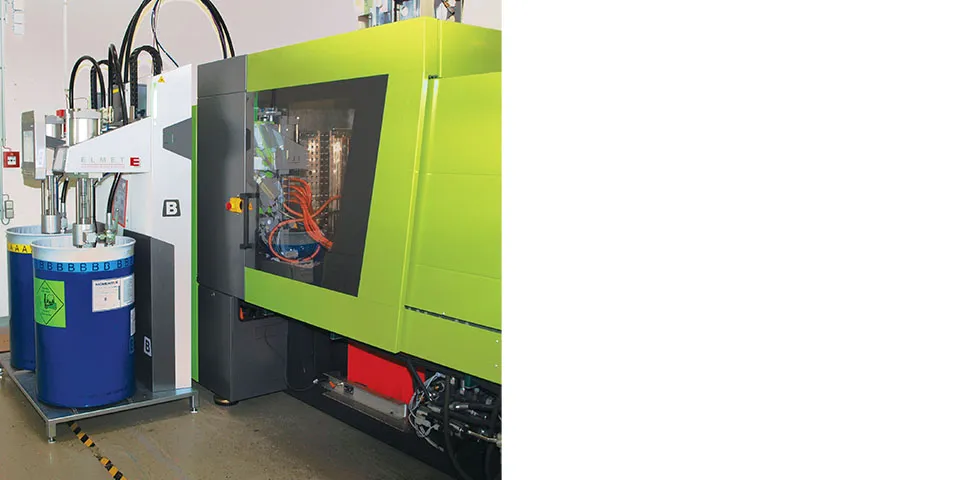
Thanks to the new, open design of the Top 5000 P dosing system, containers can now be changed easily from the front or side.
The crux of dosing
To achieve the highest component quality and process stability in liquid silicone injection moulding, precision is the top priority. The exact mixture of the two silicone components and the added additives plays a central role. “The so-called A and B components are essentially the same polymer, one containing the catalyst and the other the inhibitor. The liquids also have different viscosities,” Adlesgruber explains of the LIM process. “As soon as we mix the two components, they react with each other and vulcanise in the heated mould within seconds. At room temperature, depending on the component, the process would take several hours or even days.” Careful and efficient handling of the compressible liquid, whose viscosity fluctuates, is a key requirement for every professional LSR processor. It is important to manage the challenging processing properties of liquid silicone while keeping economic efficiency in view. “The perfect dosing system delivers an exact mixture for the best product quality, while ensuring that virtually no material remains in either the A or B component at the end of each formulation,” says Adlesgruber. “Everything is fully automated, with no manual adjustments. That is how we achieve the highest quality.”
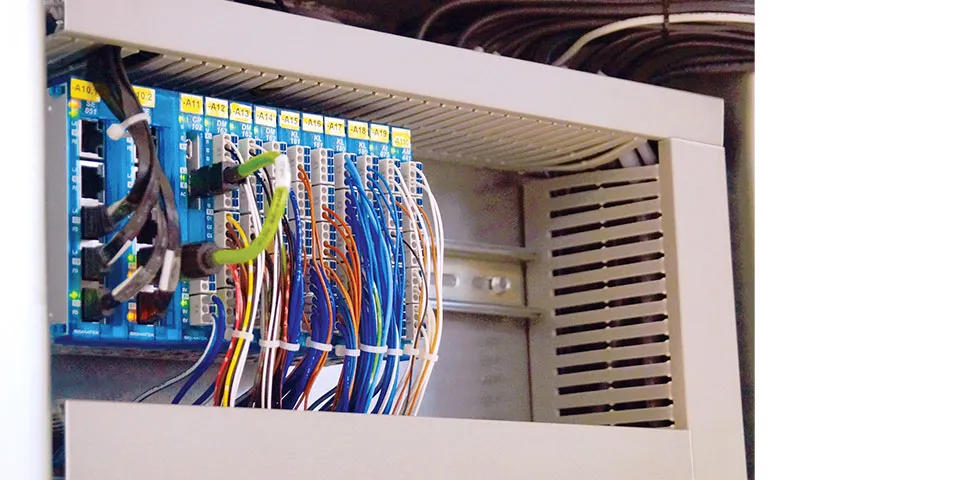
SIGMATEK’s compact S-DIAS control system handles all the process technology in the dosing system, as well as recipe management.
New Automation Technology
“When containers are changed, the individual steps in the entire process are displayed in sequence, so the operator can hardly make a mistake,” explains Kurt Mitzka. The entire process is automatically recorded in the panel’s internal memory. Communication between the HMI and the S-DIAS components installed at the rear of the control cabinet takes place via standard TCP/IP. The S-DIAS CPU controls all the process technology in the dosing system, as well as recipe management. Various I/O cards complete the system. “The data delivered at great speed by the DM 162 digital mixing module is very useful for our applications,” says Mitzka. “We appreciate the range of I/O cards, as well as the compact design.” Even the powerful CPU fits into the 12.5 mm-wide housing.” Elmet’s application engineers programmed the S-DIAS control system entirely in-house using the object-oriented LASAL engineering software package. Asked about their experience with the all-in-one engineering tool, Mitzka says: “At first glance, it looks relatively complex. But there is no need to be daunted. Compared with other systems, LASAL offers considerably more freedom and almost no limitations. The direct integration of the LASAL Screen visualisation tool into the engineering system makes engineering more efficient.”
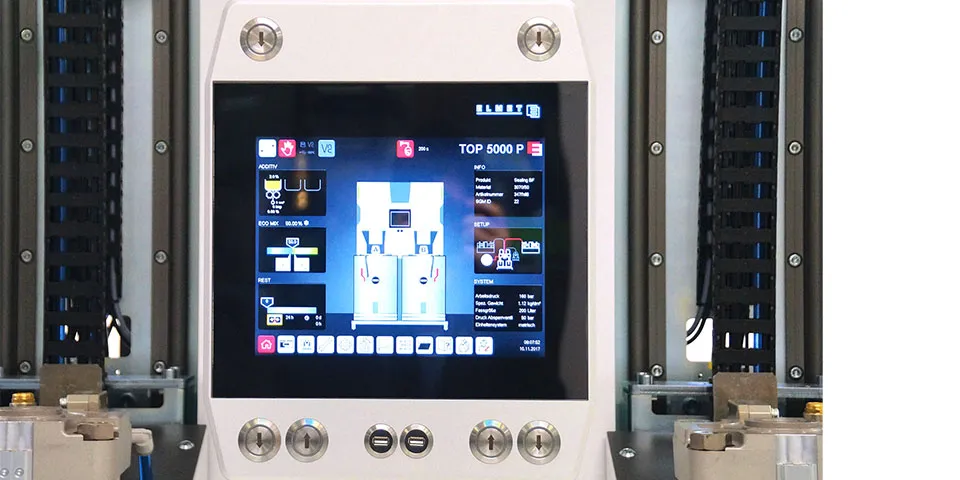
A stylish operator station: SIGMATEK’s ETT 1233-EL 12″ Multi Touch panel, with a glass front (IP65), built into an anodised aluminium housing. The visualisation was created using the LASAL Screen HMI programming tool.
Question about this story? Ask your question
Keep following this
Get an email when a new story is published. No account needed.
- SubjectNews







