












Miniature drives for use in space
It is 50 years since Apollo 11 landed on the Moon and the first man set foot on our own satellite. A lot has happened since then. Space has become a workplace (and lounge) for humankind, and topics such as space tourism, a permanent Moon base and a crewed mission to Mars are being discussed in depth. Technical progress over the past few decades has made this development possible. Drive technology has also played its part. Lightweight, compact FAULHABER miniature drives have repeatedly proven their reliability and positioning accuracy under the harsh conditions of space on numerous space and research projects. The drives are suitable for use in vacuum environments and withstand extremely high mechanical loads. Their components are optimally matched to one another, enabling them to achieve very high efficiency.
From the first Moon landing to everyday life in space
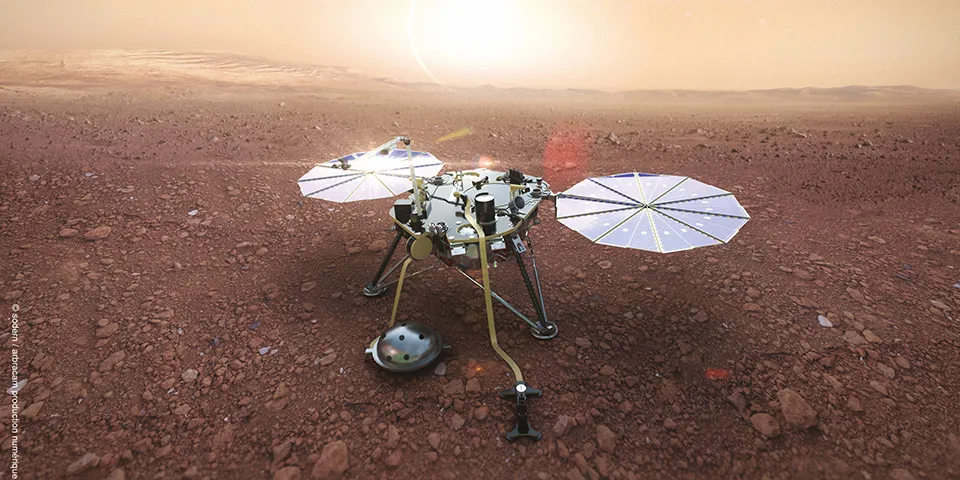
Six stepper motors with planetary gearheads are currently being used on Mars in the most sensitive seismometer ever built (Figure 1), SEIS. They are intended to establish whether seismic activity occurs on the Red Planet. The stepper motors perform two tasks for the seismological measurements: they balance the measuring mechanism and compensate for the tension forces caused by large seasonal temperature fluctuations. The small drives from Schönaich can also be found aboard the International Space Station (ISS).
Aboard the ISS, the spherical robot, which is the size and shape of a medicine ball, floats weightlessly in space despite weighing five kilograms. (Copyright: Airbus Space)
Brushless DC motors allow CIMON (Figure 2), an artificial assistant for astronauts, to move freely aboard the ISS. Stepper motors will be installed in high-resolution camera systems for the next Mars mission in 2020. The miniature drives, with a diameter of just 10 millimetres, position the lenses to capture razor-sharp images of the Martian surface. These compact miniature drives will also help advance space research and spaceflight in the future. One way to keep the costs of commercial rocket launches low, for example, is to optimise combustion and thus fuel consumption. A specially developed throttle valve ensures optimum performance in this application. It is driven by robust and reliable FAULHABER servo motors. Demand for space-qualified drive systems, which above all need to be reliable, durable, small and lightweight, is therefore constantly increasing. Who would have thought it 50 years ago, when the precision ball bearings made by FAULHABER subsidiary MPS were fitted in the watches worn by the astronauts who first walked on the Moon!
For more information on this topic, visit: https://www.faulhaber.com/de/news-events/news/miniature_drives_for_use_in_space
Question about this story? Ask your question
Keep following this
Get an email when a new story is published. No account needed.
- SubjectNews







