












Machine vision is integrating more and more technology
Text Valérie CouplezImage iStock

Industrial automation is advancing rapidly. One of the technologies to have played a crucial role in recent years is machine vision. Using cameras, sensors and sophisticated algorithms, these systems capture, analyse and assess images from industrial environments, delivering significant benefits to end users in terms of improved accuracy, efficiency and output. The technology has become considerably more powerful and, at the same time, more affordable thanks to breakthroughs in other technologies.
One area in which artificial intelligence is already proving to be a game-changer is machine vision. Combined with deep learning methodologies, artificial intelligence enables machines to learn from data and improve their performance autonomously, without human support. This has led to the development of more advanced machine vision solutions capable of identifying and assessing images more accurately and at greater speed. They help machines detect product defects, manage stock and oversee quality procedures more effectively.
Integrating 5G technology
5G is the fifth generation of wireless communications technology, offering faster data transfer, lower latency and greater capacity. Combining machine vision with 5G enables the immediate exchange of substantial volumes of data, allowing for faster decisions and response times. This is a crucial development in industrial automation, laying the foundations for more efficient production. And it is no longer a vision of the future: it is already a reality in industries such as automotive, where high-resolution images support real-time quality control.
Towards hyperspectral and 3D imaging
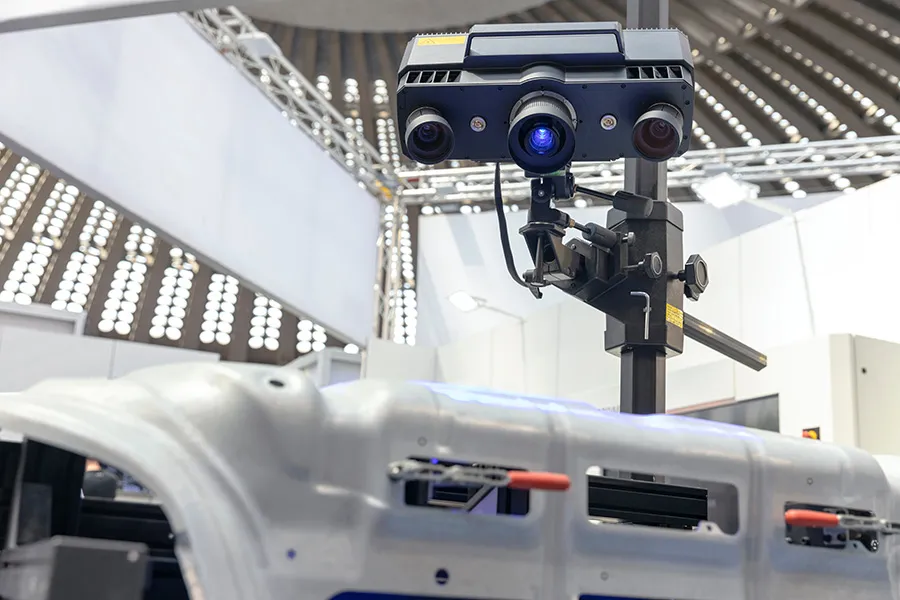
The types of images that machine vision can process are also changing. Hyperspectral imaging, for example, captures images at different wavelengths, enabling extensive spectral analysis. This method is gaining ground in industrial automation, where it helps detect product defects and anomalies more accurately. Imaging is also moving towards 3D for certain applications, enabling more extensive analysis for quality control, assembly validation and object identification. In the automotive industry, for example, it is already used to check the shape and dimensions of components against specified requirements.
Machine vision in the cloud
Machine vision is increasingly moving to the cloud. Storing and processing data there gives users around the world access to the information. Bringing together and benchmarking images from different sites around the world can offer major benefits. It also reduces costs, as there is no longer a need for expensive on-site hardware.
However, the cybersecurity of machine vision systems needs to be considered. As interconnectivity and integration into industrial automation continue to expand, so does the risk of cyberattacks that could compromise the reliability and accuracy of these applications. Traditional security measures, such as encryption and firewalls, can also be applied to protect these systems.
Remote monitoring
The Covid19 pandemic has prompted greater interest in remote monitoring and control in industrial automation. Machine vision systems play a crucial role in this, making it possible to oversee production processes and improve operational efficiency without human intervention.
Conclusion
Combining all these technologies in new machine vision solutions makes this a particularly interesting area of industrial automation. As companies set increasingly ambitious targets for efficiency, cost control and product quality, machine vision will emerge as an essential tool for achieving them. ■
Question about this story? Ask your question
Keep following this
Get an email when a new story is published. No account needed.
- ThemeProcess measurement and control
- SubjectNews







