












Lay herringbone parquet with ease
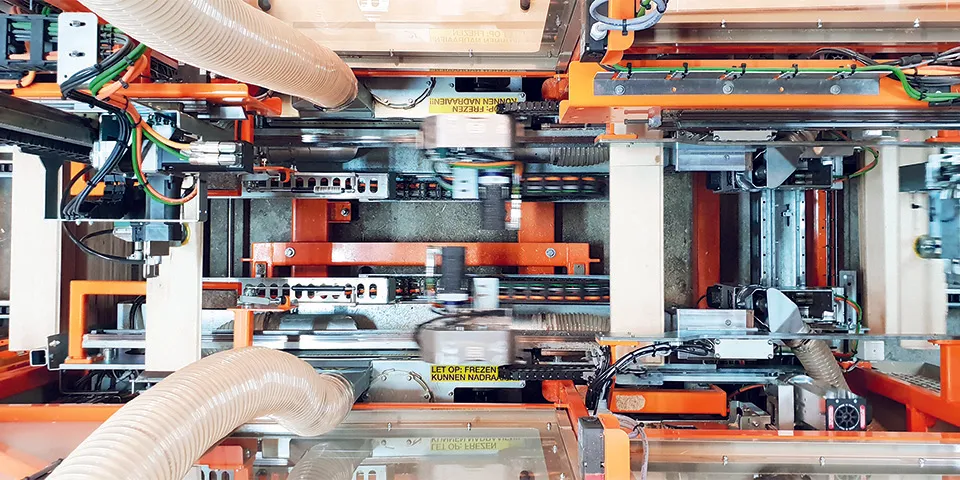
In Heeswijk-Dinther in the Dutch province of North Brabant, Bart Beugt has developed an innovative machine at his sawmill and shop. It cuts parquet boards to size and mills them so that there is no need to distinguish between left- and right-hand boards when laying a herringbone pattern. Developing this application meant taking into account not only how the product itself would be handled, but also the requirements of modern Industry 4.0. The result is something to be proud of: a CNC-controlled machine (EASYLOX® profiler), built with hardware and software from Austrian company SIGMATEK and developed with extensive support from SigmaControl in Barendrecht.
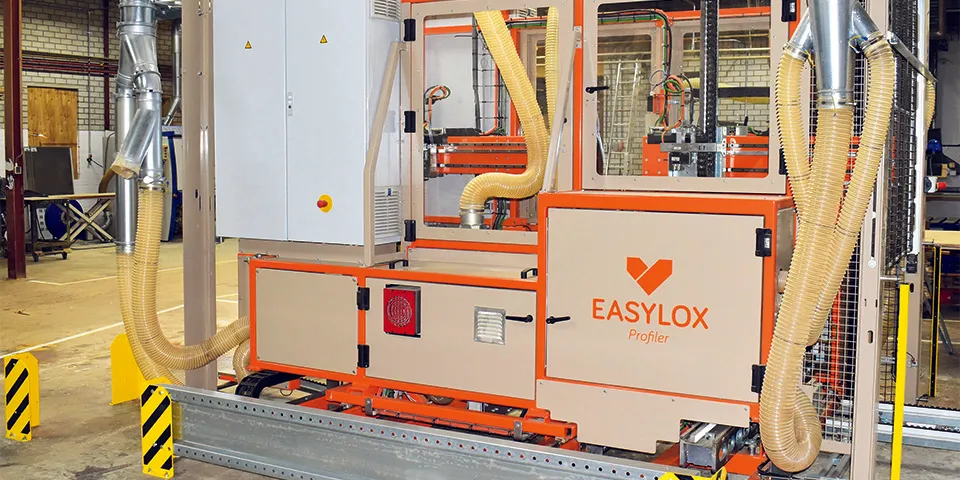
“An innovative sawing and milling machine that produces parquet boards for herringbone patterns without the need to distinguish between left and right.”
“With herringbone patterns, you always have left- and right-hand boards that can’t be used interchangeably,” says Beugt. “A customer called me because they didn’t want a tongue-and-groove joint, but two grooves at the end of each board. The left- and right-hand boards could then be laid in any order, using a set of loose splines that you hammer in yourself.” But Beugt wasn’t keen on this makeshift solution. The fit would never be as good as a joint made directly in the board, and adding loose splines would be an awkward extra step. “I soon had an idea of how to do it properly and drew up a design at home in 1.5 hours. Two days later, we had sample boards, and everyone was immediately enthusiastic.” A patent application was filed straight away, and work moved on to the next phase: making a test floor. A machine was borrowed from the neighbour, overhauled and assembled. It was a good step, as production looked manageable. The spline could already be fitted across the full width, but milling the pockets proved more difficult. “The results were still a long way from being square and fault-free, so I decided to develop a new machine for the job …”
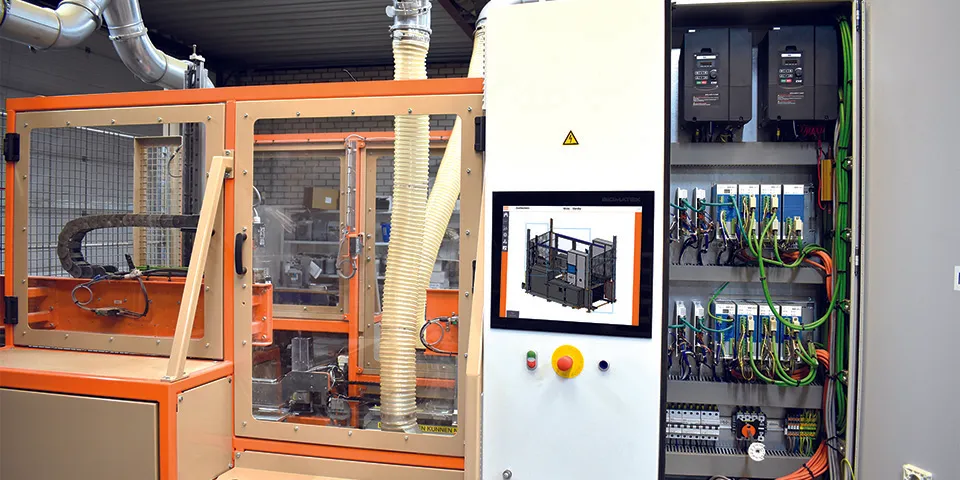
The control cabinet is packed with SIGMATEK hardware. On the right is the modular Dias Drive 100 servo drive system, alongside VST011 Stepper Motor modules linked to ultra-compact S-Dias modules on the DIN rail, including safety modules, for ultra-fast data processing. The operator controls the machine using an ETT 1933, a 19” multi-touch colour HMI with CAN, Ethernet and OPC UA communications.
The right tolerances for woodworking
Together with Ben Vissers, whose company Expertec has more than thirty years’ experience in machine development and who helped Beugt find a suitable machine builder, a set of requirements was drawn up. “I first went to Ben and told him it seemed strange to move wood through a machine, because that always creates stress in the wood. The best approach is to keep the product stationary and move the milling heads along it,” says Beugt. Vissers agrees: “It also proved difficult to specify the right tolerances for the new machine. When drawing up the specifications, we kept coming back to the question of what counts as accurate enough. That’s when you realise that wood is very different from a material such as metal.” They eventually found the right machine builder in Rob van der Meijden of Carrotte Engineering. Vissers says: “Rob already had more experience with machinery for the wood industry, which was a plus. Wood is a natural product with very different properties, so you need to know something about woodworking. In the end, we found the right team to build the machine in Rob and Jeffrey de Wit of DIDQ Besturingstechniek. They both run young businesses and are keen to grow.”
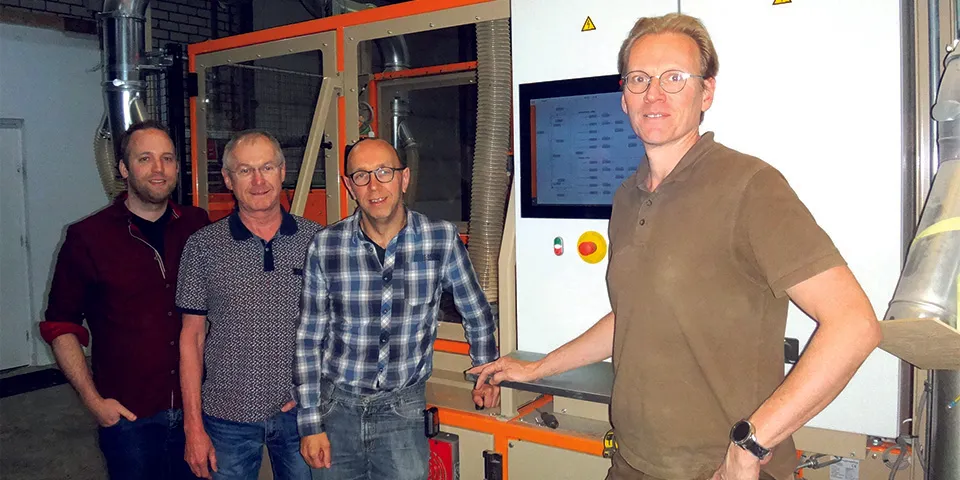
From left to right: Bart Beugt, Rob van der Meijden (Carrotte Engineering), Ben Vissers (Expertec) and Jeffrey de Wit (DIDQ Besturingstechniek).
From design to finished machine in 2.5 years
The project was both challenging and instructive. According to Beugt, it resulted in a machine that is truly unique in the world of parquet boards. The EASYLOX Profiler features a 19” multi-touchscreen HMI, and S-Dias modules are used throughout the machine’s control system, including for safety functions. SIGMATEK modules are also used to control the axes, including the MDD 121-1, which supports various feedback options (including Resolver, EnDat and Hiperface) for servos, and the VST 012, which has incremental encoder inputs for stepper motor control. For de Wit, who was responsible for implementing the control system, coordinating all the components was quite a challenge: “We opted for an integrated control system, with all the benefits that brings. All the door switches, light curtains and emergency stops, around fifty inputs and sixteen safe outputs in total, are connected individually and directly to the S-Dias Safety modules. This means there’s no need to install extra wiring or terminal modules, which saves a considerable amount of time.” Although he initially had limited experience with SIGMATEK’s object-oriented LASAL programming package, he soon got to grips with it thanks to expert support from SigmaControl in Barendrecht. “Reusing objects during programming saved a lot of time.” Vissers is also very enthusiastic about how accessible the system is: there are no high barriers to getting started with SIGMATEK, no licence fees and no lengthy training courses.
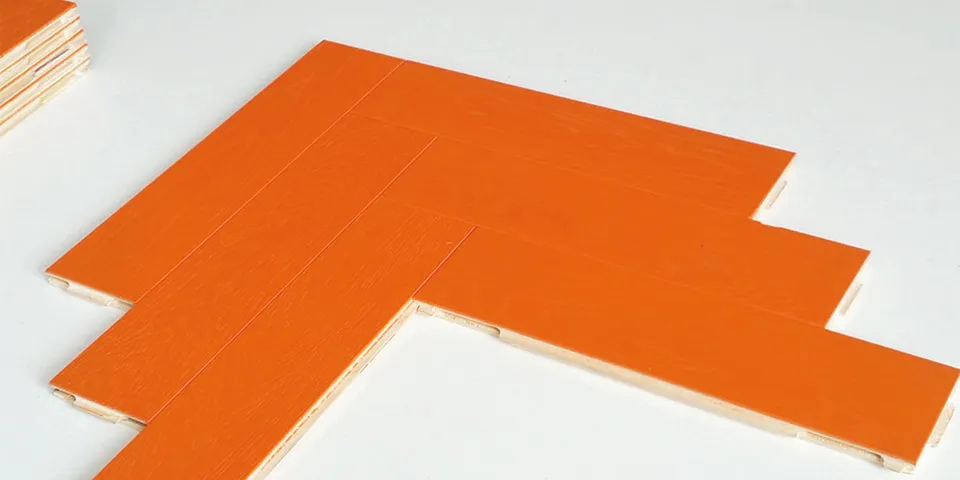
Boards for laying a herringbone pattern, more easily and efficiently. No more distinction between left- and right-hand boards.
Question about this story? Ask your question
Companies in this story
Keep following this
Get an email when a new story is published. No account needed.
- SubjectNews
- CompanySigmaControl







