












KU Leuven Campus De Nayer gets industrial engineering students moving with an Advanced Motion Control laboratory setup
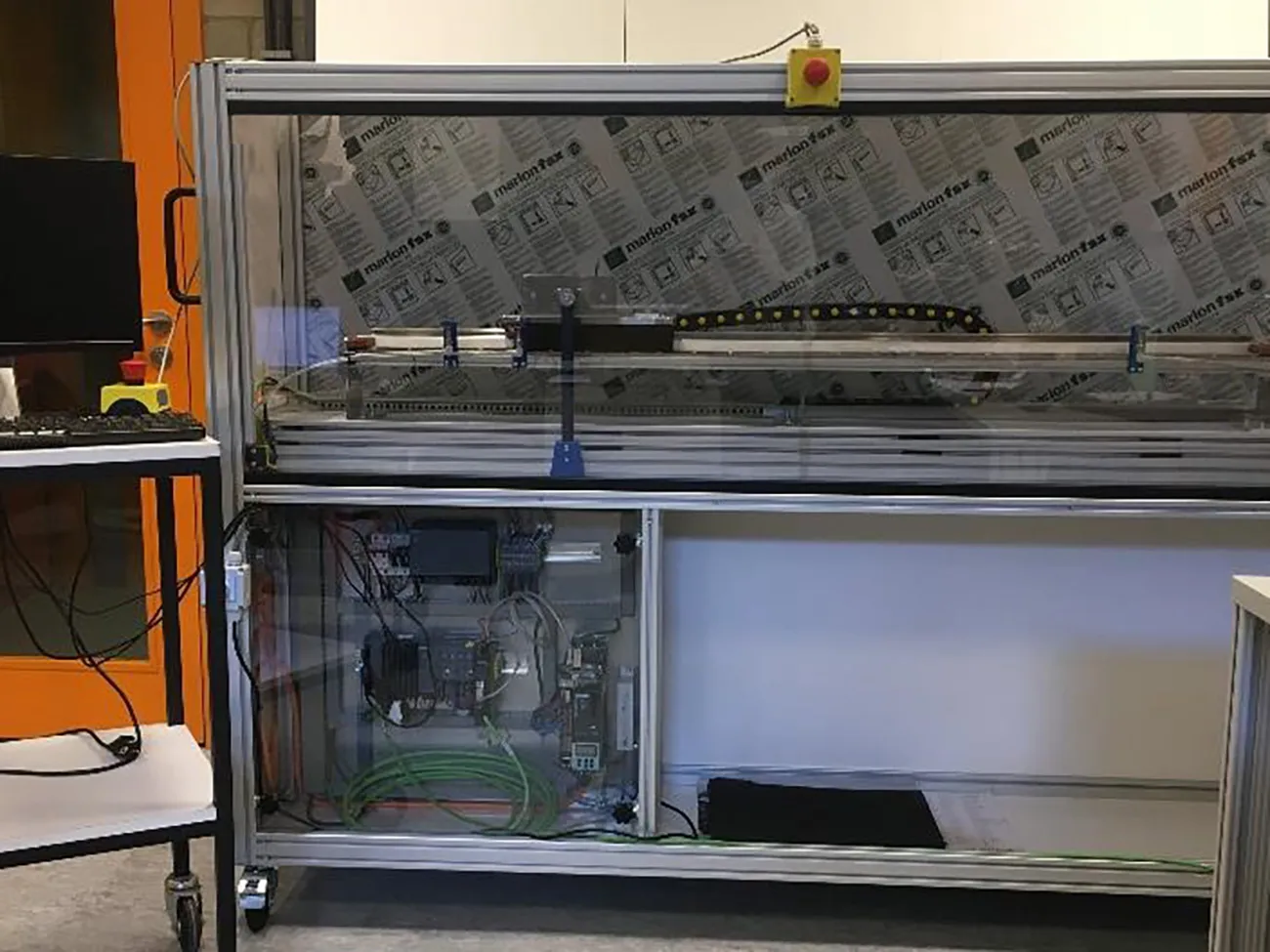
Many companies continue to face a shortage of engineers. To make the industrial engineering degree more attractive and better align it with industry needs, KU Leuven Campus De Nayer has developed a complete laboratory setup for Advanced Motion Control using industrial Siemens components. Students can develop their skills across every aspect of machine building, from automation and functional safety to advanced control engineering.
“We had been considering for some time the idea of building a motion control installation that integrates as much functionality as possible in automation and functional safety,” says Dr Ir Michel Van Dessel, an expert in electric drives and automation and a lecturer at the Faculty of Engineering Technology at KU Leuven. “By opting for industrial components, we also ensure a smoother transition to practical applications. The idea took shape in collaboration with our colleague, Ir Wouter Sas, an assistant in electrical engineering and automation at KU Leuven’s Campus De Nayer.”
High-performance, flexible drive
The project was on track and got off the ground after Continental Automotive’s Mechelen site donated a linear PM synchronous motor to Campus De Nayer. “Our aim was to build a fully operational setup with an inverted pendulum mounted on a carriage driven by the linear motor,” explains project lead Dr Ir Michel Van Dessel. “Previously, the practical element of the motion control lessons was limited to controlling the speed of a rotary motor. However, students also need to be able to experiment with ‘real’ movements and experience, among other things, the importance of safety functions.”
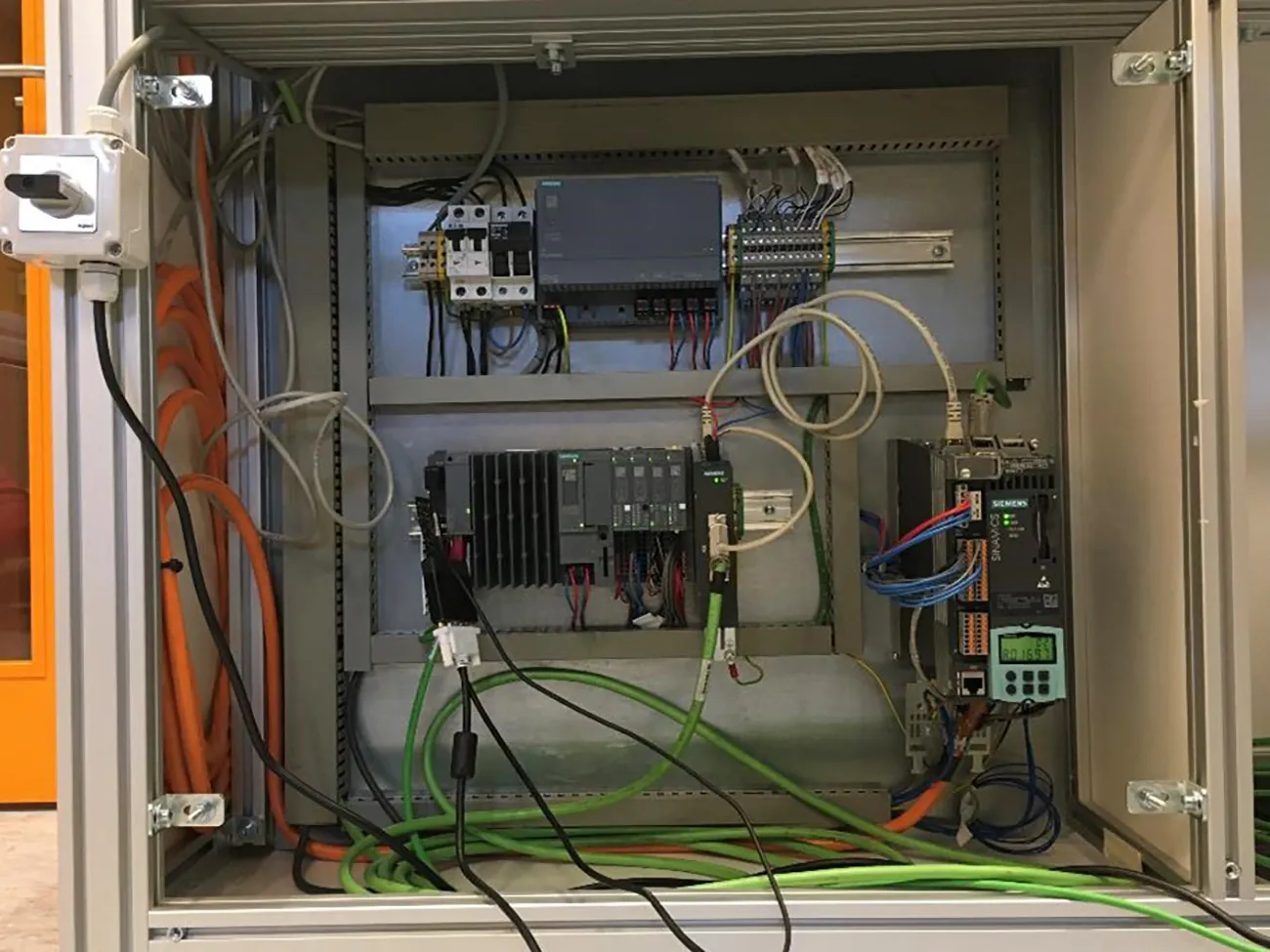
To build the setup to the required performance, KU Leuven Campus De Nayer purchased a number of essential components through Siemens Automation Cooperates with Education (SCE), including a Sinamics S120 servo drive with a CU310-2PN control unit. It provides the high-performance control and precision needed to control a carriage with an inverted pendulum, and can also be used flexibly in a range of educational setups and scenarios. KU Leuven Campus De Nayer also chose a Simatic ET 200SP I/O system featuring a CPU 1515SP PC2F Open controller with integrated HMI functionality for controlling and reading the setup’s user interface. The Totally Integrated Automation Portal (TIA Portal) software package brings the hardware and software together as a working system.
Project lead Dr Ir Michel Van Dessel: “We have built up considerable experience with Siemens technology on our campus. We have been using Siemens Simovert Masterdrives and Sinamics drives in research and service projects, as well as in teaching laboratories, since 2003. We are also very familiar with the operation and programming of Simatic S7 PLCs: Campus De Nayer is recognised as a Siemens Competence Center for PLC programming.”
Powered by Siemens technology
The Linear Motion Control setup built at Campus De Nayer consists of a HIWIN LMS 17 linear motor, controlled by a Siemens Sinamics S120 drive with a CU310-2PN control unit. A Siemens Simatic ET 200SP Open controller, type Simatic CPU 1515SP PC2F, was selected as the PLC and HMI. Based on an industrial PC platform, it can run not only conventional PLC, safety and HMI functions, but also compiled code, for example from MATLAB-Simulink, in real time.
Dr Ir Michel Van Dessel: “This allows us to apply advanced control engineering based on full-state feedback modelling to the position control of the carriage and the mounted pendulum. It can be used to model the stabilisation of a crane’s swinging motion and control an inverted pendulum.”
For the carriage’s basic motion control functionality, without taking the pendulum’s behaviour into account, the setup built by KU Leuven Campus De Nayer uses Technology Objects in TIA Portal. The Safety Integrated functions in both the controller and the drive ensure the safety of the setup and its user, and are configured in TIA Portal.
Engineering experience: Excellence in Drive commissioning
Individual components alone do not make a working laboratory setup. In 2019, therefore, project lead Dr Ir Michel Van Dessel tasked one of his thesis students with producing and implementing a complete mechanical and electrical design for the setup. The student also wrote an initial version of the PLC programme to control the setup, including functional safety and HMI. The following academic year, the project lead formed a team with a female student to integrate all the components, commission the drive and bring the setup into operation, including testing.
“One of the key challenges when bringing the setup into operation was determining the forcer position when starting up the Sinamics S120 drive, using the ‘pole position identification routine’. If this process does not run correctly and optimally, it becomes impossible to control the forcer’s movements accurately. After a great deal of experimental work, we eventually succeeded in carrying out the initialisation procedure with the correct settings. This is currently being integrated into the PLC programme.
The fact that the drive is from Siemens, but the linear motor and position sensor are not, added to the challenge and complexity of bringing the system into operation, a process known as ‘drive commissioning’. Thanks to the comprehensive, practical documentation available on Siemens Industry Support (engineering manuals), we were able to resolve the issue independently. We drew on experience gained in other projects involving Siemens drives, including the synchronous PM alternator for small wind turbines, which is controlled by a Simovert Masterdrives Motion Control converter and connected to the grid via an Active Front End module. This project was also carried out at Campus De Nayer.”
Advanced Motion Control laboratory
The first complete, mobile laboratory setup is now being optimised and finalised, and will also be used in practical classes from the next academic year. Meanwhile, a second student team is working on two additional setups for Advanced Linear Motion Control, identical to the completed prototype. With these two additional setups, project lead Dr Ir Michel Van Dessel aims to establish a fully equipped Advanced Linear Motion Control laboratory. It will be used at Campus De Nayer as part of the industrial engineering degree in Electromechanics, specialising in Automation and Mechatronics.
“This is an incredible opportunity for our students: they can learn to work with the latest technology and gain experience in commissioning and programming a real setup, not just a PLC,” concludes Dr Ir Michel Van Dessel. “They can also test the safety functions extensively. In this way, we aim to pave the way for them to build successful careers in machine building.”
Question about this story? Ask your question
Keep following this
Get an email when a new story is published. No account needed.
- ThemeFrom design to flexible machine
- SubjectNews







