












Kortrijk’s Machinebouw & Mechatronicalabs ready for manufacturers
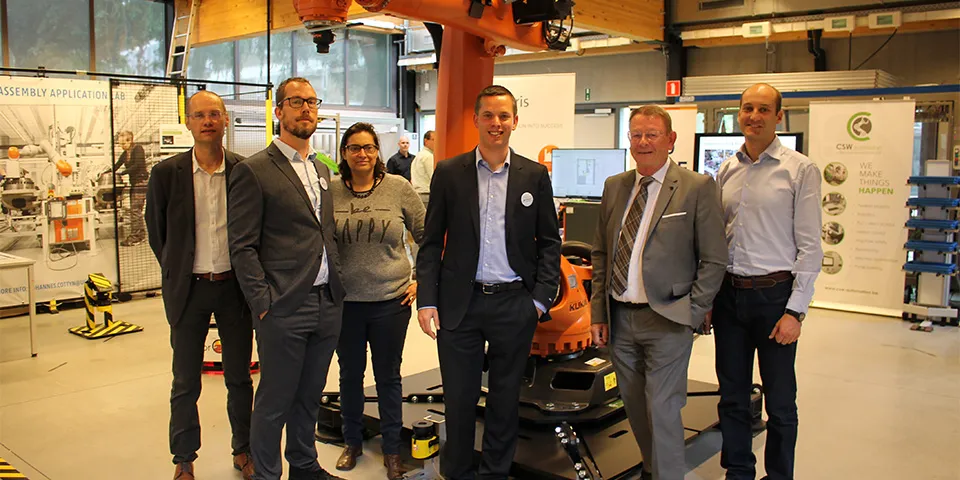
On Thursday 13 June, Universiteit Gent’s ‘Smart Assembly & Production’ and ‘Smart Production Organisation’ application labs, and Howest’s Augmented & Virtual Reality Technology Lab, opened their doors in Kortrijk. Together with the two innovation labs at KU Leuven Campus Brugge, these labs form part of the five high-tech Machinebouw & Mechatronicalabs in West Flanders, which help manufacturers take the step towards Industry 4.0.
West Flanders, and particularly the south of the province, benefits from a strong industrial ecosystem. To make the most of the potential of these manufacturers in the future, digital innovation and the integration of new technologies are essential. The five Machinebouw & Mechatronicalabs pool expertise in Industry 4.0 and help pave the way for the future of manufacturing in the region. Manufacturers can turn to these labs to make their production methods smarter and more flexible through digitalisation and automation.
West Flanders accounts for 40% of jobs in mechatronics in Flanders and almost 25% of jobs in metal processing. To support their continued development, companies in this major industrial cluster need access to high-level knowledge and expertise. These labs are the latest milestone in an investment plan designed to meet that need. “Pooling the expertise of all the knowledge partners in West Flanders, while keeping our finger constantly on the pulse of the sector, has resulted in an active network of top-tier labs close to our companies,” says Jean de Bethune, chair of POM West-Vlaanderen and TUA West. “The teams of experts from the knowledge centres are in direct contact with our companies, enabling them to quickly test new technologies tailored to their own production equipment.”
Jean de Bethune explains the reason for these efforts: “Manufacturing is close to our hearts. It puts the province on the global map with top-quality products, and it is also an essential source of employment in our region.”
At Universiteit Gent’s Campus Kortrijk, collaboration with Sirris has resulted in two application labs:
Smart Assembly & Production Lab
“This lab provides a test environment where manufacturers can experiment with innovative technologies to support operators in tasks such as assembly,” says Sirris Program Manager Bart Verlinden. “In short, we analyse how robots and people can work together safely, with an optimal division of tasks.”
Smart Production Organisation Lab
“In this application lab, equipped with a 180-degree video wall and an interactive meeting table, we improve existing production systems by creating an exact virtual replica,” says prof. Johannes Cottyn of UGent. “Simulations allow us to predict potential operational improvements to the production system.”
Augmented & Virtual Reality Technology Lab
Howest’s technology lab focuses on implementing Virtual Reality (VR), Augmented Reality (AR) and game engine functionalities for industrial applications at manufacturers. “AR can be used for internal communication or to support operators during the production process. VR lets you offer training tailored to each employee without affecting the production line. We also use AR and game technology for real-time data visualisation,” says Steven Van Luchene, XR Lab Manager at Howest.
Innovation labs
The first two innovation labs at KU Leuven Campus Brugge, which also form part of the Machinebouw & Mechatronicalabs, opened on 23 May. The Ultimate Machine creates modern machines that can detect whether they are functioning correctly and, if necessary, adjust their operation or shut themselves down. The second innovation lab, The Ultimate Factory, enables different machines to interconnect in an Industry 4.0 environment to improve production process performance.
The “Machinebouw en Mechatronica centrum West-Vlaanderen” project was submitted under the GTI West-Vlaanderen within the EFRO Vlaanderen programme. KU Leuven, Howest, UGent, Sirris, POM West-Vlaanderen and TUA West are working together to deliver the project. The total project cost is 4,270,521 euros. At least 700,000 euros of this is being provided from provincial funds. The project also receives 1.7 million euros in European support from EFRO and more than 850,000 euros from the Hermes-fonds.
Thanks to the GTI, 20 million euros in European funding is initially being channelled to West Flanders. This sum acts as a lever to inject at least 50 million euros in total into the West Flemish economy. Each project contributes a piece to the overall puzzle of strengthening industry.
Question about this story? Ask your question
Companies in this story
Keep following this
Get an email when a new story is published. No account needed.
- ThemeFrom design to flexible machine
- SubjectNews
- CompanySirris







