












Joint interview with Rik Van de Walle (UGent) and Piet Desmet (KU Leuven)
Text Björn CrulImage Carlos Lopez
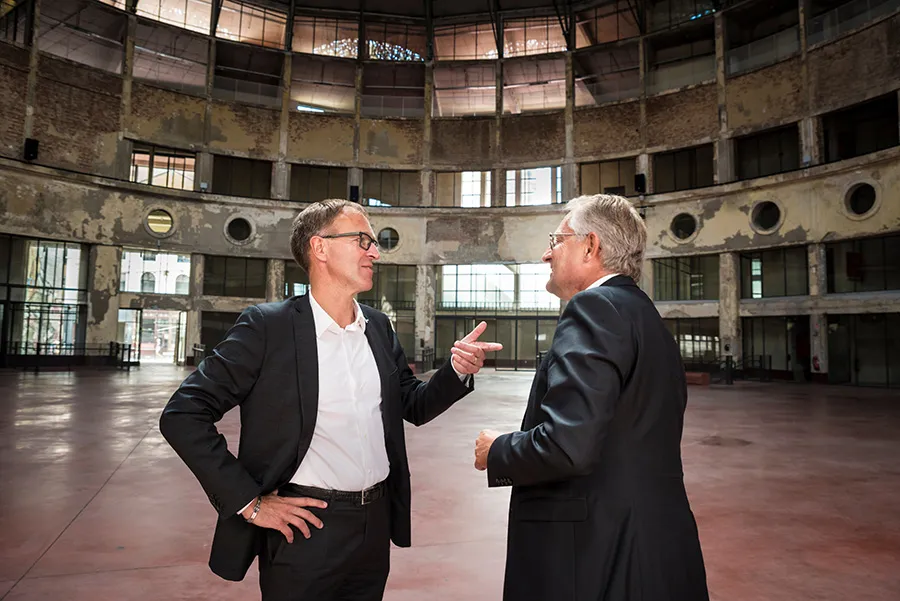
“We are big fans of working with companies and want to raise the bar even higher”
Tens of thousands of students returned to lecture halls and laboratories in October, full of fresh enthusiasm. Rik Van de Walle, rector of UGent, and Piet Desmet, vice-rector of KU Leuven and responsible for the campuses in Kortrijk and Brugge, also started the new academic year full of energy. We meet them for a joint interview in the restored Wintercircus in Gent, which is set to become a new tech hub from 2024 with support from both universities: “The days of the great battle between universities are behind us. We are working together more and more on research and lifelong learning.”
Gentlemen, to what extent has the coronavirus pandemic had a lasting impact on university teaching?
Rik Van de Walle: “Before the pandemic, we had already made a lot of plans for the digitisation of education and the introduction of blended learning and e-learning. The prolonged lockdowns forced us to switch gears very quickly. It was not without its difficulties. We had to build support for online teaching among both lecturers and students. The main lesson we learned is that extremes do not work: today, neither teaching entirely on campus nor entirely online is an option. We now ask faculties to look closely at each course, and even at individual parts of the course, to determine the best teaching format. This allows us to find a smart mix that supports the learning process, knowledge creation and knowledge sharing. We do this in close consultation with students, too.”
Piet Desmet: “As vice-rector, I am also responsible for educational technology. We had already drawn up a clear policy plan for this in 2017. To be honest, when the pandemic broke out, we were ready for the ‘learning’ side of things, but not for everything related to examinations. Yet suddenly we needed both. At one point, there was no choice but to teach entirely online, but we now know that this is counterproductive in many cases: nobody wants a glorified school television service as the standard again. We, too, remain committed to blended learning, in which face-to-face teaching plays an important role. We teach, but we also build a community in which social contact is essential to our students’ development.”
Our society is now paying more attention than before to mental health and wellbeing. How are universities trying to play a part in this?
Piet Desmet: “Students who went through secondary school during the pandemic and have now started university are at risk of falling behind in their studies. We were quite concerned about that. But so far, we have not seen any significant impact on results.” “That does not mean there are no outliers, though. Demand for psychosocial support is also rising. That is why, as a matter of policy, we decided to develop a holistic support model through our KU Leuven Support Lab, in which learning and living are two sides of the same coin.
For our staff, meanwhile, there is the KU Leuven Healthy initiative, which offers support for physical, mental and social health.”
Rik Van de Walle: “The situation at UGent is very similar. Looking at our staff, we have offered many opportunities for working from home since the pandemic. There are no central guidelines for this, and teams are free to schedule home working by agreement. Even so, we have found that some units have seen fewer people return to the workplace than we expected. To the extent that people who come to work on campus sometimes now feel lonely. In recent months, we have heard more concerns about a lack of social contact and interaction in the workplace. You can make light of it, but informal moments in the coffee corner really do matter. We may have to introduce a little more regulation after all, in the interests of teams and our staff’s wellbeing.”
For many 18-year-olds, university is their first ambition. Which courses are particularly popular? And do these choices meet labour market needs?
Rik Van de Walle: “I had to ask someone to look it up, because I do not actually keep track of enrolments by programme. Among bachelor’s programmes, business administration, psychology and law attract the most students. For master’s programmes, the top three are business administration, medicine and veterinary medicine.” “In general, we have seen a sharp increase in student numbers at Flemish universities over the past two decades. That is a good thing. But students are making less progress and taking longer to graduate. That does reveal something. I think we try very hard to convince final-year secondary school pupils of the value we offer, but we go too far. We need to move away from the idea that university is the only level worth aspiring to. Professional bachelor’s programmes, associate degrees and higher vocational education deserve more positive attention.”
Piet Desmet: “Trends in study choices are not all that different at KU Leuven. The biggest change is the very strong growth in international students: one in five students now comes from abroad. I do think we should not focus too heavily on the labour market. Our primary mission is, and remains, to educate critical thinkers. What is more, fewer than 50% of 25- to 29-year-olds go on to higher education, and only one in five has attended university. So yes, our education system has become more democratic, with relatively low tuition fees, but we can certainly do more to differentiate and give talented students who really need it a chance to enter higher education.”
Is there still fierce competition between UGent and KU Leuven in East and West Flanders?
Piet Desmet: “The days of fierce competition between universities are well behind us. Just look at where this interview is taking place: Wintercircus in Gent, a project involving both UGent and KU Leuven as partners. Of course, KU Leuven takes a more modest approach in this city. The way we are both present in Kortrijk and Gent is highly complementary, with a distinct campus concept of our own as well. We are also working together increasingly often on research, or on the range of advanced master’s programmes, which also cater to companies promoting lifelong learning.”
Rik Van de Walle: “Today, our major challenges are also similar. We are underfunded and have to find ever more resources beyond the contribution from the Flemish government to deliver on our core missions. Here is a concrete example: for every euro in government funding that UGent invests in infrastructure and building maintenance, we have to contribute five euros ourselves to keep our estate in good condition. That is not sustainable.”
On the other hand, €14.7 billion, or over 26% of the Flemish budget, went to education in 2022, a real increase of almost 10% compared with 2017. Is that not enough?
Piet Desmet: “That is, of course, the total education budget. Needs are particularly great in primary education. Compared with other countries, secondary education is slightly overfunded.” “But funding for higher education has fallen significantly:
we are investing less and less in a rapidly growing demographic group of people aged 18 and over. If we claim to be a knowledge region, then we need to keep investing more in knowledge, brains, research and education. We are counting on the next Flemish government to do so and honour the commitments made previously.”
Rik Van de Walle: “We are not asking for a new funding stream for higher education. We are simply asking for the funding decree to be implemented in full, with all the mechanisms it provides for. This has only happened to a limited extent during the current and previous legislative terms. As a result, UGent alone is missing out on €80 million in revenue every year. Our multi-year plan to 2027 therefore showed a structural deficit of €30 million. We will address this by finding €10 million in new revenue and making €20 million in savings, which will unfortunately also mean cutting a number of jobs.”
Piet Desmet: “At KU Leuven, things are under control. Under the budget agreement framework for 2024-2027, we are spreading the effort across services and faculties, so that our finances are in order, albeit through painful savings. We, too, have to watch our spending carefully. On the other hand, KU Leuven signed 3,500 new agreements with companies and non-profit organisations for contract research last year. This is a growing trend at all universities, although that does not mean we can transfer those research funds to education.”
How can academia contribute further to the development and anchoring of our industry?
Piet Desmet: “We are huge fans of technology transfer, working with companies and all kinds of social organisations. Our universities make an incredible contribution to innovation and to our region’s competitiveness. Think of UGent’s initiatives in the blue economy in Oostende, or KU Leuven’s work on new materials and plastics in Kortrijk. And Flanders Make’s hub in Kortrijk is a site where both universities put their expertise to work. We also often bring together competitors from the business world and encourage them to work together, so they can compete internationally.”
Rik Van de Walle: “Our manufacturing industry could certainly be more ambitious in this respect. Look at imec, a world leader because we want to be number one in the world in ICT, chip and sensor technology. The same goes for VIB and biotechnology. Let’s raise the bar for industry and get the best researchers working more closely with the best talent from the business world. If we can establish an international position, everyone will ultimately benefit.” ■
Question about this story? Ask your question
Keep following this
Get an email when a new story is published. No account needed.
- SubjectNews







