












Innovation also means taking risks
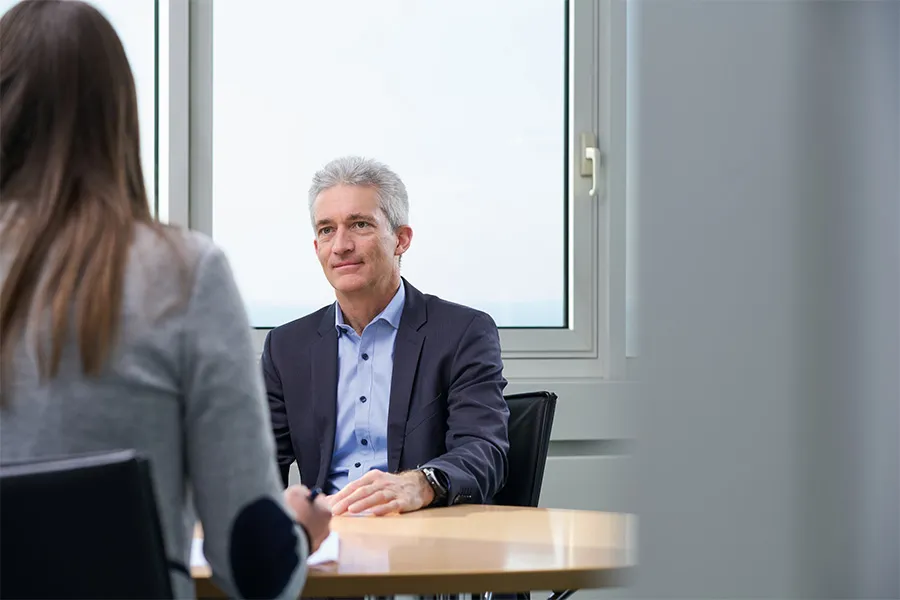
As Managing Director at FAULHABER, Dr Udo Haberland is responsible for research and development, quality, logistics and production. In this interview, he explains why innovation is about much more than new products, how FAULHABER is addressing the challenges facing the industry, and why change is often the root of lasting success.
Mr Haberland, you are responsible for research and development, quality, logistics and production at FAULHABER. What do you find most fascinating about your work?
All these areas are interconnected in different ways. The exciting part, and undoubtedly the most important, is the interplay between interlinked processes and the continuous nature of all the work. From the initial product idea to series production, we go through many different stages. Quality, for example, is a key consideration: if you ensure a smooth process meets a high standard from the outset, you will have no problems during production, or at most only a few. Our product portfolio is growing ever larger and more complex. That also means we must constantly reassess our approach and make our processes even more efficient. It is a question of balance, because we want to streamline processes without compromising the core of our business model or the quality of our products. One important factor is how we automate our core processes. We need to streamline workflows while working faster and more accurately. Automating steps in production or logistics frees up capacity for strategic work and allows us to respond more quickly to market changes. Data quality also plays an extremely important role. We can only work efficiently and sustainably if our decisions are based on reliable data. That is why we invest not only in technology, but also in our planning capabilities. This ensures that we always have a clear overview, supported by sound analysis.
Innovation is one of the key factors behind FAULHABER’s success. How do you define innovation in your field?
Innovation is crucial to us, but it is not limited to developing new products. To maintain our technological lead, we need to take a holistic approach to innovation. That means continually developing our processes as well. After all, we operate in an environment where we are already pushing the boundaries of what is technically feasible.
I like to think of innovation in terms of five pillars: products, processes, people, methods and tools. And, of course, you also have to consider the environment. When we think of innovation, products often come to mind first. To some extent, we assume that new products should offer innovative solutions. But innovation does not stop there. We also need to continually adapt and improve our processes to keep them efficient and flexible. Another key factor is people. A forward-looking company cannot do without an innovative mindset. That means our employees are willing to learn and try things out, and that they have the space to do so. They are free to come forward with creative ideas and to make mistakes. You learn from mistakes, and even a failure can provide valuable information and help us move forward. It is also important to use the right methods and tools. In product development in particular, you cannot stay up to date without modern measurement methods, simulations and ongoing training.
And which trends are shaping the development of new products?
Digitalisation, decarbonisation and deglobalisation: the three Ds. When it comes to digitalisation, we see huge opportunities to make our processes more predictable and connect them with one another. This includes IoT and interface integration. That enables us to make decisions faster and better. The other two Ds, decarbonisation and deglobalisation, are just as important. For a sustainable future, we need to reduce CO2 emissions, both at FAULHABER and across our supply chain. We also need to establish a circular economy with closed-loop recycling. At the same time, supply chains are shifting. For example, we cannot do without rare earth metals. But the question is whether we want to remain dependent on supplies from distant countries in the future, or source even more of these materials within Europe. For us, then, innovation is a holistic process that is not just about products, but about continual improvement across the board.
Are there any current research projects or technological developments that you find particularly exciting?
We are currently working intensively on several research projects and technological developments with enormous potential for the future. The project that particularly excites me is our pilot project with the Fraunhofer Institute, which also involves artificial intelligence. Everyone is talking about it, and we want to understand at an early stage what opportunities it offers for future technologies and processes.
At the same time, we are conducting an internal assessment of AI use to gain insight into the current situation. We can then use this to develop new initiatives. This gives us an important basis for investing in the most promising areas in a targeted way and strengthening our capacity for innovation. These developments have enormous potential.
Developers of new products need an in-depth understanding of technological trends and customer requirements. Which factors currently play the most important role in the development of new drive systems?
Many things come together in this process. Developing a systems-level understanding is extremely important. Ultimately, you are not simply developing a high-performance product, but providing a working solution for a specific application. This requires technological expertise and a clear focus on what the customer needs. It is therefore a major advantage to work closely with the customer as early as possible in the design process. Successful bespoke solutions require direct dialogue and the opportunity to discuss technical details without hierarchy.
What do you see as the current challenges facing industry, and what opportunities do they create for FAULHABER?
It is like skiing through the fog: you are moving, but you cannot see much. At best, you can guess what lies ahead. So it is important to stay focused and flexible, so you can react quickly when something comes your way. The market is much the same at the moment. Economically, we know that less is invested in uncertain times, and we can see the impact geopolitical changes are having on us. This makes it even more important for us as a company to be resilient and maintain our ability to respond.
Efficient production and planning processes are essential to supplier performance. What strategies is FAULHABER implementing in its operations?
One of the keys is collaboration between everyone involved, from sales and inventory management to planning and operations. The entire chain is optimised from end to end, so that we can quickly identify and address all relevant issues. To do this, we distinguish between different types of work. A customer ordering products from our catalogue has different expectations from a customer with a framework agreement. In the former case, availability, short lead times and on-time delivery play a major role. We also focus heavily on digitalising and automating our order processing. Orders for products in our standard range should be handled as automatically as possible, without additional steps. This frees employees to focus more on special requests and customer-specific solutions. At the same time, we want to make employees’ role in the overall process more visible. Everyone at FAULHABER contributes to delivering reliably and on time to our customers. It is important to raise awareness of this, from order placement through to delivery.
What motivates you personally in your work at FAULHABER, and what is your vision for the company’s future?
It is always great to work with an exceptionally capable team, to feel their enthusiasm for our technology and to tackle challenges with a wealth of ideas. I believe this motivation and passion are reflected in our products and solutions.
My vision for FAULHABER is clear: we want to be number 1 in precision drives. If we cannot find a technologically sound solution for a particular application with a reasonable amount of work, then nobody can. We do not claim to be miles ahead of others, but we are always at least one step ahead. FAULHABER should set the standard for the industry. Our goal is for customers to think of us first when faced with a challenging drive application, come directly to us with their enquiries and trust us to develop the best solution. We want to be more than just a supplier: we want to be the first point of contact for the optimal technological solution. To achieve that, we need to combine two things: a broad product range and customer-specific solutions supported by lean processes.
Was there a particular moment in your career that shaped your view of technology and innovation?
Yes, absolutely. A major customer cancelled an order, which initially seemed like a setback. But it forced us to rethink and look for new approaches to developing solutions. It was a situation that involved risks, but also opportunities, and it showed that change can be the starting point for something new and for success. We seized the opportunity and began working on a new technology. You have to be willing to take risks. Sometimes you need the courage to try something new, even when there is no guarantee it will work straight away. In an established process, you rarely have the freedom to experiment with something new. But these are often the moments when you are challenged and forced to change that drive innovation. That is why I believe it is essential to remain open to change, take risks and actively seize opportunities.
Een zakelijke vraag aan FAULHABER Benelux B.V.? Get in touch
Companies in this story
Keep following this
Get an email when a new story is published. No account needed.
- SubjectNews
- CompanyFAULHABER Benelux B.V.







