












igus | Less downtime and greater customer satisfaction:
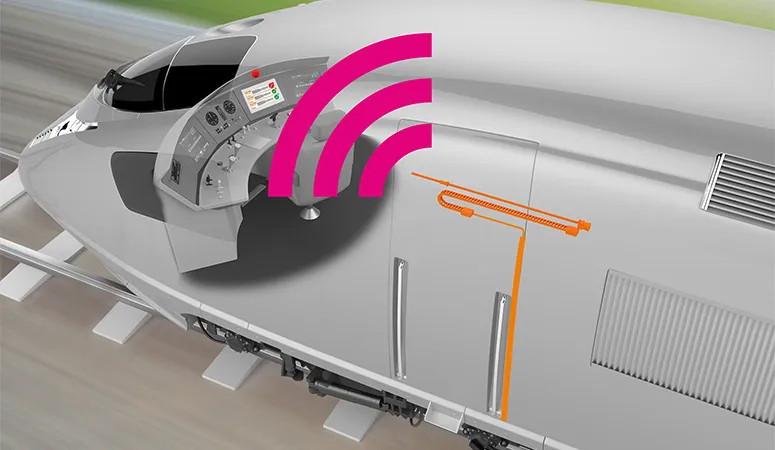
At Innotrans 2018, igus showcased intelligent energy chains and cables for trains, trams and high-speed rail vehicles
The growing digitalisation of railway technology has considerable potential to improve reliability and, in turn, punctuality. At the exhibition, igus presented its smart plastics to show how intelligent cables and energy chains that enable predictive maintenance can help trains, trams and high-speed rail vehicles run on time.
Thousands of commuters depend on punctual services. But faulty trains can throw a spanner in the works. The result is dissatisfied customers and financial losses. “Digitalisation can change this,” says Thorsten Mersch, Industry Manager Railway Technology at igus. To play a part in this digital transformation in rail transport, the Cologne-based company is developing intelligent cables and energy chains under the “smart plastics” banner. These are monitored in real time, and their service life can be predicted.
Trains can be monitored in real time
Trains, trams and high-speed rail vehicles are constantly subject to wear. Doors are one example, opening and closing hundreds of times a day. A common problem occurs when a safety edge, which protects against injury from closing doors, fails. The affected door is usually taken out of service immediately. Passengers then take longer to board and alight, disrupting the timetable and causing delays. One solution for transport operators is to equip safety edges with CF.Q modules from igus’s isense range. The monitoring modules track the condition of the cables and send status data to the operator’s control centre via the mobile communications module (icom). At the control centre, staff use dashboards to monitor the condition of every safety edge on every train. The system manages all threshold values and issues an advance warning when a safety edge is at risk of failure. With this early information, operators can centrally plan preventive maintenance and carry it out during scheduled stops. The predictive maintenance principle also applies to other components, such as energy chains and linear units used in train interiors. Railway technology companies using smart plastics have a precise basis for planning maintenance and servicing. Components are repaired or replaced only when necessary, and before faults or delays occur.
A reliable basis for maintenance planning
There is considerable interest in these solutions. “Expectations around digitalisation are just as high among train manufacturers and operators as they are in industry,” says Thorsten Mersch confidently. At Innotrans 2018, Siemens Mobility presented, among other things, new applications for igus smart plastics that enable intelligent monitoring, analysis and prediction of failures. The planned collaboration is based on Siemens’ “Railigent” suite, which offers a wide range of digital services, for example in predictive maintenance.
Source: igus b.v.b.a.
Question about this story? Ask your question
Keep following this
Get an email when a new story is published. No account needed.
- SubjectNews







