












How connectors promote sustainability
Sustainability is now one of the most important issues in industrial manufacturing. Not only must the materials used be sustainable, but so must the processes. Sustainable processes are efficient and save resources and costs by avoiding and reducing machine downtime. Moreover, one of the most important resources in a production facility is employees’ working time. Efficient maintenance and installation times protect it.
Connectors play an important role in designing sustainable processes. Their function of quickly connecting or disconnecting a machine or attachment is not their only important feature. Modern connectors help production workers make safe, error-free connections. This is particularly important in modern modular systems, which are frequently reconfigured. Error-free connections help save important resources, such as energy, as well as time.
SmEC: Our connector concept for modular machines and systems
One of a connector’s most important additional functions is indicating the connection status. Depending on the application and connector, this status covers various parameters. Plug-in status typically answers the following questions:
- Is the connector connected to the correct mating connector?
- Is the connector fully electrically connected?
- Is the connector fully mechanically locked?
- Is the connector electrically overloaded?
- Are the ambient conditions (temperature, humidity, etc.) within the permitted range?
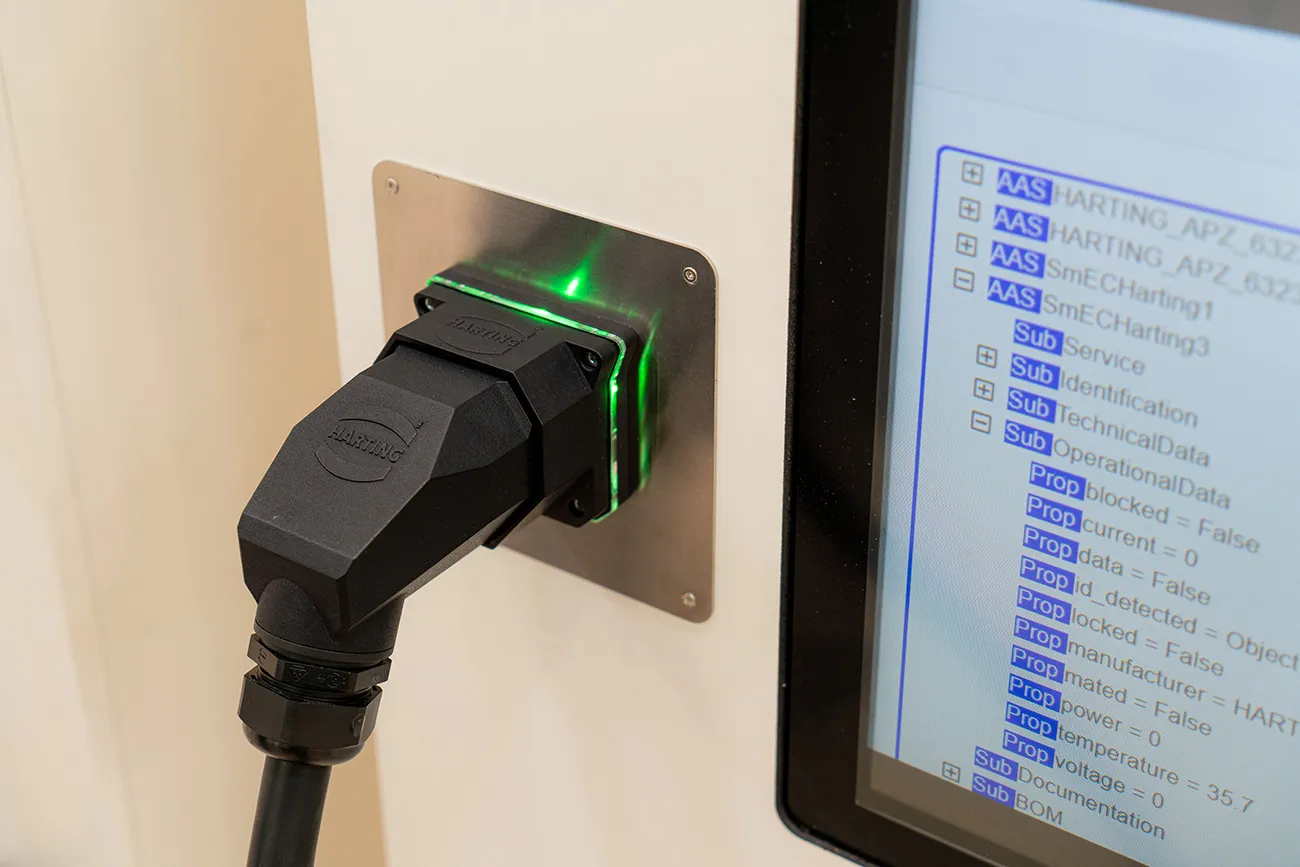
The plug-in status is indicated to the operator by an LED, a light ring or an audible signal. In the simplest case, a red/green display is sufficient to show whether there is a fault. Modern full-colour LEDs with additional flashing patterns or animations indicate other states, such as the presence of voltage. As well as visual or audible signals, a digital interface also sends much more detailed information to a control centre. HARTING Technology Group’s SmEC (Smart Electrical Connector, Figure 1) transmits data via MQTT or OPC-UA PubSub. The data is available in JSON format and can be received and processed by any data controller. Among other things, the Asset Administration Shell also provides the connector’s live data as a digital twin.
In addition to indicating the mating status, the SmEC actively prevents the connector from being disconnected unintentionally, using its integrated locking mechanism. This prevents damage to components and avoids risks to people. The connector can only be disconnected after it has been de-energised and the active lock released. To do this, the SmEC has integrated voltage and current measurement, which also monitors the connected machine. This makes it possible to calculate the current CO2 footprint from energy consumption data.
Data diode: Our connector concept for protection against tampering
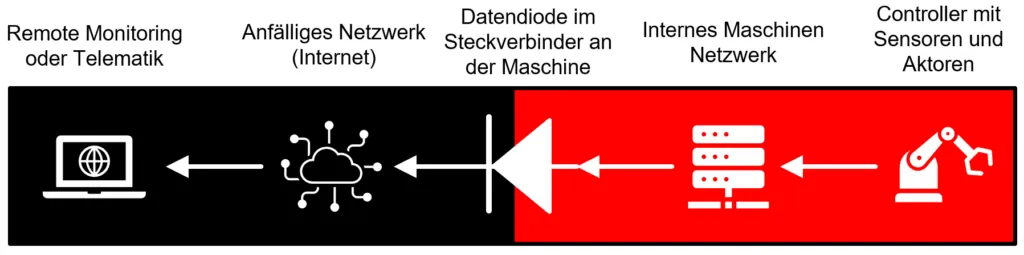
CO2 footprint measurement can also be easily retrofitted to older machines. A data diode protects the measuring device (for example, the SmEC) against tampering (Figure 2), as it only allows data signals to pass in one direction. This means that data can be sent from a protected network to an unprotected network, for example to a dashboard, while the protected network remains safe from attack. To achieve this, HARTING has developed a data diode for a connector. With data rates of up to 1Gbit/s, it transmits standard IoT protocols such as OPC-UA, MQTT or Modbus-TCP. The integration of a true hardware data diode, consisting of a laser diode on the transmitter side and a photodiode on the receiver side, makes it impossible for data to flow back.
Smart ix: Our connector concept for small connectors with an identification function
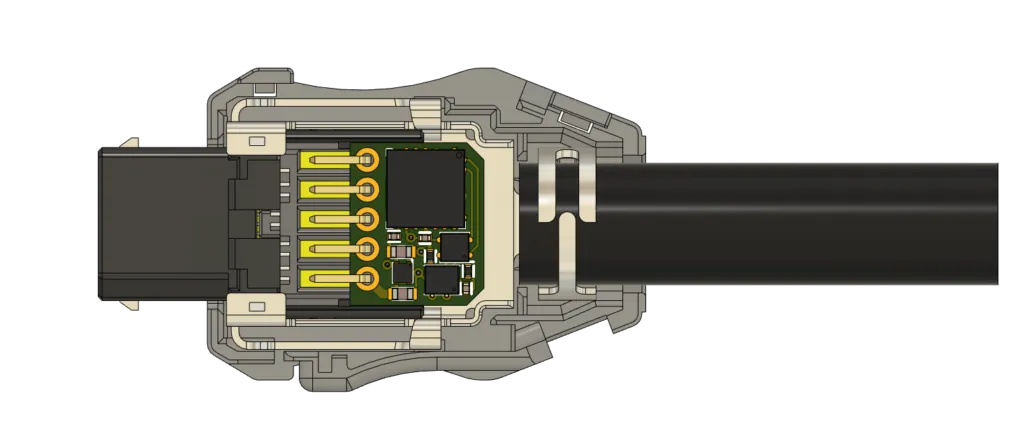
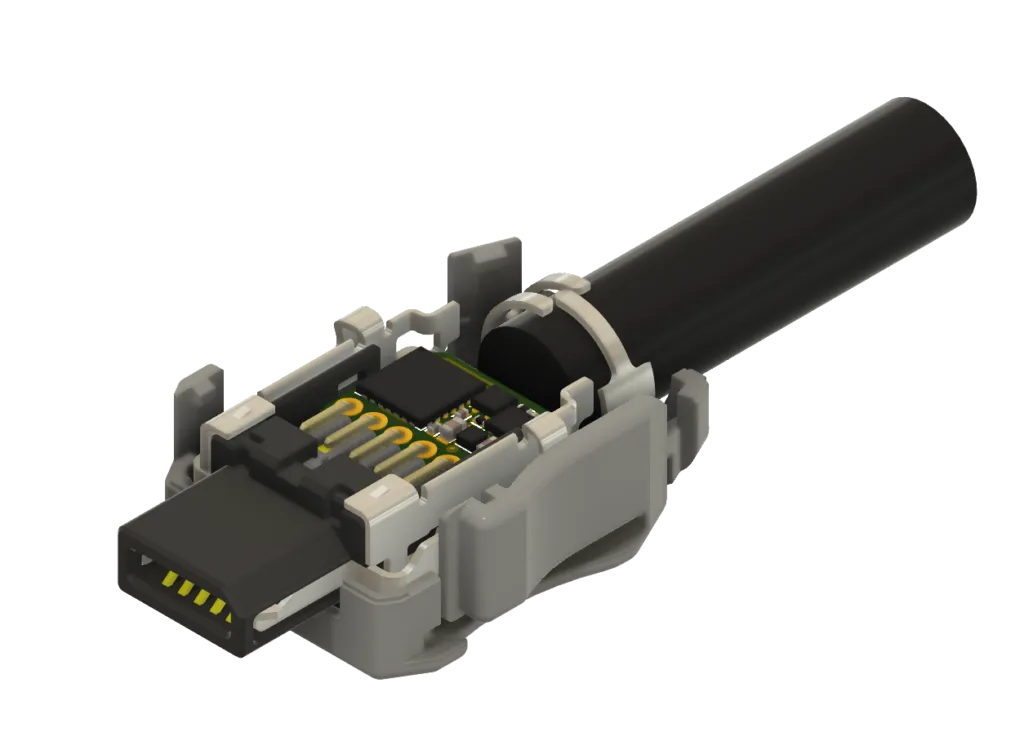
To determine whether a connector is connected to the correct mating connector, it must be identifiable. The simplest solution is to use additional electrical contacts as coding pins. Unlike mechanical coding, this allows the machine control system to determine which attachment is connected. However, this method quickly reaches its limits, particularly in large, flexible systems. Electrical coding with coding pins also uses up an unnecessarily large number of contacts. A more suitable option is to identify the connector using a bus system and a small microcontroller, or alternatively via NFC (Near Field Communication). This gives each connector a unique ID, which is assigned to the corresponding component (for example, an attachment or tool). The Smart ix from HARTING (Figure 3) shows that this method also works with very small connectors. The Smart ix is a small 10-pole connector with an integrated microcontroller. The microcontroller enables precise identification. The ID is used in the device/machine control system to establish a link with the connected component. This means that even simple components such as lights, door contacts or analogue sensors can be identified. The control system tells the user whether the components are connected to the correct port.
Han Protect: Han® 3A: Our connector concept for simpler repair processes
Unplanned downtime is common in production because the necessary skilled personnel are not on site at the time. For example, a blown fuse may only be replaced by someone who has received the necessary training. Since the fuse is inside the control cabinet, other people cannot access it. One way of making the fuse accessible from the outside is to integrate it into a connector, such as the Han Protect (Figure 4). Since the connector must be disconnected to replace the fuse, even people with basic instructions can carry out the task, particularly in low-voltage applications. This speeds up repair processes and reduces downtime, with lasting benefits for resource use.
HARTING Technology Group offers innovative connector solutions that improve sustainability in industrial manufacturing. The smart connector concepts presented here will be on show in a technology demonstrator at SPS 2023 in Nuremberg.
Question about this story? Ask your question
Keep following this
Get an email when a new story is published. No account needed.
- SubjectNews







