












How can metal detectors contribute to OEE?
However safe and efficient your production may be today, you need to keep improving, because your competitors are doing exactly the same. OEE, or overall equipment effectiveness, is often used to measure the efficiency of a production line. Quality control may not seem to improve the score at first glance, and may even appear to cost time, but nothing could be further from the truth. Understanding how modern metal detection works can give you a real advantage and help boost OEE.
Food safety is the number one priority for everyone in the food industry. If a product containing metal particles were to reach the market, the consequences could be disastrous. First and foremost for the consumer, but your business would also suffer: damage to your reputation, high recall costs, strained relationships with retailers … Prevention is better than cure, so responsible producers do everything they can to keep contaminants out of their production lines and remove any finished products that may contain them from the conveyor. A metal detection system is an ideal tool for this. The right inspection equipment at critical points along the production line can keep it free of metal particles. This ensures compliance with all legal requirements and international safety standards.
OEE, an important factor in manufacturing
So much for the importance of metal detection in food processing. Like any manufacturing business, a food producer must also aim to operate as efficiently as possible. OEE is often used as a measure of this. It comprises three components: availability, performance and quality. The aim is to keep machines running for as long as possible, at the highest possible line speed, without compromising quality. In other words, without losing products. It sounds straightforward, doesn’t it? But putting a figure on it requires a good understanding of the subject. Making progress is even harder. To achieve world-class status, a company needs to reach an OEE of 85%, while the average is around 60%. Quality control can help raise that figure, precisely because it also provides insight into the processes that come before it.
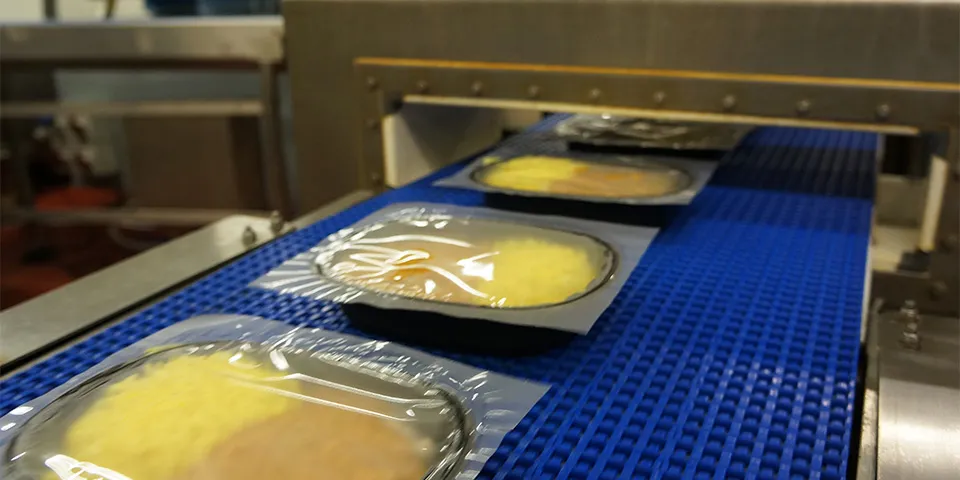
Metal detectors are typically used to protect your products and your reputation. (Image: GAnnison)
A trade-off between OEE and food safety?
Metal detectors are typically used to protect your products and your reputation. Traditionally, a trade-off has had to be made between the sensitivity of a metal detector, which means more products being wrongly rejected from the line, and a higher OEE, which brings a greater risk of contaminants passing through. This is mainly an issue with products that have a limiting property of their own. Products in brine are a good example, as salt is a good conductor and can interfere with the magnetic field used for metal detection. Temperature also plays a role. Variations in size and shape, product density, and the product’s position and orientation in the metal detector can also have a negative impact, requiring the detector to be set to a higher sensitivity.
A new generation of metal detectors overcomes these limitations
The latest generation of these inspection devices is designed to improve your OEE too, by making production lines more efficient. They overcome the traditional limitations discussed above. This makes it possible to maintain a high level of sensitivity without so-called false rejects, where good products are removed from the line. This helps improve quality and identify the source of metal contamination in earlier processes. A second innovation in metal detectors is intuitive cluster technology, which allows multiple products to pass through using the same settings. This meets the needs of today’s high-mix, low-volume production. Thirdly, condition monitoring of metal detectors contributes to higher OEE. Critical functions are monitored continuously, allowing verification intervals to be extended. Predictive analysis can go a step further and indicate when the metal detector’s sensitivity changes.
Conclusion
These new features enable modern metal detectors to increase sensitivity by 50%. In other words, particles half the size can now also be detected, without increasing the number of false rejects. This naturally has a very positive impact on OEE.
Question about this story? Ask your question
Keep following this
Get an email when a new story is published. No account needed.
- ThemeSmart manufacturing and logistics
- SubjectNews







