












Heurisko brings together fascinating applied research
Once a year, everyone gets the chance to catch a glimpse of the latest industrial solutions to emerge from applied research. At the Heurisko seminar, Flanders Make offered a look at which new technologies are of interest to industry and what applications they could support. Industrial Automation joined the audience.
When Archimedes was sitting in his bath, he made the legendary exclamation ‘(h)eureka’, which means ‘I have found it’. It is a phrase you can use when you discover that the buoyant force acting on a body in a liquid (or gas) is equal to the weight of the liquid (or gas) it displaces. It is no surprise that the Heurisko event can be traced back to the same Greek verb, albeit in the present tense. After all, the researchers present what they are working on right now, what they are finding. Participants can expect innovative, industry-ready research results and practical applications from the partner companies involved.
New strategy
Visitors to the 2022 edition were treated to an appetising appetiser. Flanders Make CTO Tom Munters explained the research strategy and approach for the coming years. As a strategic research centre, it has a multi-year agreement with the Flemish Government, which expires on 31 December. It is therefore time to set out the main priorities for the next five years.
Over this period, Flanders Make wants to help drive the four transformations it has identified for the manufacturing industry: smart, connected products and production systems; personalised products at the price of mass-produced goods; flexible production organisation with people at its heart; and sustainable products and production systems. Digitalisation will have an impact here too, with a focus on end-to-end engineering. Linking mechatronic assets to a digital twin makes it possible to create value and achieve production intelligence across the entire asset lifecycle. Linear models will also have to make way for circular ones.
Boosting innovation at Deceuninck
A clear strategy for tomorrow’s research, then. But what does today’s research look like? We take a closer look at one session focused on boosting innovation.
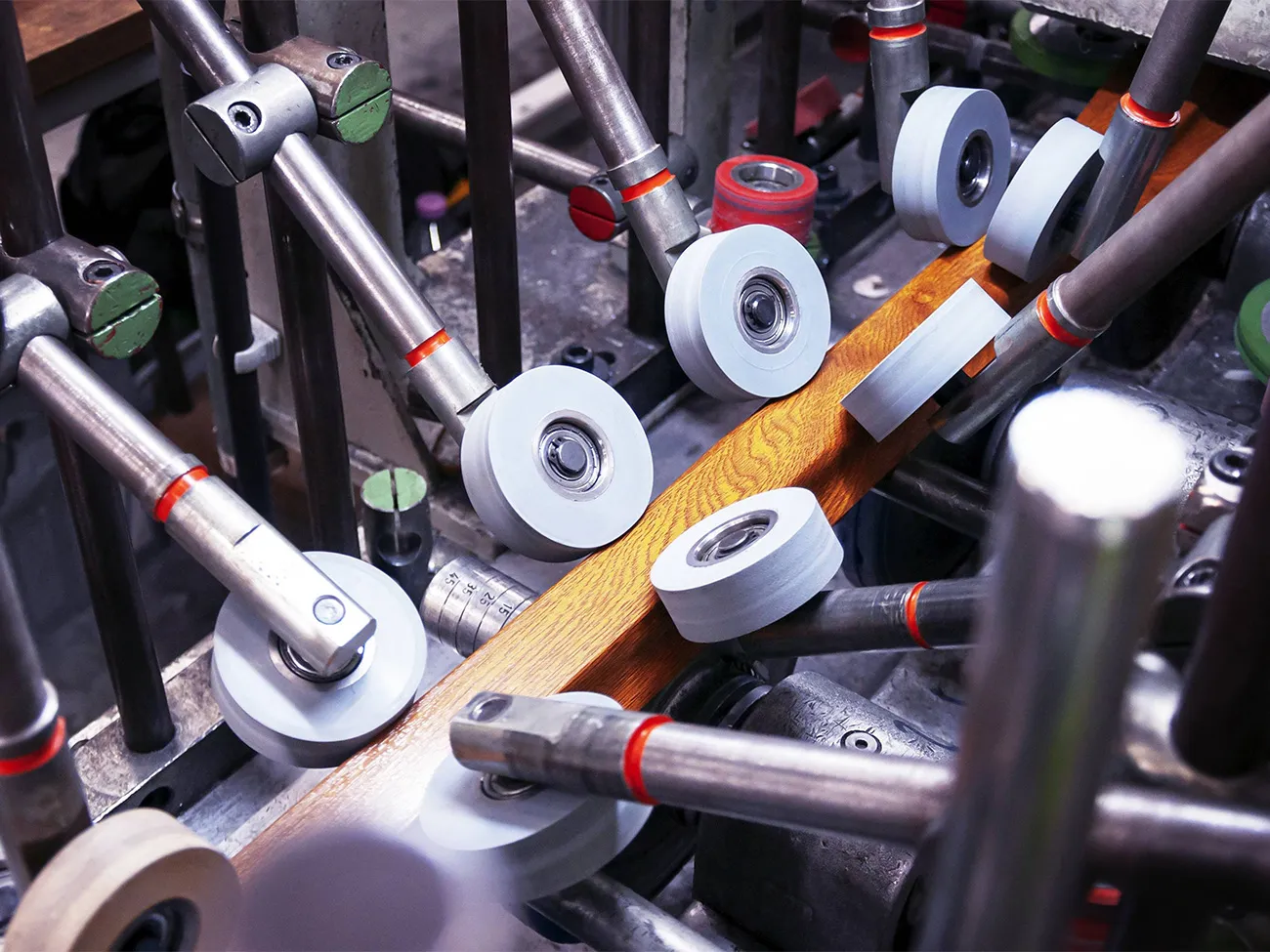
Deceuninck approached Flanders Make to further optimise productivity and cost efficiency in its production without compromising flexibility. Jan Stroobants (senior research engineer at Flanders Make) and Johan Pauwels (R&D manager at Deceuninck) explained how they had managed to shift from an experience-based way of working to a knowledge-based approach on the profile wrapping line. Changing the line over to a different profile took too much time and experience. This involved 8,000 changeovers a year, each taking an average of 90 minutes. As a result, OEE never exceeded 50%. Working with Flanders Make, they focused on one line handling around seventy different profiles, with the following goals:
- automatic creation of work instructions;
- a database of product variants;
- reducing changeover times to thirty minutes;
- reducing losses (-10%);
- preformed tools for faster changeovers.
Two algorithms developed
Flanders Make helped Deceuninck tackle these challenges by programming two practical building blocks.
The first building block is an algorithm that determines the optimal profile sequence for the wrapping line. Based on measured or estimated changeover times and a desired set of profiles, the algorithm identifies the sequence that results in the shortest changeover time. A basic requirement for an effective profile sequence is that changeover times are known or can be estimated accurately, which is not always the case.
A second building block helps address this: a piece of software that analyses production drawings (2D DXF) for the wrapping operation and extracts distinctive properties directly related to wrapping in a matter of seconds. The software takes into account the surface to be wrapped, symmetry and the number of operations in the process. These properties make it possible to determine which profiles are similar for the specific wrapping process. This also makes it possible to estimate changeovers that have never taken place before, such as those involving new profiles.

Lessons learnt
Deceuninck not only succeeded in its ambition to drastically reduce changeover times, but also gained valuable insights during the research to further optimise the production process.
For example, the drawings used by operators were changed from product drawings to process drawings, with each process step handled separately. Deceuninck also wants to ensure consistent quality across its production sites in several countries, so it aims to move towards a standardised approach. A basic structure has been drawn up for each profile, in the form of a template that now needs to be populated.
Finally, the research encouraged the production and IT departments to work more closely together to link the right data in the right way.
Question about this story? Ask your question
Keep following this
Get an email when a new story is published. No account needed.
- SubjectNews







