












Growing safely into the future
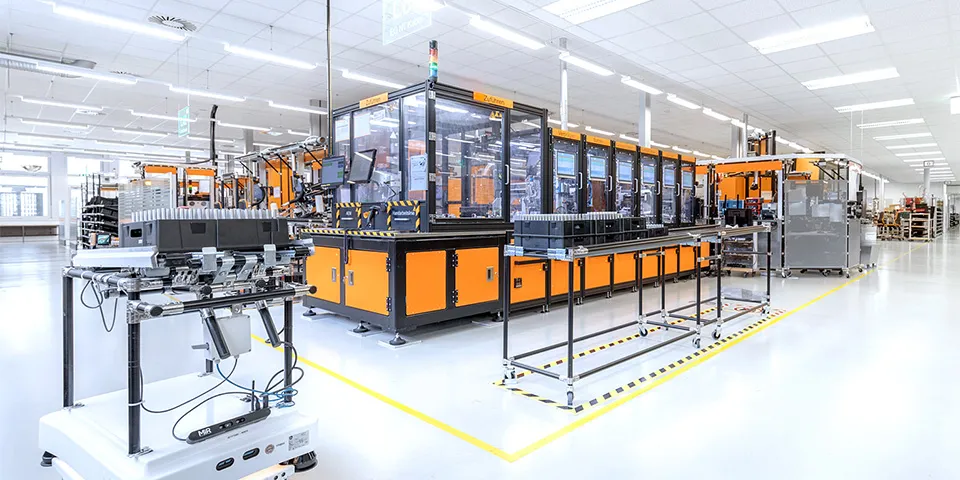
From small sensor manufacturer to hidden champion with an exceptionally extensive portfolio. This is the journey ifm electronic has made over the past fifty years. A journey that will continue well beyond the anniversary. In the years ahead, the company will continue to focus on digitalisation and show customers how intelligent sensors and software can deliver the right information to the right person at the right time.
The story of ifm electronic begins in a small flat. Robert Buck, an inventor through and through, designs an inductive proximity switch. His good friend Gerd Marhofer is convinced he can find the right market for it. The design moves away from purely mechanical signal processing and firmly embraces electronics. “A choice in favour of reliability,” recalls Martin Buck, son of the founder and current CEO of ifm electronic. “Sensors have to ensure that machines operate reliably. After all, they are at the heart of those machines. Electronic signals mean greater robustness and less wear.” It is the start of a success story that repeatedly builds on the same foundations while exploring new areas. “From there, we have always followed the same guiding principle. First, expand the product portfolio to cover more applications. Then explore new markets, before meeting customer needs with our own new technological developments. We have always aimed for the top so we can add value for our customers,” Buck sums up.
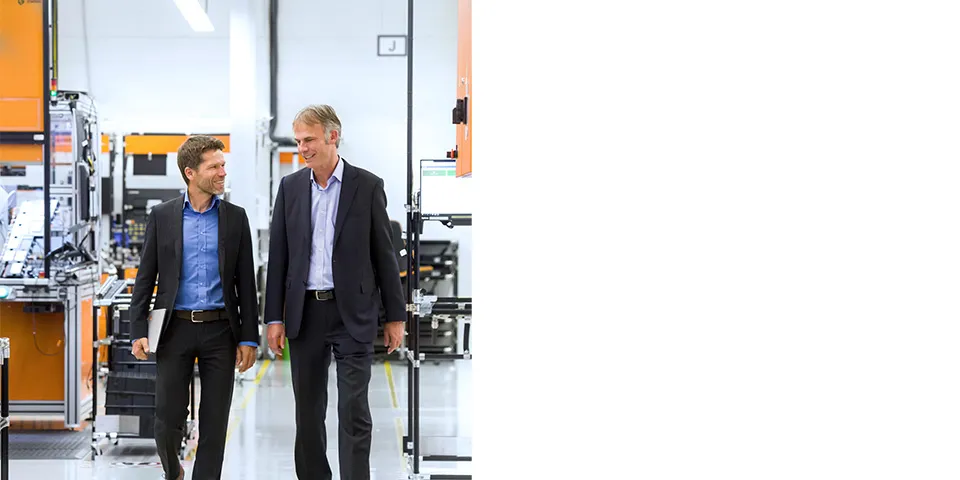
The two families still own all the shares. Today, the second generation is at the helm.
From hardware to hardware with software
On the eve of its golden anniversary, ifm electronic may be facing the biggest transformation in its history. “We are proud that we will most likely pass the €1 billion revenue mark this year,” says the other CEO, who is also the son of one of the founders, Michael Marhofer. The two families still own all the shares. “At present, just 2.4% of our revenue comes from software solutions. Yet this is where the future lies. Of course, we remain sensor specialists through and through. But our know-how will enable us to turn the data captured by sensors throughout the production process into information. A flow sensor generates 2 TB of information a year, so processing all that data would be impossible and impractical. We can help our customers extract the right information from their machines or production lines and deliver it to the right person at the right time.”
Towards open, standardised platforms
ifm electronic is firmly committed to standardisation and open platforms. Equipping all sensors with IO-Link means their signals can be processed digitally and in real time, using a uniform approach. “The traditional automation pyramid is disappearing. Hierarchy has given way to uninterrupted two-way communication, all the way from the shop floor to the top floor and even the cloud. That is what IO-Link delivers,” says Peter Wienzek, manager business development systems at ifm electronic. “IO-Link also grew in part out of our own standard for calibrating sensors. Today, it is embraced by more than 250 companies and there are over 12 million nodes. IO-Link is without doubt the future of automation interfaces. It owes this status to its ability to capture and transmit up to 200 bytes of information. This additional information can reveal hidden sensor data and enable new features. And it is all plug and play. Customers no longer need to assign addresses or configure anything. Integrating a new sensor into an existing factory environment takes less than five minutes.”
The traditional automation pyramid is disappearing. Hierarchy has given way to uninterrupted two-way communication, all the way from the shop floor to the top floor.
In-house production shows what is possible
This is no distant prospect, however. Industry 4.0 is already within reach at ifm electronic. The company uses its own components and software solutions in its own production to take productivity to the next level. A good example is the MiR AGVs. They have been fitted with a patented ifm racking system, which identifies trays of components or products, checks their quality and sends them reliably on to the next production stage. This has transformed them from AGVs into automated guided vehicles. ifm is also currently integrating Pick Control, a vision solution that uses object identification to check whether every step in an assembly process has been completed correctly, including the movement and speed. In future, every workstation will be equipped with it, further reducing the margin for error.
And what does the future hold?
Clearly, there is no question of resting on its laurels. On its anniversary, the company is already looking ahead. Marhofer: “We set ourselves ambitious targets. By 2030, we want to achieve revenue of €2.5 billion, half of it generated by our digital platforms. Hopefully, our employees, who will be digital natives by 2030, will say that we made the right decisions today. That is not to say there are no challenges. One of them will be turning huge volumes of data into information that is worth its weight in gold to our customers. But the biggest challenge will undoubtedly be ensuring cybersecurity. We also want to do even more on sustainability: avoiding plastic waste, increasing recycling rates and using energy and water sparingly. These efforts should enable us to become climate-neutral by 2030.” .
Question about this story? Ask your question
Keep following this
Get an email when a new story is published. No account needed.
- ThemeProcess measurement and control
- SubjectNews







