












GPS FOR THE MILKY WAY
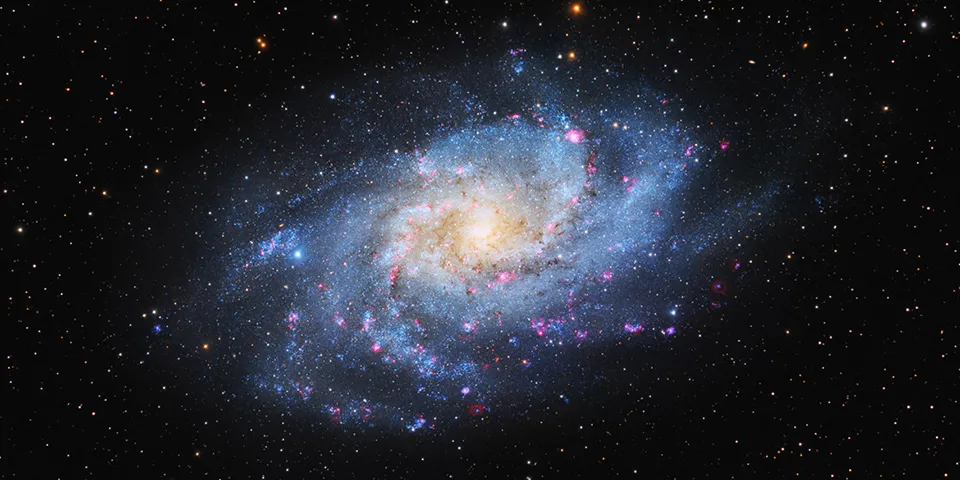
What is happening around us? We all want to know, whether we admit it or not. Ever since humans first appeared on Earth, we have asked ourselves: What is happening in the Milky Way? Surprisingly, we know very little about it, because we literally struggle to see the wood for the trees. But the MOONS project, initiated by British astronomers, aims to change that. FAULHABER technology will play an important role.
A galactic lack of knowledge
When it comes to exploring our own disc-shaped spiral galaxy, astronomers face a fundamental problem: although the Earth is not exactly at the centre, it is located in the central disc of the Milky Way. So when astronomers want to look towards the centre from this vantage point, or at what lies beyond it, their view is obstructed by countless stars. From our earthly perspective, it is very difficult, or even impossible, to determine where they are located within our shared disc. One of the regions we know little about is the dense area at the centre of the galaxy, where countless stars and gas clouds are clustered around a presumed black hole. But a major astronomy project could soon fill many gaps in our knowledge. Eight institutes from different countries are involved in the project, which was initiated by the European Southern Observatory (ESO). This scientific organisation operates some of the world’s most powerful telescopes in Chile’s Atacama Desert. These include the Very Large Telescope (VLT) at Paranal Observatory, with a mirror diameter of 8.2 metres. The project aims to equip the VLT with a new instrument to capture optical signals from space. It is a spectrograph that can observe a large number of cosmic objects simultaneously in the visible and infrared parts of the spectrum. The project’s name is an acronym for its English description: MOONS, or Multi-Object Optical and Near-infrared Spectrograph. It is coordinated by the United Kingdom Astronomy Technology Centre (UK ATC) in the Scottish capital, Edinburgh.
Spectrum instead of a photograph
“With a good camera, you can replace the lens. With a telescope, it’s the other way round: the VLT has an excellent lens, but we’re replacing its current ‘camera’ with our MOONS,” explains William Taylor, a researcher at UK ATC. Its new technology opens up entirely new possibilities for observing space, although MOONS does not produce large photographs in the traditional sense. Instead, it captures minute details. Here’s how it works: the VLT’s enormous lens and mirror are pointed at the region of space to be observed. So far, nothing new. But now the ends of exactly 1001 optical fibres in MOONS are directed at individual objects within this cosmic region. Rather than capturing the whole area, as a camera would, the new instrument focuses the fibres on specific points in the universe. And even these points are not simply photographed. Prisms split the light into its individual components, the different wavelengths. “Scientifically, this method provides much more information than a photograph,” Taylor explains. “It allows us to learn a great deal about an object’s chemical composition. We can also calculate its dynamics, meaning its speed and direction of motion. Because MOONS is designed for the near-infrared spectrum, we can accurately analyse the redshift undergone by light travelling to us from distant objects.” When a star moves away from Earth, the wavelength of its light gets longer. This shifts some of the visible light into the invisible infrared region, which is still close to the visible spectrum.

Moons at VLT © eso.org
Thousands of objects in view
With previous technology, a maximum of around a hundred objects could be observed individually, and only in the visible range. MOONS not only multiplies that number tenfold, it also increases the depth of the information available. Within the Milky Way, this will allow us to look between the trees much more precisely and get a much clearer picture of the whole proverbial forest. “One of the project’s aims is to create a 3D map of the Milky Way, enabling a kind of GPS navigation through our entire galaxy. MOONS technology, with its unprecedented resolution, will also allow us to look a very long way into space, and therefore a very long way back in time. We will be able to get to within a few hundred million years of the Big Bang.” This will give scientists insight into the early years of the universe. Although this is already possible to some extent, MOONS will give us a much clearer and more detailed picture, says Taylor. “We will be able to map the universe to an unprecedented depth.” The astronomers plan to observe several million objects over a period of around five years. To achieve this, the spectrograph’s 1001 optical fibres must be directed quickly and, in most cases, automatically at their cosmic targets. This is done using an equal number of fibre positioning units (FPUs). Each FPU has two stepper motor drive units mounted on low-backlash gearheads. The rear unit moves the FPU’s central axis (Alpha). The front motor and gearhead drive unit (Beta), mounted eccentrically on it, moves the fibre end at the same time. Combining the two axial movements allows each FPU to cover a circular area within which the fibre can be aligned in any direction. This area partially overlaps with those of neighbouring FPUs. This means that every point within the area to be captured can be targeted. To meet the challenging requirements for positional repeatability, which is necessary to prevent collisions between FPU ends, the drive system solution must be extremely precise. The high-quality stepper motors come from FAULHABER PRECISTEP; the zero-backlash gearheads from FAULHABER Minimotor contribute to positioning accuracy. FAULHABER subsidiary mps is responsible for the modules’ mechanical design.
Custom-built positioning instrument
“We’ve received valuable input from all three Swiss companies in the FAULHABER Group,” says Steve Watson, who is responsible for FPU development at UK ATC. “Without their unique know-how, it would have been impossible for us to develop this core module in this form, and in the quantities we need. As well as moving the optical fibres quickly, they also have to be extremely precise. We achieve an accuracy of 0.2± degrees and positional repeatability of up to 20 microns. These are excellent figures, given the length of the FPU and the modular design. And the units remain well aligned on the focal plane, where the modules are arranged in all positions.” The high precision and extreme reliability of the components make it possible to keep operation simple, another requirement for the spectrograph to work flawlessly. Complex electronics and control logic would seriously hamper the rapid, simultaneous operation of 1001 units. Thanks to the high quality of the components, precise alignment can be achieved with simple open-loop control. The technology must also be highly robust and virtually maintenance-free, so that it can carry out its tasks without interruption throughout the system’s planned ten-year service life. Project manager Alasdair Fairley is already looking beyond these technical challenges: “We’re making good progress with MOONS. We expect to install the spectrograph in the summer of 2021. Commissioning will take around half a year, so we will probably be able to start mapping in early 2022. We’re confident that the FPU will remain fully operational for ten years without maintenance.”
Question about this story? Ask your question
Keep following this
Get an email when a new story is published. No account needed.
- SubjectNews







