












Get a firm grip on precision
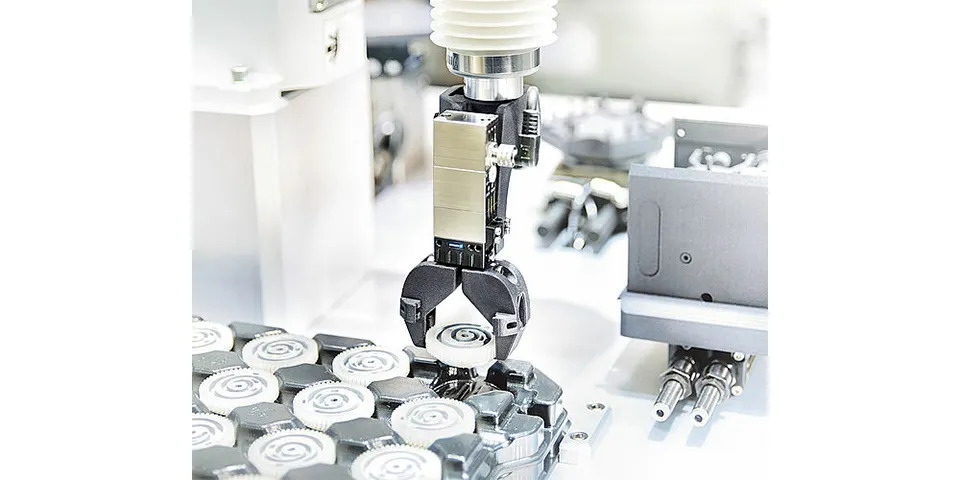
SCHUNK’s new small-parts gripper operates without compressed air. A compact gripping system that is both fast and powerful: until now, this has only been possible in most cases with the help of pneumatics. Compressed air can deliver high pressure at another location with virtually no delay. However, compressed-air systems require complex infrastructure, which is difficult and costly to provide at every production stage. Fortunately, this is no longer necessary, thanks to SCHUNK’s mechatronic EGP 40. The new gripper from this leading expert in workpiece gripping technology and gripping systems easily matches the performance of its pneumatic counterparts. The driving force behind it is a FAULHABER brushless DC servo motor.
Pick & Place is the term used for this classic application for small-parts grippers. Picking up components and placing them in the right position is a standard task in many handling and assembly processes, but not only there. One example is modern, high-throughput laboratories, which analyse thousands of blood, DNA or active-substance samples. These are distributed at high speed onto sensitive pipetting plates. Small robots grip the plates and transfer them to the next stage of the analytical procedure. Another common application is assembling printed circuit boards for larger electronics, for example in electric machines or switching systems. SCHUNK grippers pick up components and place their contact points in the designated holes on the circuit board. They must grip a component firmly without damaging the workpiece. Alongside carefully calibrated force, speed is a key factor in most processes: fast gripping increases productivity.
Until now, pneumatically powered systems have dominated industrial gripping. This is due to both tradition and practical considerations. Pneumatic drives have a high power density, meaning they can deliver considerable force relative to their compact size. This force is available with virtually no time lag. As soon as the control valve opens, the supplied compressed air can immediately perform the required lifting operation, in this case gripping.
Pneumatics require dedicated infrastructure
In principle, however, pneumatic drives have only two states: open or closed, full power or none at all. Incremental control is possible only with considerable effort and expense in terms of control technology. In addition to the electrical connections for control, a pneumatic gripper also requires connections for compressed-air lines. This can be a real problem in confined spaces, which are not uncommon when handling small parts.
The biggest drawback, however, is the compressed-air system itself. At least one compressor, an air purifier, a dedicated supply network and a complex control system are required to ensure that constant pressure is continuously available at every point. These components are relatively expensive and require considerable maintenance. Owners of new facilities in particular are therefore increasingly inclined to do without this additional infrastructure and rely entirely on electrically operated drive systems.
Proactive motor power
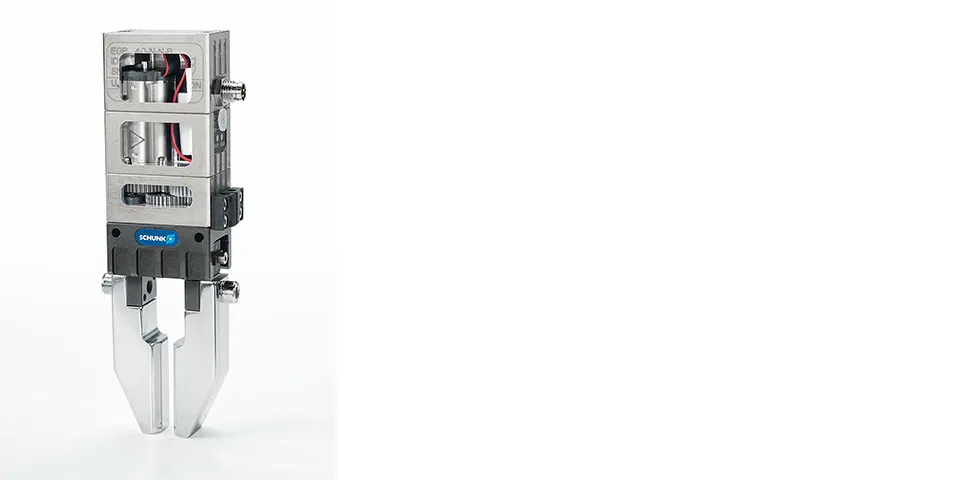
Thanks to the new EGP 40 electric small-parts gripper, this can now be achieved on a purely electric basis, virtually without compromising performance. With 140 Newtons, it develops even greater closing force than its pneumatic counterpart, the MPG-plus 40, which is also manufactured by SCHUNK. This high performance is delivered by a 4-pole brushless DC servo motor from the BX4 series by FAULHABER. The motor has an optimised, exceptionally high power density. In other words, it delivers maximum torque and power relative to its mass. Its compact, robust design can be manufactured economically and automatically.
“Because the motor runs without cogging, its output torque is independent of position,” explains Andreas Knebel (customer adviser) of FAULHABER. “Its minimal rotating mass also gives it a very high dynamic response. Full torque is available immediately, both when starting and at low speeds. This is particularly important for this application, as the gripper fingers often move only a very short distance.” Low energy consumption is an added benefit of the high-quality motor technology.
These characteristics have made the FAULHABER motor an important technological platform for developing these electric small-parts grippers. “The gripper is designed to be easy to operate and integrate into customers’ applications. Motors with this level of performance used to be simply too expensive to install in this type of device,” says SCHUNK development engineer Matthias Quaas. “This motor type is based on a low-cost concept, which made it possible for us to consider using an electric drive from another supplier. It was also very important for us to be able to rely on robust, proven technology. This motor had already demonstrated its reliability and long service life in many applications.”
Customised electronics
However, for space-related reasons, the control electronics had to be adapted to SCHUNK’s requirements. To fit inside the gripper, the shape of the circuit board and the layout of its components had to be optimised. A customer-specific connection and an EMC protection circuit were added to protect against electromagnetic interference. The software was also adapted to the gripper’s function. “FAULHABER is not a supplier to me, but a development partner,” emphasises Matthias Quaas.
“The collaboration was highly constructive and always focused on finding solutions. We received excellent support throughout.”
SCHUNK can now offer the world’s most powerful mechatronic small-parts grippers with integrated electronics in the form of the EGP 40. The housing design and electrical connections match those of the equivalent pneumatic product, the MPG-plus 40. The sensor system and control signals are also identical. This enables users to switch from pneumatic to electric operation with minimal cost and effort. Other strengths of the gripper include an excellent ratio of gripping time to lifting capacity, highly precise control of the gripper fingers, thanks to powerful ball guides, and four adjustable gripping-force settings. What requires a complex control system in pneumatic applications is exceptionally simple here: switch positions can be selected through an opening in the side of the housing to determine how firmly the gripper should grip.
This also allows the gripping force to be adapted to deformable or delicate workpieces. In many production processes, gripper speed is also crucial. In this case, the EGP 40 is available in a high-speed version. “The motor inside uses different gear ratios,” explains Matthias Quaas. “It is considerably less powerful, but achieves remarkably short cycle times and is even faster than the pneumatic versions.”
Question about this story? Ask your question
Keep following this
Get an email when a new story is published. No account needed.
- ThemeRobots on the shop floor
- SubjectNews







