












Future-proof logistics and production thanks to intelligent sensors and vision systems
Text Geert Van Cauwenberge –Image © Luc Nimmegeers
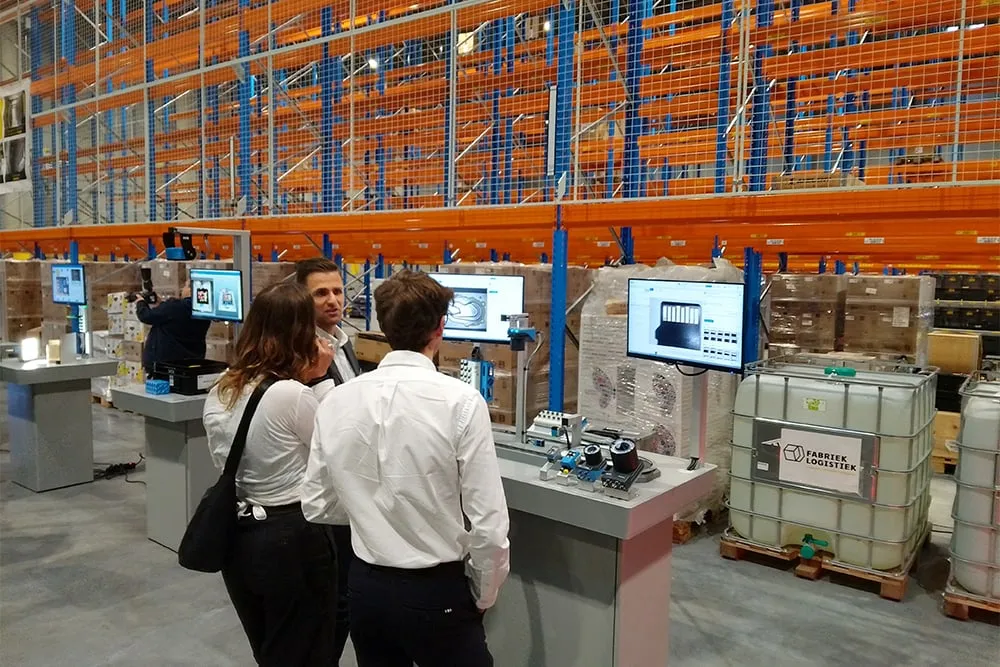
SICK Explore 2024 informs professionals at Fabriek Logistiek test centre
On 5 November 2024, SICK Explore 2024 took place at Fabriek Logistiek’s Ghent site. At the event, themed ‘Increase Quality in Production & Logistics’, attendees learned more about the central role vision technology plays in production processes and warehousing. Alongside engaging presentations, there was also ample opportunity to see practical demonstrations of intelligent sensor technology.
SICK Explore 2024 opened with a brief introduction from host Danny Vanrijkel, key account manager at Fabriek Logistiek. He explained the important role Fabriek Logistiek plays as a logistics testbed for Flemish companies and logistics service providers, highlighting the extensive logistics testing facilities at its Ghent site and the opportunity for businesses to organise team-building activities or product demonstrations there.
Smart cameras and LiDAR for quality control
Following the introduction, Marcel de Jonge, Product Manager Quality Control & Track and Trace at SICK, presented various camera- and LiDAR-based solutions for quality control in production and logistics. LiDAR stands for LIght Detection And Ranging. He discussed 2D and 3D vision technologies used for tasks including defect detection, label inspection and content verification. 2D vision is mainly used for code reading and contrast-based quality inspections, while 3D vision provides more detailed measurements of volume and dimensions, which are useful in complex logistics and production processes. Marcel de Jonge demonstrated various SICK products, including the Inspector and TriSpector cameras, which can be used for specific tasks such as sorting food, checking packaging and assisting robots with picking up objects. SICK’s solutions range from simple standalone systems to advanced AI-supported solutions, enabling the company to support a wide range of industries in their efforts to increase efficiency and reduce costs.
The added value of artificial intelligence
Next, Henk Oosterhuis, Industry Manager at SICK, explained how AI and deep learning can improve quality in production processes. Attendees discovered how AI tools can automate processes and solve complex tasks, such as detecting anomalies and classifying objects. Examples included contamination detection in the food industry, label inspection on consumer products and quality control of pharmaceutical packaging. Henk Oosterhuis discussed the use of the Inspector83x 2D vision sensor and the SICK Nova platform. This combination of technologies detects faults quickly and reliably, resulting in fewer product recalls and a more efficient production process. With the cloud-based dStudio, users can manage training data and train AI models without extensive AI knowledge. SICK also offers cost-effective testing options and a user-friendly interface to ensure smooth integration of AI solutions.
Engaging practical demonstrations
Following the presentations, attendees had ample opportunity to see intelligent sensors and vision systems for production and intralogistics in action. The range of applications on display was broad: quality control, 2D and 3D vision, ranging, pallet inspection, AI vision applications, content inspection, picking, object visualisation, and more. Experts answered questions, after which attendees could also try things out for themselves at the various test stations.
Question about this story? Ask your question
Keep following this
Get an email when a new story is published. No account needed.
- ThemeProcess measurement and control
- SubjectNews







