












E-MOTION ON TWO WHEELS
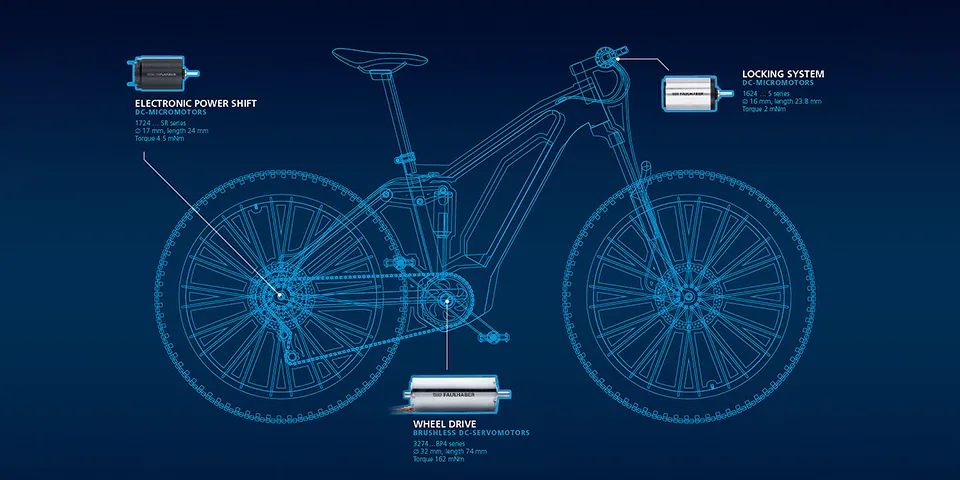
Cycling is an integral part of our active lifestyles. In Germany, 97¦per cent of the population can ride a bike. They use bicycles not only for leisure rides, but also to get to the supermarket or work every day. With fuel prices rising and roads congested during rush hour, people living in large cities in particular see cycling as a good alternative to driving. FAULHABER drives are used in various components of these bicycles.
Bike sharing is gaining ground.
You do not need to own a bike to use one. In cities in particular, bikes can be hired quickly and easily. This saves the cost of buying and maintaining a bicycle and minimises the risk of theft. Cyclists also benefit from the health advantages and help reduce CO2 emissions. Sustainability is another benefit of bike sharing worth mentioning: a shared bike is used four times as much, proportionally, as a privately owned bike.
Locking systems from FAULHABER.
Bike-sharing providers rely on FAULHABER drives to manage the use of their rental bikes. Small FAULHABER drive motors are installed in the front fork to lock the bikes. Depending on the system, users can hire a shared bike at designated rental locations or even use an app on their smartphone to rent one without a fixed location. Several bike rental companies now offer bicycles and e-bikes at their locations.
Cycling with a helping hand.
An e-bike provides the rider with assistance from an electric motor. The level of assistance can be adjusted to suit the individual and depends on the rider’s pedalling force or cadence. A bicycle with electric assistance is legally classified in the same way as a conventional bicycle. Riders therefore do not need a number plate or driving licence. The European e-bike market has grown considerably since 2008: 1.6 million of these bicycles were sold in 2016. Germany is leading the way in this sector.
Bicycle drive systems from Schönaich.
An e-bike works as follows: a sensor detects when the rider is pedalling and sends this information to the controller. As the control unit, it manages the battery and ensures that the required current is sent to the motor. Once the current starts flowing, the e-bike’s pedal assistance is activated. FAULHABER motors are used as drive systems for e-bikes, providing optimum propulsion. Despite their high performance, the motors from Schönaich are so small that they can be discreetly integrated, so the e-bike is not even recognisable as such from the outside. The 3274 … BP4 brushless DC servo motor and a planetary gearbox are integrated into the frame, while the corresponding battery is ‘disguised’ as a water bottle. This type of electrically assisted bicycle can reach a peak output of 330 watts for around five minutes at a time.
In the right gear.
DC micromotors from the 1524/1724SR series also provide the right drive for shifting gears on both conventional bicycles and e-bikes. Electronic shifting systems make for more efficient riding and improve comfort and safety. At the same time, they reduce wear on the shifting components. Gear changes are made using small servo motors.
The future.
The future of cycling is exciting, as further electronic components are set to transform the experience. One example of where things could be heading is the SmartFaraday Pedal project, developed by a team of students from the Faculty of Engineering at the University of Freiburg. The bicycle’s intelligent pedal offers a range of functions to help cyclists keep track of their journeys, from monitoring performance and routes to theft alerts and even an interface for the internet and smartphone. The students won the Cosima competition with this project in 2017. One of their main sponsors is FAULHABER
Question about this story? Ask your question
Keep following this
Get an email when a new story is published. No account needed.
- SubjectNews







