












Common causes of motor failure
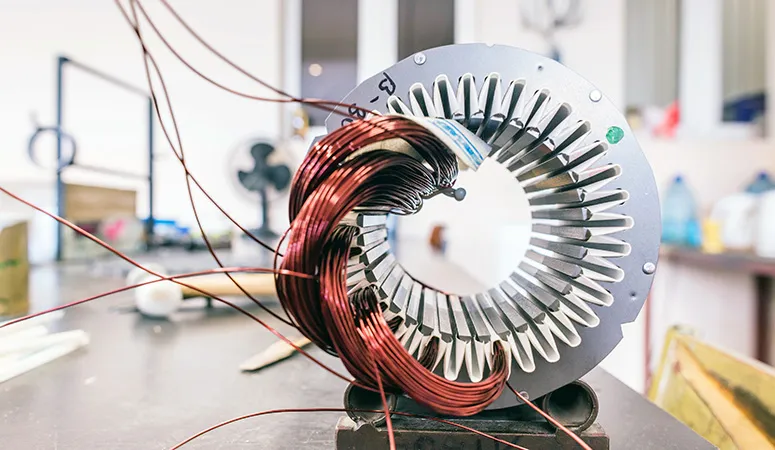
Electric motors are becoming increasingly complex and technically advanced, which can make it challenging to keep them running at their best. Problems with electric motors and drives are not confined to a single area of expertise: both mechanical and electrical issues can lead to motor failure. The right knowledge can make the difference between costly downtime and improved asset availability.
Winding insulation failure and bearing wear are the two most common causes of motor failure, but they can result from a wide range of factors. This article explains how the most common causes of winding insulation and bearing failure can be identified in advance. Factors relating to incorrect installation are not covered.
Transient voltage
Switching adjacent loads on or off, capacitor banks used for power factor correction, or even distant weather conditions can cause transient voltages in distribution systems. These transients, which vary in amplitude and frequency, can cause motor winding insulation to deteriorate or fail. Tracing the source can be difficult because these events are irregular and the symptoms can take many forms. For example, a transient may occur on control cables and may not cause immediate equipment damage, but it could disrupt operations.
Voltage imbalance
Three-phase distribution systems often supply single-phase loads. An imbalance in impedance or load distribution can contribute to an imbalance across all three phases. There may be faults in the cabling to the motor, its connections and, potentially, the windings themselves. This imbalance can cause internal loading in each of the phase circuits of a three-phase supply system. At the most basic level, all three voltage phases should always be equal in magnitude.
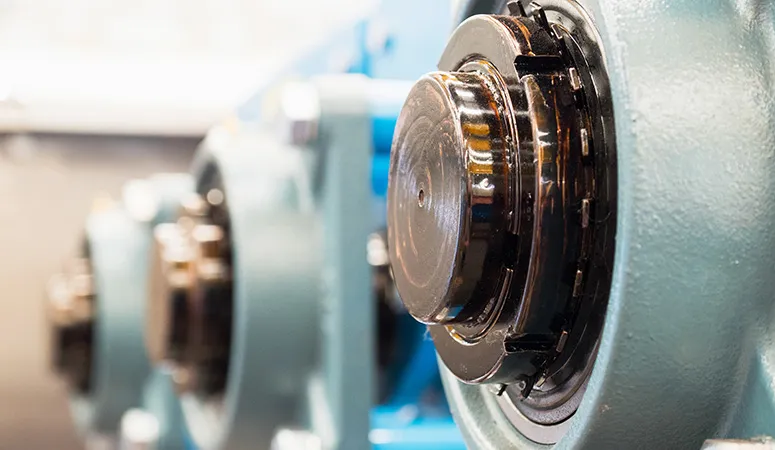
13% of motor failures are due to bearing defects, and more than 60% of mechanical failures in a plant are caused by bearing wear. (Image: Epixx)
Harmonic distortion
Put simply, harmonics are any unwanted additional source of high-frequency alternating voltage or current that supplies energy to the motor windings. This extra energy is not used to turn the motor shaft. Instead, it circulates in the windings and ultimately contributes to internal energy losses. These losses are dissipated as heat, which over time degrades the insulation capability of the windings. A certain degree of current harmonic distortion is normal. Each harmonic has a different permissible distortion level, as set out in standards such as IEEE 519-1992.
Reflections on the drive’s pulse-width-modulated output signals
Variable-speed drives use pulse-width modulation (PWM) to control the output voltage and frequency supplied to a motor. Reflections are generated when there is an impedance mismatch between the source and the load. Impedance differences can arise from incorrect installation, an unsuitable choice of components or equipment deterioration over time. In a motor drive circuit, the peak of the reflection can be as high as the DC bus voltage.
Common-mode current
Common-mode currents are primarily stray currents circulating in a system. They arise as a result of signal frequency, voltage level, capacitance and inductance in conductors. These circulating currents can find their way through grounding systems, causing nuisance trips or, in some cases, excessive heat in the windings. Common-mode current can be found in motor cabling and is the sum of the current in the three phases at any given time. In an ideal situation, the sum of the three currents would be zero. Common-mode current can also be understood as asymmetrical signals in multiple conductors that can capacitively couple currents into the ground conductor.
Operational overload
The primary symptoms of motor overload are excessive current draw, insufficient torque and overheating. Excessive motor heat is a leading cause of motor failure. When a motor is overloaded, individual components such as bearings, motor windings and other parts may be working properly, but the motor continues to get hotter. It therefore makes sense to start troubleshooting by checking for motor overload. Since 30% of motor failures are due to overload, it is important to understand how to measure and identify motor overload.
Misalignment
Misalignment occurs when the motor drive shaft is not correctly aligned with the load, or when the component connecting the motor to the load is misaligned. Many professionals believe that a flexible coupling prevents and compensates for misalignment, but a flexible coupling only protects itself from misalignment. Even with a flexible coupling, a misaligned shaft will transmit negative cyclic forces along the shaft and into the motor, leading to excessive motor wear and increased visible mechanical stress.
Electric motors are becoming increasingly complex and technically advanced, which can make it challenging to keep them running at their best.
Misalignment can also generate vibration in both the load and the motor drive shaft. Types of misalignment:
Angular misalignment: the shaft centre lines intersect but are not parallel
Parallel misalignment: the shaft centre lines are parallel but not concentric
Combined misalignment: a combination of parallel and angular misalignment. (Note: almost every misalignment is a combined misalignment, but practitioners refer to the two individual types when discussing misalignment because it is easier to correct when angular and parallel misalignment are addressed separately.
Shaft imbalance
Imbalance is a condition in rotating equipment where the centre of mass does not coincide with the centre of rotation. In other words, there is a ‘heavy spot’ somewhere on the rotor. Although imbalance in a motor can never be eliminated entirely, you can identify when it falls outside the normal range and take action to address the problem. Imbalance can be caused by many factors, including:
Dirt build-up
Missing balance weights
Manufacturing variations
Uneven mass in motor windings and other wear-related factors.
Shaft looseness
Looseness occurs when there is excessive clearance between components. It can occur in several places:
‘Rotating looseness’ is caused by excessive clearance between rotating and stationary parts of the machine, such as in a bearing.
‘Non-rotating looseness’ occurs between two parts that are normally stationary, such as a foot and a foundation, or a bearing housing and a machine. As with all other sources of vibration, it is important to know how to identify looseness and address the problem to prevent financial losses.
Bearing wear
A defective bearing runs with greater friction, generates more heat and operates less efficiently because of a mechanical or lubrication problem, or because of wear. A defective bearing can have several causes:
A load greater than the design load
Insufficient or incorrect lubrication
Ineffective bearing sealing
Incorrect shaft alignment
Incorrect fit
Normal wear
Induced shaft voltages
Once a bearing starts to fail, it also creates a cascade effect that accelerates motor failure. 13% of motor failures are due to bearing defects, and more than 60% of mechanical failures in a plant are caused by bearing wear, so it is important to learn how to detect and address this potential problem.
Based on a white paper by Fluke
Words and image: Valérie Couplez
Featured image: Problems with electric motors and drives are not confined to a single area of expertise: both mechanical and electrical issues can lead to motor failure. (Image: Smoczyslaw)
Question about this story? Ask your question
Keep following this
Get an email when a new story is published. No account needed.
- ThemeMotion with less energy
- SubjectNews







