












Collaborative bin picking
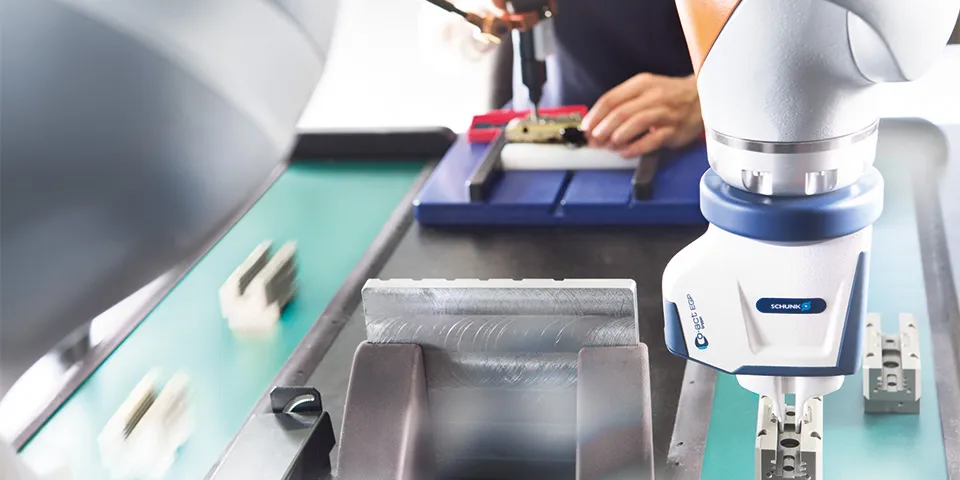
How can collaborative handling scenarios be implemented in unstructured environments? SCHUNK tackled this challenge in collaboration with KUKA and Roboception. In a technology study, the three companies demonstrate how bin picking can be carried out quickly, simply and efficiently in a collaborative process.
The example task reflects a realistic scenario: unsorted metal components are picked up by a cobot, removed from a bin, placed in a grinding machine and accurately put aside after processing. At the same time, workers can manually add, move or remove transport boxes or individual components while the system is running. The study thus combines bin picking with the concept of human-robot collaboration (HRC), drawing on the interaction of several leading technologies in robotics, gripping and vision.
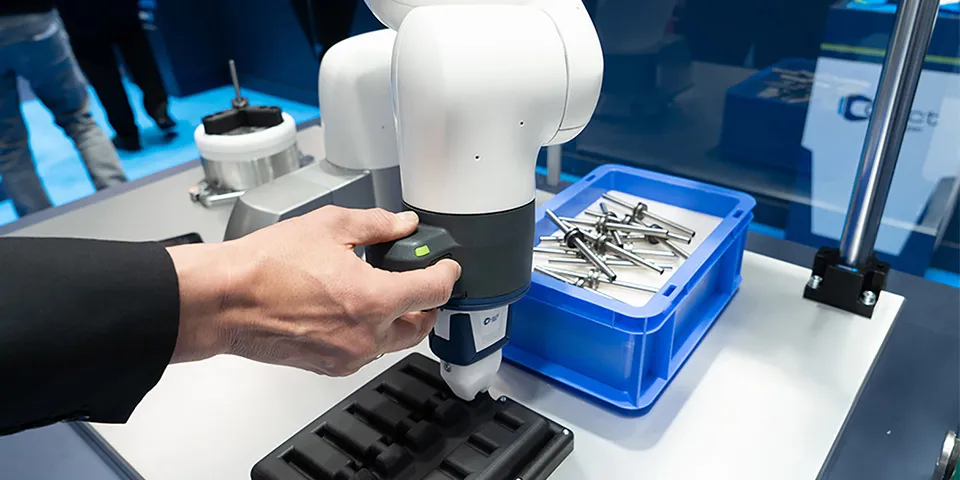
After Roboception’s cost-effective rc_visard has determined the optimal grasp points for an unsorted workpiece in
< 1s, the KUKA Cobot uses the SCHUNK Co-act gripper to pick up the component and place it fully automatically in the simulated machine. A worker can intervene in the process at any time.
(Image: Sven Cichowicz)
Determining optimal grasp points
Using CAD-based recognition, Roboception’s passive stereo camera system, rc_visard, detects the unsorted workpieces. The world’s first 3D sensor that enables robots to perform 3D measurements and determine positions in space processes complete depth images directly in the camera system in < 1s. These are then used to determine the optimal grasp points for each case, which the sensor sends directly to the KUKA collaborative robot without an external PC. Alongside the camera images, the cost-effective industrial sensor provides depth images, accuracy images and confidence images. The latter indicate the reliability of the depth measurements and can be used as a basis for decision-making in methods involving artificial intelligence (AI). As the passive camera system recognises its surroundings in both natural and artificial light, it can be used in a wide range of working environments. After Roboception’s cost-effective rc_visard has determined the optimal grasp points for an unsorted workpiece in < 1s, the KUKA Cobot uses the SCHUNK Co-act gripper to pick up the component and place it fully automatically in the simulated machine. A worker can intervene in the process at any time.
Co-act gripper portfolio
The front end of the cobot is equipped with a SCHUNK Co-act gripper designed specifically for the application in question. The gripper meets the requirements of EN ISO 10218-1/-2 and ISO/TS 15066, ensuring safe interaction between humans and robots. All control and power electronics are integrated into the gripper, so no space is needed in the control cabinet. SCHUNK has tailored the interface, dimensions and clearance radii to the application. In addition to these application-specific Co-act grippers, SCHUNK also offers a range of standard grippers for collaborative applications, such as the DGUV-certified Co-act
EGP-C small-component gripper from SCHUNK, and soon the SCHUNK Co-act EGL-C long-stroke gripper, which will also be certified for collaborative applications. The latter will be the first gripper to offer a gripping force of no less than 450 N in HRC applications.
The application can be programmed and adapted to new working environments in no time.
(Image: Nico Herzog)
Intuitive robot programming
The cobot’s handling makes programming new placement positions simple and intuitive. In the event of an unexpected interruption, the KUKA robot remembers every movement or action already completed and can resume work on the fly without reprogramming. As the solution is easy to implement on both the sensor and robot, and requires little training, it is suitable for a wide range of applications and user groups. No in-depth knowledge of robotics or image processing is required. This also minimises the integration workload. If required, the camera system can be expanded with additional projectors and modules for neural learning. The system can be operated in stationary or mobile mode on the cobot, enabling even flexible gripping scenarios on mobile platforms.
Question about this story? Ask your question
Keep following this
Get an email when a new story is published. No account needed.
- SubjectNews







