












BAC is back
Text Valérie CouplezImage Siemens
How sustainability creates competitive advantage
For the seventh year running, Siemens’ Best Application Contest (BAC) is showcasing the creativity and innovative strength of Belgian machine builders and integrators. This year’s edition got off to a flying start: after just one month of campaigning, we had already received almost ten impressive entries. The spotlight is not on Siemens technology, but on the technical talent and fresh thinking of its partners. This year, the BAC focuses on ‘sustainable operations’: using energy and raw materials wisely.
Two years ago, no fewer than thirteen entries made it through to the public vote, which reached its climax at Indumation. “This year, too, we’re sticking with the trade fair for the awards ceremony. Innovation is increasingly a story of partnerships, after all. There’s no better setting than a place where the entire sector comes together. Ultimately, these showcases are also intended to inspire other customers and show how Siemens technology can make a difference in operating more sustainably,” says digital marketer Joyce Gevaert, who is driving the BAC forward. The BAC is not looking for greenwashing, but for proven sustainability gains with Siemens technology at its core. Take Q-Pinch, for example, which makes better use of waste heat from industrial cooling towers thanks to Siemens’ DCS system. “For every kW of electricity consumed, the installation delivers 35 kW of heat,” Gevaert says, offering a striking example.
Three pillars of sustainability
This year, the projects submitted must have one main aim: to make a process or application more sustainable. At Siemens, this encompasses three pillars: decarbonisation and energy efficiency, resource efficiency and circularity, and impact on people and society. Siemens Sustainability Manager Katrien Valkiers says: “90% of our business enables our customers to make a positive impact on sustainability.” She cites the retrofit of a decoiling line at Decomecc as an example. Thanks to a new Siemens electrical installation, it now operates more efficiently and safely. “The machine used to consume
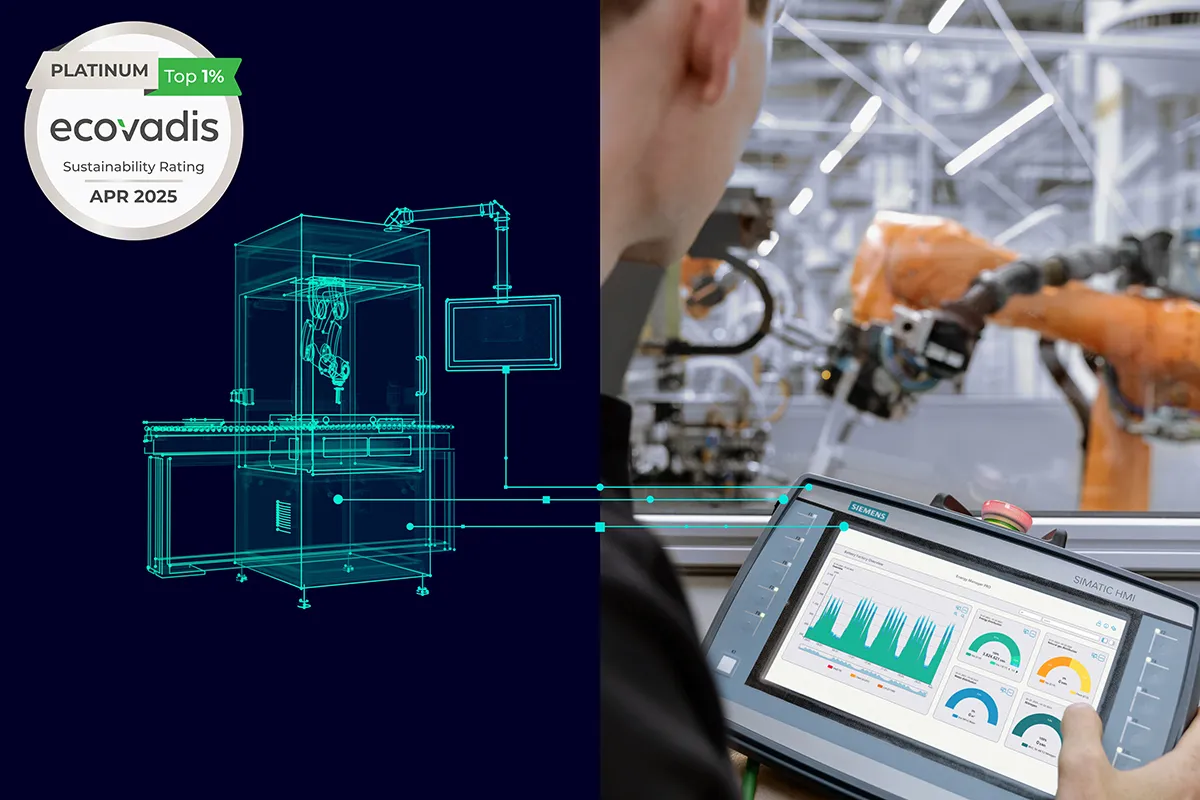
40 kW when idle; today, it uses just 1 to 1.5 kW. A fantastic result. But of course, we also put our own house in order. To that end, we have our DEGREE strategic sustainability framework, a set of fourteen concrete, global sustainability ambitions. Our recent platinum EcoVadis rating, our highest ever, shows that we’re on the right track.”
Green noose or opportunity
But is this really the right time to put sustainability in the spotlight with the BAC? Many companies see the Green Deal from the previous European legislative term as a green noose around their necks. Europe has come to realise this and has itself eased off on implementing those rules. Thierry Van Eeckhout, Head of Siemens Digital Industries Belgium, says: “As a company, we’re convinced that sustainability is a strategic advantage. If you do the same things as before, but use fewer raw materials, less water and less energy, you build a stronger competitive position for yourself. It’s always a good idea to be less dependent. Sustainability is therefore not about obligation and compliance, but common sense.”
Knowledge is essential
But if you want to turn waste back into raw materials, you have to think very differently about how you design and manufacture products. That requires the right knowledge. The Siemens Industry Academy (SIA) was set up to connect that knowledge with industry from the classroom onwards. Van Eeckhout says: “Technology is only one side of the story. You also need people to implement it. It’s up to us to inform customers about all the things that new technology can do today. But we’re also trying to familiarise future generations with digital twins, IIoT, AI and machine learning. Automation and digitalisation really do go hand in hand with sustainability.”
A great project illustrating SIA’s potential to make a social impact is Helicus’ Drone Cargo Port for Jan Yperman Hospital in Ieper. It is the world’s first automated drone airport to transport blood samples from A to B. SIA students built a digital twin to simulate the landing with precision. “Transport is now faster and more energy-efficient, and takes the burden off staff so they can focus more on patients. That’s what it’s all about,” Van Eeckhout concludes.
A business enquiry for Siemens NV/SA? Get in touch
Companies in this story
Keep following this
Get an email when a new story is published. No account needed.
- ThemeFrom design to flexible machine
- SubjectNews
- CompanySiemens NV/SA







