












Avoiding obstacles with an autonomous forklift
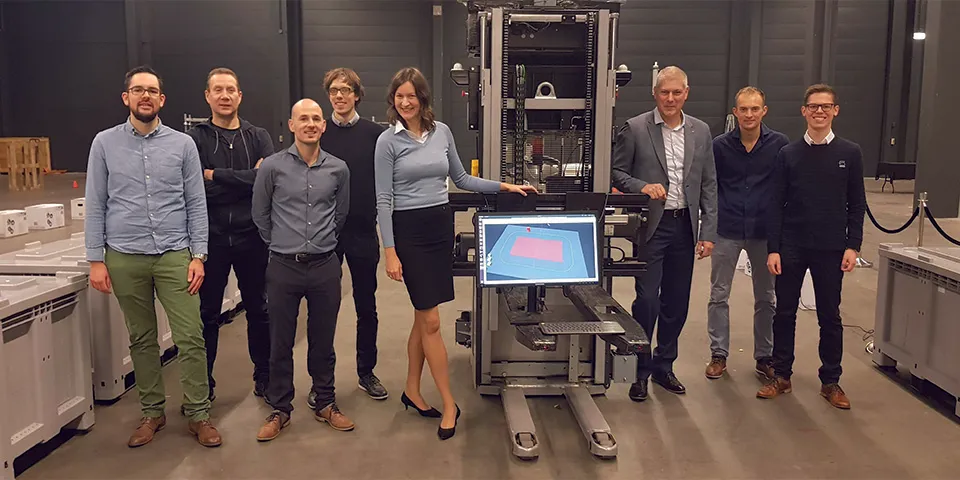
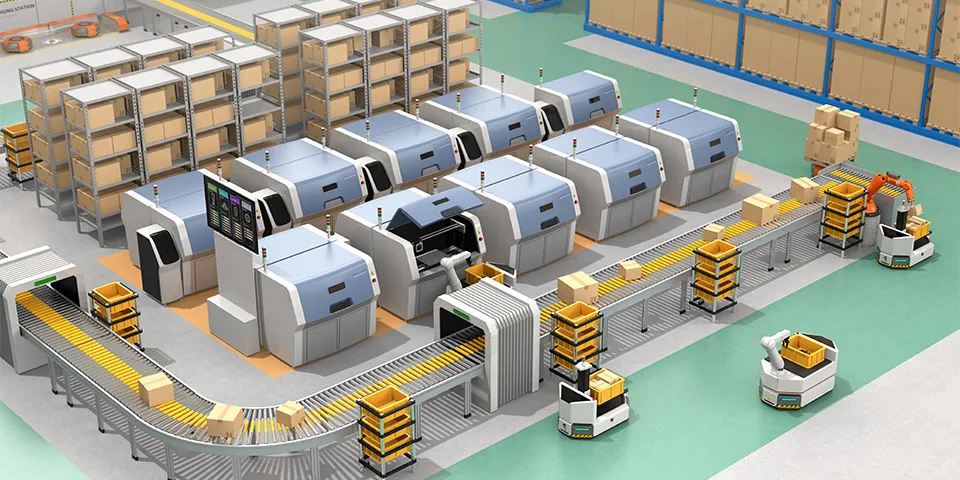
Vehicles moving autonomously through production facilities and warehouses are already key to optimising flow for many manufacturers. In the future, this technology will become even more widespread, provided that AGVs, forklifts and mobile robots require few or no human interventions. People and machines can then work safely alongside each other. Research centre Flanders Make has therefore developed technology that enables autonomous vehicles to avoid unexpected objects in narrow aisles. Using robust algorithms, autonomous vehicles can reach their destination safely, adaptively and productively. The technology was validated on an autonomous forklift performing logistics tasks.
The research had a dual objective. “On the one hand, we wanted to increase productivity by eliminating the human interaction currently required when autonomous vehicles encounter an unexpected object. On the other hand, autonomous operation also needs to be sufficiently cost-effective. In a production environment, profitability goes hand in hand with speed. The focus was therefore on affordable technology that would enable vehicles to reach the highest possible speed safely,” explains project leader Ellen van Nunen.
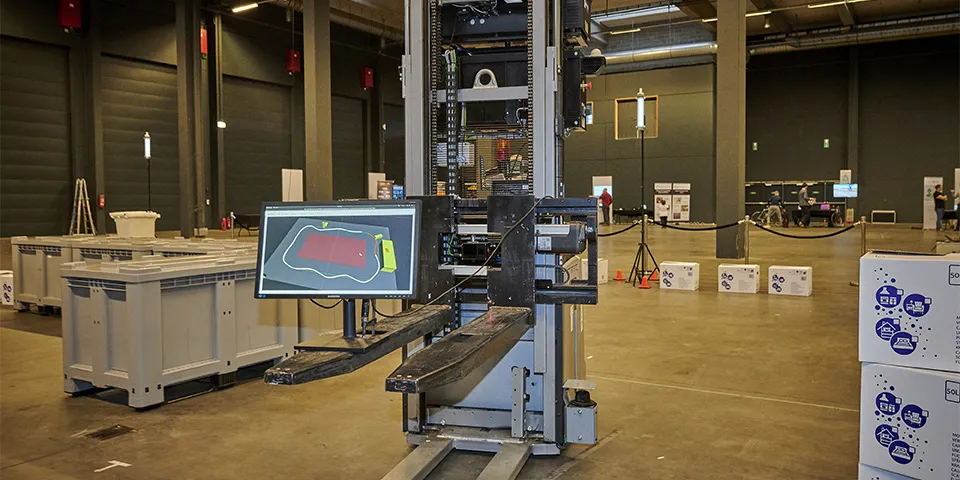
“We map the surroundings using lidar sensors. We combine this data with camera images. The combined data is interpreted to map the environment.”
Ultra-wideband sensors
The objective was clear: by the end of the project, the forklift had to be able to move automatically and safely around a pallet and a container in a narrow aisle. The first task was to equip the forklift with additional sensors. Van Nunen explains: “We chose ultra-wideband sensors. Their main advantage over laser sensors is that they are much cheaper and provide a robust solution. Their lack of precision could be compensated for by the other sensors already fitted to mobile platforms. We call this ‘sensor fusion’: combining data from different sensors. This produces a more reliable picture of the surroundings than individual sensors can provide.”
Dynamic speed control
The first obstacle in the forklift’s path was a pallet. Calculating a new, safe route that avoids collisions is relatively straightforward in this case. The camera and laser scanner on the vehicle can see over the pallet and assess whether there are people or other objects nearby. “A second consideration was dynamic speed control based on visibility,” says van Nunen. “When there is nothing and no one nearby, the forklift can manoeuvre around the pallet at high speed without the risk of collision. It takes account of obstacles, as well as corners and bends from behind which, for example, people might appear. Safety remains the top priority. The forklift must therefore always be able to brake in time and come to a complete stop.
Application-based predictive control
When the forklift encounters a container, it needs to manoeuvre more cautiously. In other words, it moves using predictive control based on the vehicle model (model-predictive control). Model-predictive control calculates almost in real time the likelihood of a collision and the appropriate speed. Van Nunen explains: “This is done using polynomials. These are mathematical functions that we use to calculate a new route based on optimal parameters. The parameters depend on the application. For lawnmowers, for example, the aim is to follow the preset path as closely as possible. Mowing quality takes priority. In a production environment, by contrast, the goal is to minimise time lost. The focus there is on reaching the destination as quickly as possible.”
Sensor fusion
Successfully implementing autonomous driving and obstacle avoidance requires processing a huge stream of data. This places heavy demands on the processor’s computing power. First, the forklift has to interpret its surroundings. “We use sensor fusion for that, too. We map the surroundings using lidar sensors and combine this data with camera images. The combined data is interpreted to map the environment,” says van Nunen. The forklift’s location is then used to calculate its route. All this software runs on an open platform comprising an Nvidia Drive platform and an Intel i7 computer. “During the research, we developed several algorithms to plot these routes. Robust, self-learning algorithms continuously optimise themselves. This also makes it possible to teach the forklift to reverse, further increasing the flexibility of the application.”
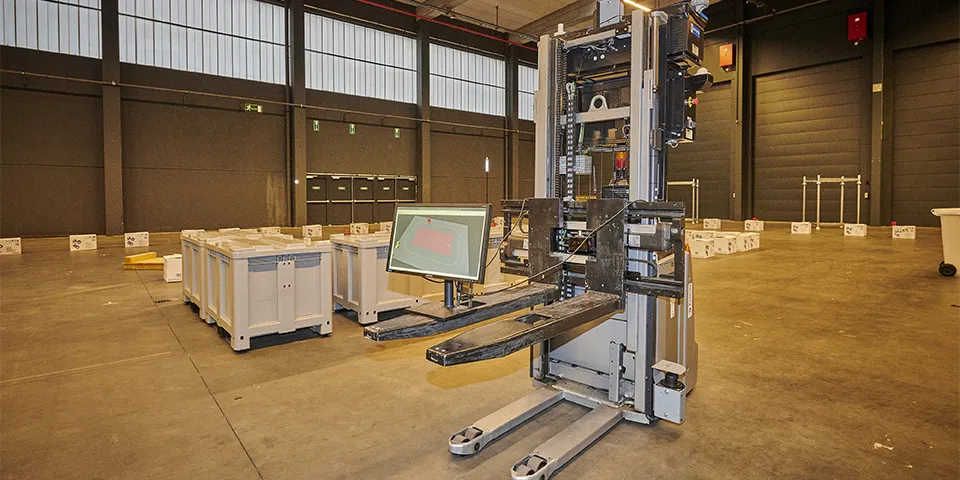
By the end of the project, the forklift had to be able to move automatically and safely around a pallet and a container in a narrow aisle.
Efficient obstacle avoidance
Van Nunen is very pleased with the results. “We have succeeded in developing a flexible solution that automatically navigates around obstacles in narrow aisles, with clearance from as little as 0.2 m on either side, reversing if necessary. The built-in speed control makes this particularly efficient, while always ensuring safety. The solution works with different types of vehicles, too. In a follow-up project with Vlaams Instituut voor Logistiek, we want to investigate how different types of containers can be lifted autonomously to collect waste automatically at large companies. We also want to use the technology outdoors, where sensors face more demanding conditions and road surfaces are not always even.”
Flanders Make conducts high-tech research for and with SMEs and large companies. This contributes to practical product and production innovations in the automotive industry, machine building and production environments. The research into autonomous obstacle avoidance for logistics is part of an Interdisciplinary Cooperative Research Project with partners Bekaert (which uses autonomous forklifts to collect coils), Kobi (which offers solutions for robotic lawnmowers), Octinion (which develops autonomous strawberry-picking robots, among other things) and Siemens (which works on simulation software). In these pre-competitive research projects, companies work together to find solutions to shared technological challenges. Once the project is complete, each partner applies the technology to its own needs. Flanders Make comprises three co-creation centres, the Flemish drone federation EUKA and laboratories at the five Flemish universities.
Question about this story? Ask your question
Keep following this
Get an email when a new story is published. No account needed.
- SubjectNews







