












Automatic charging for electric cars
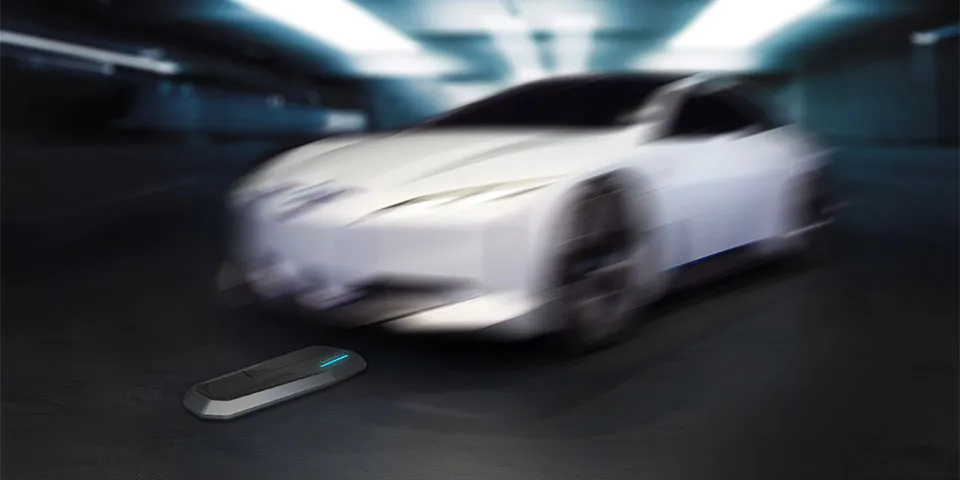
Although electric mobility is becoming increasingly popular, there is still scope in some areas to develop functional standard technologies. One example is the way cars are charged. Nobody wants to see the streets filled with charging points. Inductive charging is largely out of sight, but it has a number of significant drawbacks. Volterio offers an efficient, smart alternative. The charging robot prototype moves using FAULHABER motors.
Charging stations can be an eyesore in city centres, while heavy cables and plugs are not particularly convenient in private garages either. Contactless inductive charging is possible, using coils embedded in the garage floor or road surface. This is an attractive option, both visually and mechanically. But it comes at a high cost, in several respects: installing the coils requires digging and then carefully restoring the surface. And all this for a maximum power output that is currently just three kilowatts in most cases, which can result in long charging times. What is more, this charging method loses a considerable amount of power compared with cables and plugs. Losses are even greater if the car is not parked directly over a coil.
Plug finds its connection
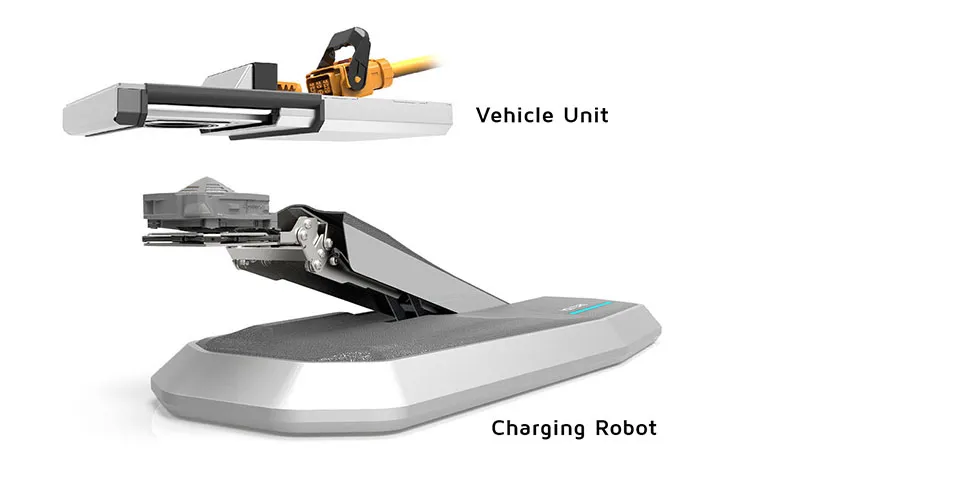
Volterio’s technology offers an elegant solution to all these problems. When the charger is not in use, it is an inconspicuous structure no more than 6 centimetres high, mounted on the ground. The car is parked over it for charging. A robotic arm then extends telescopically. At the end of the arm is a plug that seeks out its counterpart on the underside of the car. The two components have already exchanged information via encrypted wireless communication. And because the cone-shaped power connector is not a plug in the traditional sense, it can make full contact even if the car is not parked in the optimal position. An ultrasonic system ensures that the arm finds its target precisely. The connection is established in less than 15 seconds.
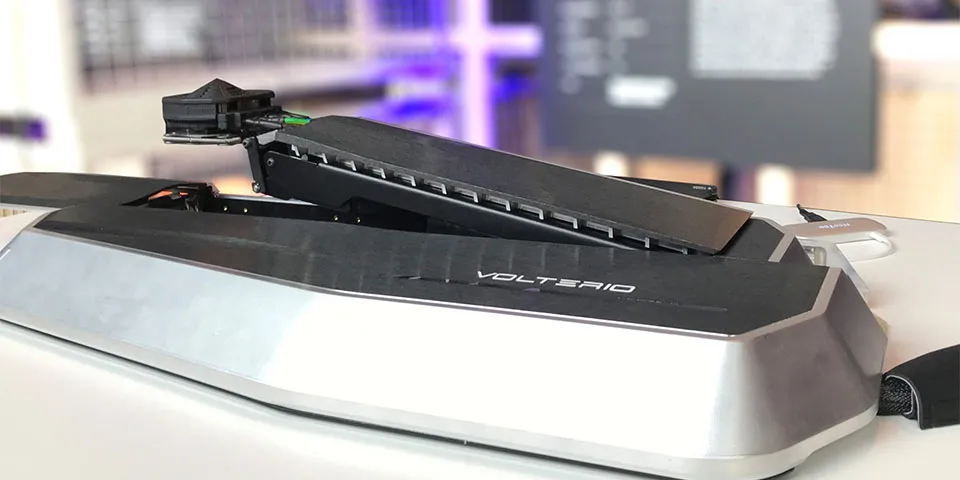
The plug only needs to be within a 50 by 50 centimetre range, and the car can even be parked at an angle. The entire unit can also be built into the ground, for newly laid garage floors or parking spaces. A charger connected to a domestic supply has a charging capacity of 22 kilowatts, meaning that even the largest car batteries can be fully charged in 4-5 hours. The technology is already ready to handle 100 kilowatts DC, bringing charging time down to one hour.
The idea behind Volterio came from a master’s thesis that Christian Flechl wrote in 2014 at Graz University of Technology (Austria). Flechl is now managing director of VOLTERIO GmbH, and his product is on the brink of entering series production. Three motors that move the robotic arm along three axes were a key element in the prototype’s development: “We wanted to build a device that was as flat as possible, which meant there was very little space available from the outset,” says the young engineer. “But we also have to move a considerable weight. So the motors, combined with the right gearbox, have to deliver high torque and speed while remaining compact.”
Powerful, fast and reliable
An internet search quickly led to FAULHABER, as few companies can meet this kind of specification. “In discussions with other experts, I kept hearing that FAULHABER was the right choice. That became even clearer once we started working together. FAULHABER supported the entire project with extensive technical advice, help selecting the right motors and by providing the motors themselves.” The prototypes were fitted with DC micromotors, planetary gearheads and a suitable motion controller. FAULHABER also selected and supplied other drives for testing.
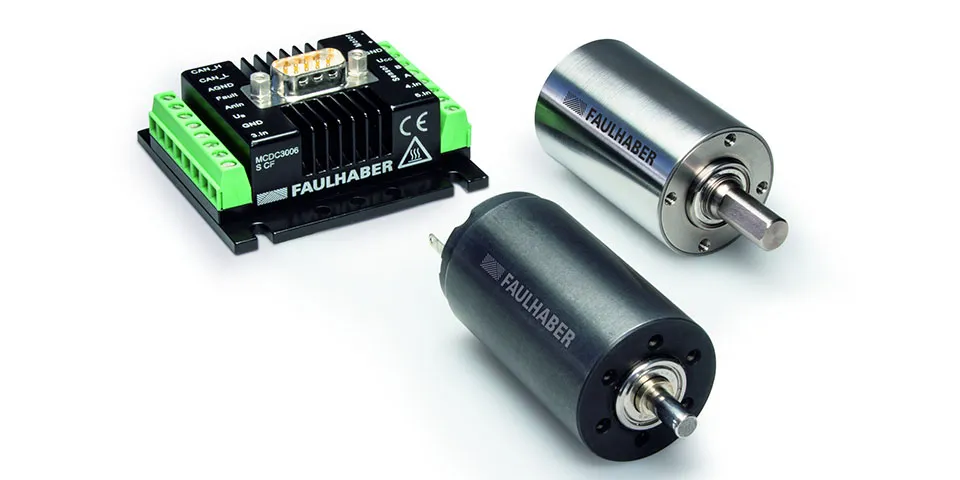
The high motor performance of the CR series is based on highly stable graphite commutation, highly wear-resistant, powerful neodymium magnets and a particularly high copper content in the winding. The charging station is designed for approximately 20,000 cycles. This means that only around 1% of the drives’ service life is used. Robustness is also crucial, as Volterio units must operate reliably after long periods of inactivity and in poor weather conditions.
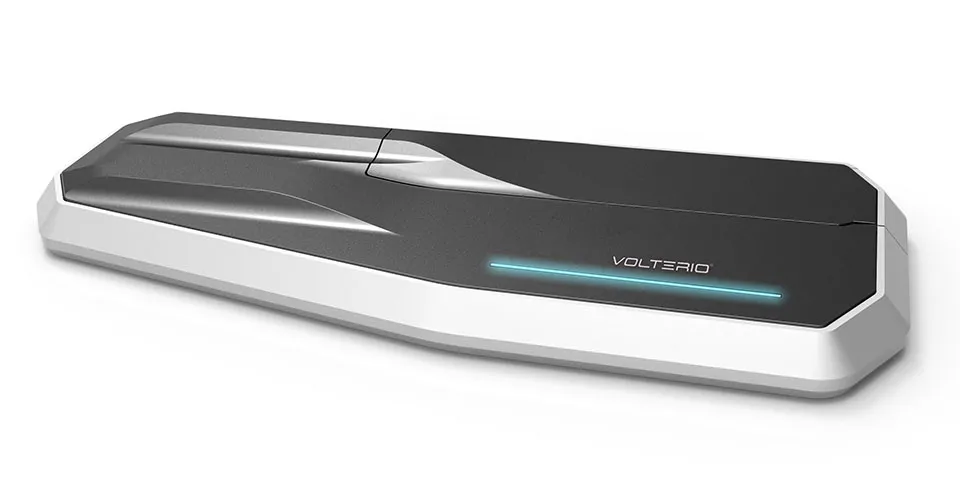
The prototype performed very well in extensive testing. The technology is significantly better than competing concepts in key respects. Several manufacturers of top-end cars agree. They are already preparing for series production of the chargers. Volterio is meanwhile working on new challenges: “Automated charging processes can be used in many different ways,” explains Christian Flechl. “This applies to the entire logistics sector as well as to all self-driving cars. Solutions for electric trucks are also under development. We are developing suitable charging robots and continue to rely on FAULHABER’s valuable support.”
Question about this story? Ask your question
Keep following this
Get an email when a new story is published. No account needed.
- SubjectNews







