












3D printing Notre-Dame?
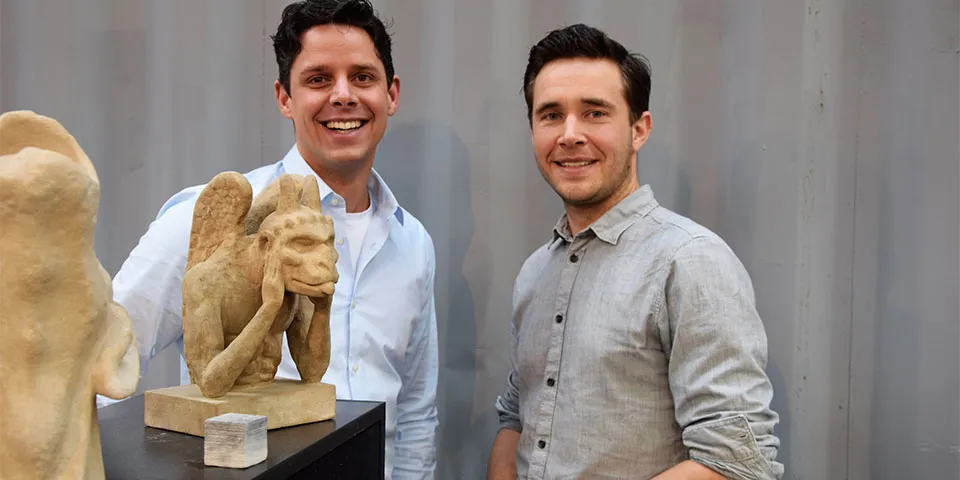
Bring Notre-Dame literally back from the ashes with 3D technology. Concr3de proposed using the burnt remains of the Paris cathedral as raw material to restore the damaged stonework using 3D printing. To develop its 3D printer, the Rotterdam-based company found and sought a full-package supplier in Festo.
In its proposal, Concr3de pointed to the lack of skilled craftspeople and original materials needed to reconstruct the destroyed sections using medieval techniques. It advocated the use of modern materials and techniques. Printing with ash from the building is not only much faster, it also adds a story to the building. The scans required for 3D reconstruction are available. In 2013, American scientist Andrew Tallon mapped the entire structure in 3D. Concr3de used one of his scans to reconstruct an ornament from Notre-Dame known as a Stryge. Using limestone powder and a binder, the company printed a 30 cm-high model of the ornament in five hours.
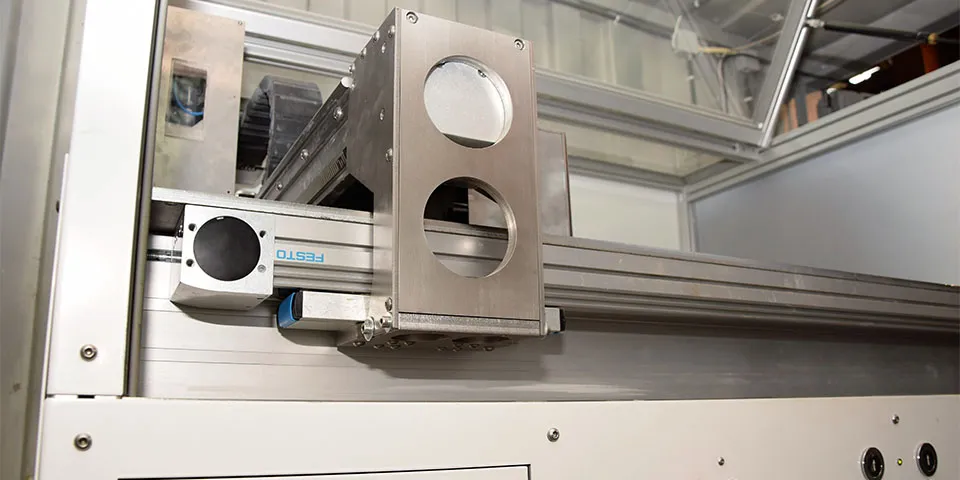
The Festo ELGA linear actuator was also mounted upside down, ensuring that no dust could get inside.
Actuator with overpressure option
Designing a machine like this was no easy task. Evert Kranendonk explains the challenges involved in building it and how Jeroen ter Brake from Festo helped overcome them. The brief was to use a linear actuator in the handling system that controls the movements of the print head. Festo optimised the prototype design and made it scalable. The actuator used, the ELGA, has an overpressure option. It also has an effective cover. That makes it ideal for the conditions inside the printer. Kranendonk says: “I’m a mechanical engineer, but I didn’t know such an actuator existed, or that it could have an overpressure option. Jeroen recognised the challenge of a dusty atmosphere and knew exactly what was needed.”
Accuracy
In addition to the ELGA, Festo supplied a controller, the Z-axis, components for the binder fluid feed and the piping. Using Concr3de’s data, Festo carried out detailed calculations on the axes, accelerations, motor and controller to establish the correct ratio between all the moments of inertia. “We opted for a servo because of its high accuracy. We’re now printing in 60-micron steps, or pixels. The chemical process continues for a certain period. We therefore had to work through all those reactions, both the stable and unstable phases, very precisely,” says Kranendonk.
Question about this story? Ask your question
Companies in this story

Keep following this
Get an email when a new story is published. No account needed.
- SubjectNews
- CompanyFesto







