












Top five robot trends for 2024
Text Valérie CouplezImage IFR
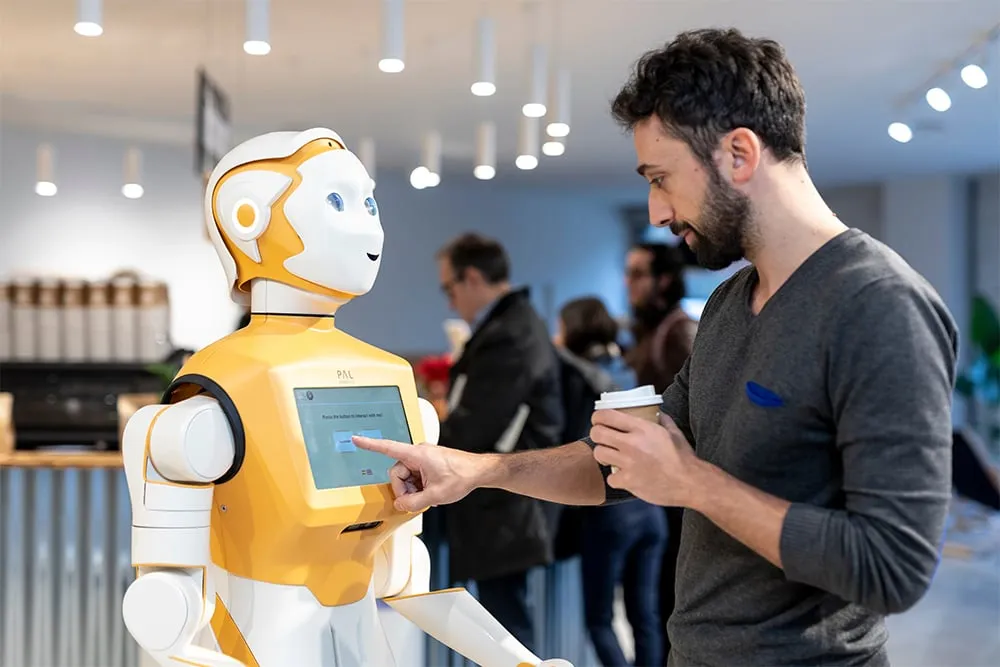
The number of robots in operation worldwide reaches new heights every year. Last year, the figure stood at
3.9 million units. Demand is set to be driven even higher in the coming years by a number of exciting technological innovations.
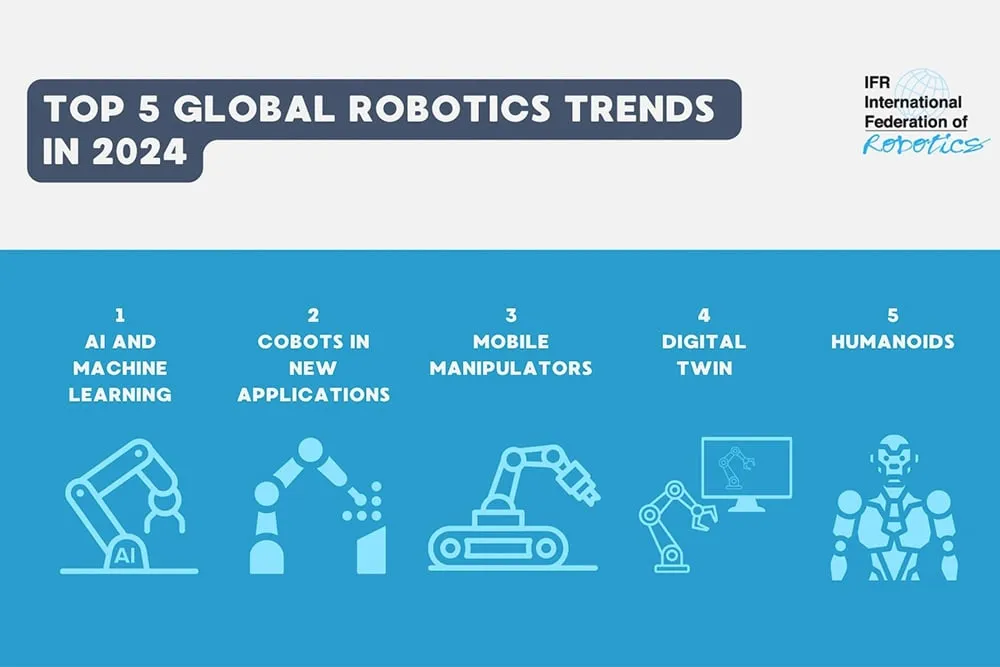
The use of artificial intelligence in robotics and automation is growing rapidly, particularly with the advent of generative AI (GenAI). This subset of AI specialises in creating something new from what it has learnt during training, and has been popularised by tools such as ChatGPT. Robot manufacturers are developing GenAI-based interfaces that allow users to programme robots more intuitively using natural language rather than code. You can now select and adjust a robot’s actions even without programming skills.
Another example is predictive AI. This can be used to analyse data on robot performance to determine the future condition of equipment. In the automotive industry, every hour of unplanned downtime is estimated to cost 1.3 million dollars. This illustrates the huge potential of predictive maintenance. Machine-learning algorithms can also analyse data from multiple robots performing the same process, helping to optimise it.
Cobots take on new applications
Human-robot collaboration remains a major trend in robotics. Thanks to rapid advances in sensors, vision technologies and smart grippers, robots can respond to changes in their surroundings in real time and work safely alongside human workers. Collaborative robot applications offer human workers a new tool to ease their workload and provide support. They can help with tasks that involve heavy lifting, repetitive movements or working in hazardous environments.
Their scope continues to expand. One recent development is the growing use of cobots for welding, driven by a shortage of skilled welders. Cobots will complement, not replace, investment in traditional industrial robots, which operate at much higher speeds and will therefore remain important for improving productivity in response to tight product margins. New competitors are also entering the market with a specific focus on cobots.
Mobile manipulators
Mobile manipulators, known as ‘MoMas’, automate material-handling tasks. They combine the mobility of robotic platforms with the dexterity of manipulator arms. This enables them to navigate complex environments and manipulate objects, which is crucial for manufacturing applications. Equipped with sensors and cameras, these robots carry out inspection and maintenance tasks on machinery and equipment. One of the key advantages of mobile manipulators is their ability to work alongside and support human workers. A shortage of skilled labour and a lack of people applying for factory jobs are likely to drive demand.
Digital twins
Digital twin technology is increasingly used as a tool to optimise the performance of a physical system by creating a virtual replica. As robots become more digitally integrated into factories, digital twins can use their real-world operational data to run simulations and predict likely outcomes. Because the twin exists purely as a computer model, it can be tested and adjusted without safety implications, while also saving costs. All experiments can be checked before the physical world itself is affected. Digital twins bridge the gap between the digital and physical worlds.
Humanoid robots
Robotics is seeing significant advances in humanoids, designed to perform a wide range of tasks in different environments. Their human-like design, with two arms and two legs, allows robots to be deployed flexibly in working environments originally designed for people. They can therefore be easily integrated into existing warehouse processes and infrastructure, for example. China’s Ministry of Industry and Information Technology (MIIT) recently published detailed targets for putting humanoids into mass production by 2025. The MIIT predicts that humanoids are likely to become a disruptive technology, comparable to computers or smartphones, that could change the way we produce goods and the way people live.
Question about this story? Ask your question
Keep following this
Get an email when a new story is published. No account needed.
- ThemeRobots on the shop floor
- SubjectMotion, gears & drives







