












Retrofit of decoiling line improves safety and performance
Text and images Siemens
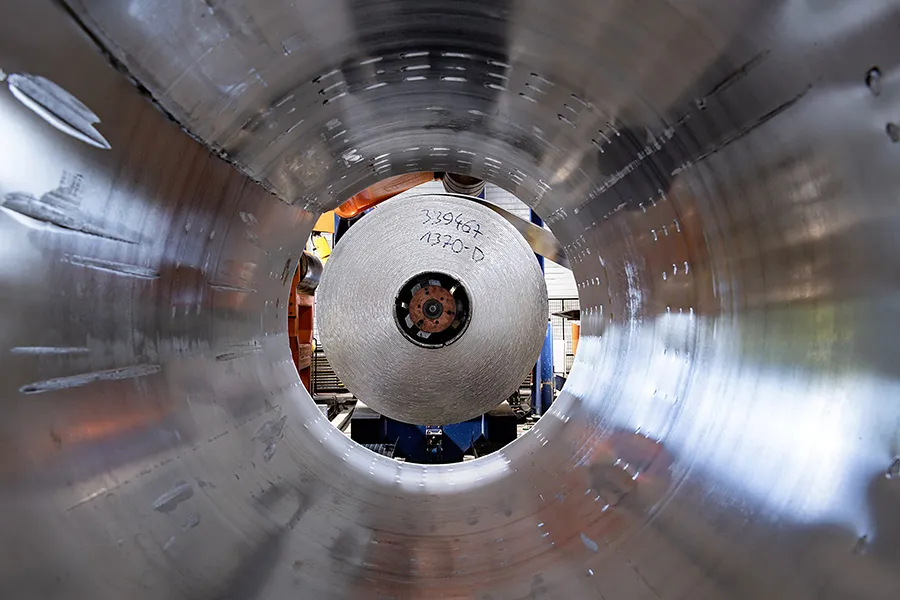
Turning coils of sheet metal into usable flat sheets is the core business of family-run Decomecc (Decoiling and Metal Cutting Company). Its crown jewel is a decoiling line capable of processing sheets of immense dimensions. It was recently retrofitted with a new Siemens electrical system. Decomecc COO Peter Vanschoenwinkel: “We now operate more economically and safely.”
If you want to build ships or storage tanks, you need large, thick sheets of metal. But the metal is supplied in large coils. To turn it into usable pieces, you have to uncoil it (decoiling), flatten the sheets (levelling) and then cut them to size. You may also want a neat hemmed edge on your sheet. Decomecc can take care of all of this.
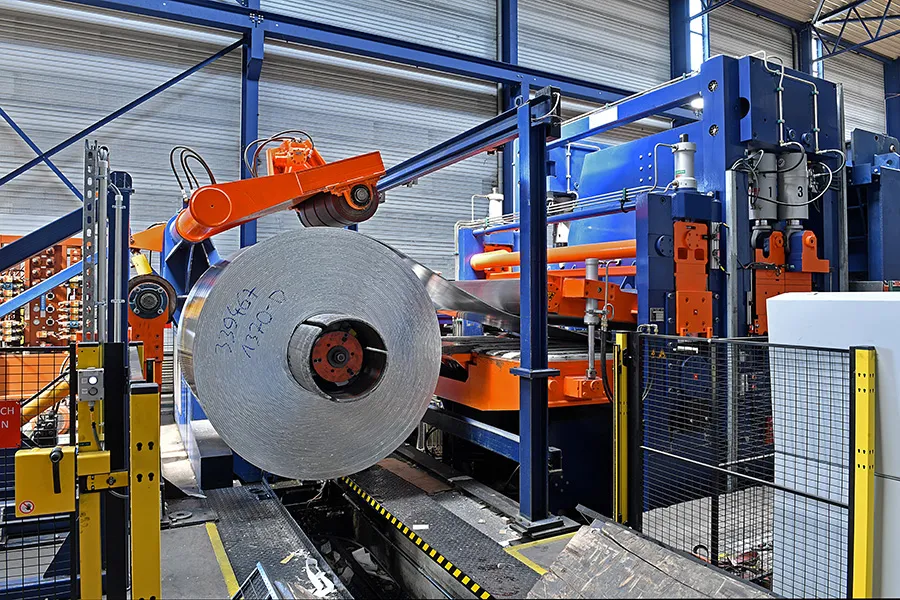
“We are a family-run service centre,” says Vanschoenwinkel. “Companies supply their coils, we process them and deliver the finished sheets back to them. We have built up considerable experience in this field. We have eleven production lines, four of which are decoiling lines. The heart of our first and largest decoiling line dates back to 1994. It can process sheets up to 20 m long, 2.6 m wide and 15 mm thick.”
Retrofit: greener and more cost-effective
The decoiling line was gradually expanded to enable it to process sheets in greater detail and to a higher standard. As a result, the installation became a collection of AC and DC motors, different controllers that did not communicate with one another, and controls in various locations around the factory. “If a component broke down, it took us a long time to find the problem. But our customers expect continuity, and we also operate seven days a week. We needed to improve.”
Decomecc went looking for a solution and turned to Siemens, which had already supplied controls for several of its other lines. Since the mechanical part of the installation was still in perfect condition, they decided on a retrofit. Siemens upgraded the controls and some of the old DC motors, and introduced a host of functional and safety upgrades. Anything that could be retained was kept. “That makes financial sense. It is also much more sustainable, because it requires fewer raw materials. And the line is out of action for less time.”
Improved ergonomics
Siemens replaced the various controllers with a single central SIMATIC S7-1500TF controller, combining all PLC and safety tasks. Complex kinematic functions, synchronisation of the various axis drives and integrated safety are now managed centrally. All the cables and motor drives are new too: Sinamics S120 for the line drives and setup motors, and Sinamics G120 for the auxiliary drives. Of the line’s 39 motors, only three were still DC motors; these were replaced with AC motors (Simotics M and S).
Jody Fissers, Motion Control project manager at Siemens: “By combining the existing motors with new drives, we saved Decomecc a considerable amount of money. We could have done the same with the three DC motors, but that would have meant using three DC drives, and maintaining old DC motors is expensive too. The AC motors are now completely maintenance-free.”
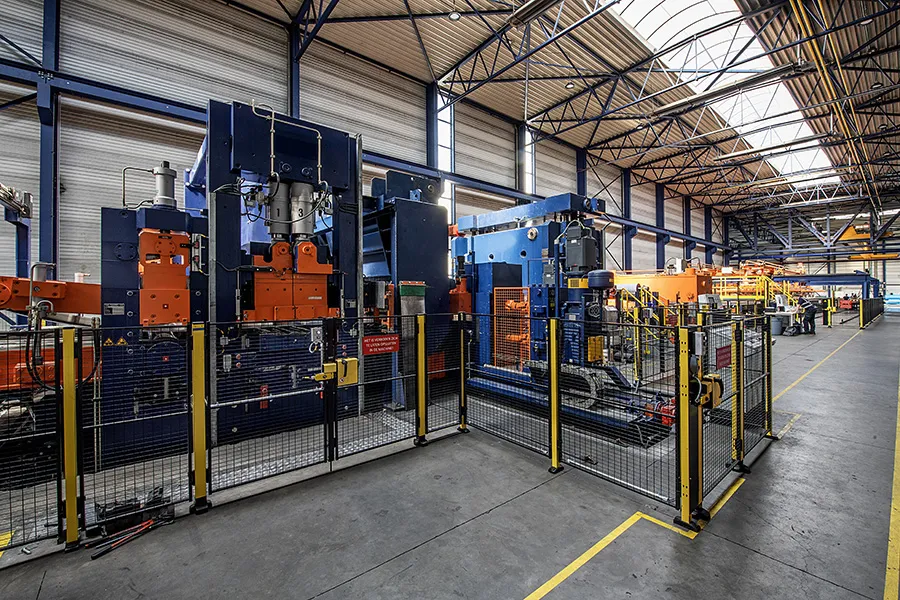
The controls are now grouped together in a new electrical room, with space for future expansion. “It has freed up a lot of space,” says Vanschoenwinkel. “The new electrical room is more efficient and ergonomic, as heat and noise are no longer released into the hall. The extra space also makes it easier to carry out visual inspections along the line. Another advantage is that the line could continue running while the new installation was being built.”
Safety and functional upgrades
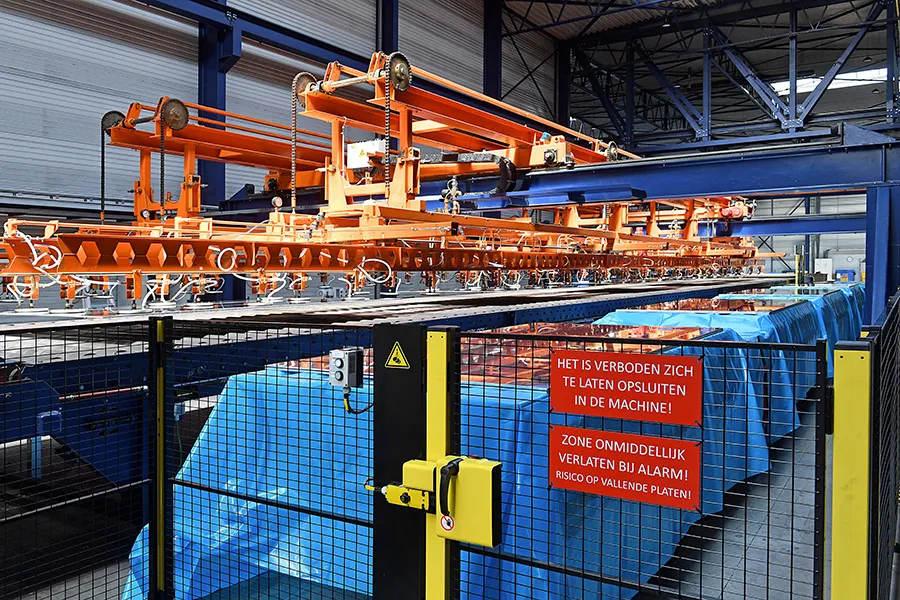
“The conversion also brings us fully into compliance with the current requirements of the Machinery Directive and Low Voltage Directive,” Vanschoenwinkel continues. “Following a risk assessment, we installed fencing where necessary. Some areas are no longer accessible, while others have been cordoned off with light curtains and light screens. We also added a number of functional upgrades. The PLC is integrated at level 2/3. This means it is connected to our ERP system, so orders are read in automatically. Previously, operators had to enter the data manually, which risked incorrect dimensions or quantities. We also print on sheets. Now that data comes directly from the server.”
Another functional upgrade was the electric paper winder. Paper is placed between the coils and has to be wound up as the metal is uncoiled. “It used to be done pneumatically, but now it is electric. The Siemens drives control it as well, so the paper tears much less often.”
Energy savings
The retrofit has reduced the installation’s electricity consumption. Fissers: “We have added an eco mode. If the installation is not in use for a set period, we switch off components. Previously, the machine consumed 40 kW when idle; now it uses just 1 to 1.5 kW. This also reduces wear on the machine.” Vanschoenwinkel adds: “In other cases, a conversion does not pay for itself. Our customers will not pay extra because we have upgraded the line. We had to do it to guarantee continuity and safety. But thanks to the substantial energy savings, the retrofit will pay for itself in the long run.”
Vanschoenwinkel is pleased with how the retrofit went. “We had planned to shut down from mid-November to mid-January. We were back up and running before Christmas. Siemens also did an excellent job with the aftercare. They were here for three weeks to ‘babysit’: making sure everything went smoothly and supporting our people with the new procedures. A retrofit of our second decoiling line is already in the pipeline. It is a pleasure to work together.” ■
A business enquiry for Siemens NV/SA? Get in touch
Companies in this story
Keep following this
Get an email when a new story is published. No account needed.
- SubjectMotion, gears & drives
- CompanySiemens NV/SA







