












Overview of optimal gearbox and industrial robot combinations

What is the optimal gearbox for your robot? In this article, we list a wide range of industrial robots and match each one to the optimal gearbox series in the Apex Dynamics product range. We explain why the gearbox is a good fit for each type of robot.
The word robot was first used by Czech writer Karel Čapek in his play R.U.R., short for Rossum’s Universal Robots. Written in 1920, the word is derived from the Czech robota, meaning ‘work’ or ‘forced labour’. In this article, we cover industrial robots only, meaning those used primarily in industry. We exclude cobots, which work alongside people, as well as robots used in surgery, the home, hospitality and other fields.
For each type of robot, we recommend an Apex Dynamics gearbox and outline its key features. In this article, we cover the following industrial robots:
- Single-belt or H-bridge
- Cartesian, linear or XYZ robot
- Single-arm, articulated-arm or robot arm
- Delta, parallel or kinematic robot
- Automatic Guided Vehicle (AGV)
- Autonomous Mobile Robots (AMR)
- SCARA robot
GEARBOX FOR A SINGLE-BELT OR H-BRIDGE ROBOT
This is a 2-axis X/Z gantry robot, consisting of a dual guide in the horizontal X plane and a vertical Z axis. The belt is fixed and tensioned at the load end. The system is driven by a rotating belt, which remains connected via several deflection points. Movement is achieved by two motors. The coordinate lies diagonally across the deflection points of the X and Z axes. This system can move small masses, making higher acceleration rates possible.
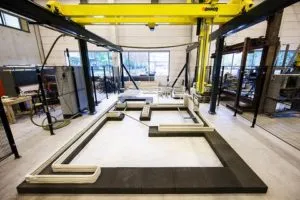
The optimal gearbox for a single-belt or H-bridge robot is from the PAII series.
The gearbox’s low mass moment of inertia enables high dynamics, while backlash has little effect on accuracy. This is a relatively simple solution, which makes this economy series a good fit.
GEARBOX FOR A CARTESIAN, LINEAR OR XYZ ROBOT
A Cartesian robot is an industrial robot whose three main axes of motion are linear, meaning they move in a straight line rather than rotate, and are perpendicular to one another. The three axes correspond to up and down, forwards and backwards, and left and right. Among other benefits, this mechanical arrangement simplifies robot arm control. It offers high reliability and precision when working in three-dimensional space. As a robot coordinate system, it is also effective for horizontal movement and stacking crates.

A standard Cartesian robot has 3 axes.
Which gearbox?
The optimal gearbox for a Cartesian, linear or XYZ robot is from the AF series.
Low backlash and high stiffness to handle greater mass moments of inertia, combined with robust bearings to withstand the high radial loads involved.
GEARBOX FOR A SINGLE-ARM, ARTICULATED-ARM OR ROBOT ARM
A robot arm is a mechanical manipulator with functionality similar to that of a human arm. It consists of a number of segments connected by joints, allowing translation and/or rotation between them. Together, these parts form a kinematic chain. The way the parts are connected and how they can move relative to one another determine the number of degrees of freedom of the robot arm.
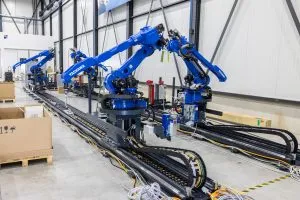
The robot arm’s tool, which enables it to perform tasks such as gripping or turning objects, is located at its end. A standalone articulated-arm robot often has 6 axes of motion. When mounted on a track, it has 7 axes.
The optimal gearbox for a single-arm, articulated-arm or robot arm is from the AH series.
High precision and accuracy, along with high torque. The gearbox has an output flange for added stiffness.
GEARBOX FOR A DELTA, PARALLEL OR KINEMATIC ROBOT
A delta robot is a 3-axis robot suited to small work areas and high-speed applications. The axes are connected by a shared joint above and below the arms to maintain force and speed. The first delta robot was invented in the early 1980s by Professor Raymond Clavel and his team at the Ecole Polytechnique Federale de Lausanne (Switzerland). A standard delta robot has 3 axes. Adding a central rotation gives it 4 axes.
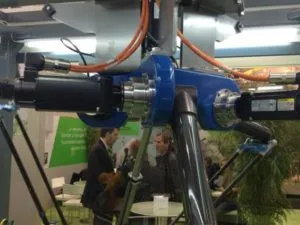
The optimal gearbox for a delta, parallel or kinematic robot is from the AP series.
Extremely low backlash to prevent following errors, combined with high torque and low mass moment of inertia for high-dynamic control.
GEARBOX FOR AN AUTOMATIC GUIDED VEHICLE (AGV)
An automated guided vehicle is a mobile robot that uses markers, wires, magnets, lasers or other instruments for navigation. AGVs are widely used in industrial applications to transport materials around factories and depots. Since the late 20th century, they have become increasingly important in the logistics sector.
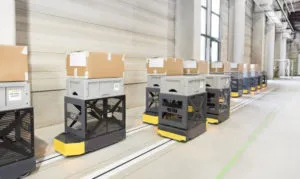
The optimal gearbox for an Automatic Guided Vehicle (AGV) is from the PD/PL series.
As this application does not require very high accuracy and has low dynamics, medium accuracy is sufficient. (Markers allow the vehicle to correct its course.) The large bearings can withstand high radial loads.
GEARBOX FOR AUTONOMOUS MOBILE ROBOTS (AMR)
An autonomous mobile robot is a type of robot that can understand its surroundings and move through them independently. AMRs differ from their predecessors, automated guided vehicles (AGVs), which rely on tracks or predefined paths and often require operator supervision.
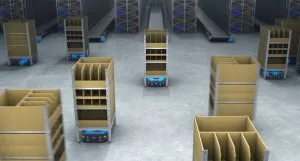
AMRs use a sophisticated combination of sensors, artificial intelligence, machine learning and computer-based route planning to interpret their surroundings and navigate through them without relying on wired power. Equipped with cameras and sensors, AMRs use a navigation technique such as collision avoidance to slow down, stop or change course around an object if they encounter an unexpected obstacle while navigating, such as a fallen crate or a crowd. They then continue with their task.
The optimal gearbox for an Autonomous Mobile Robot (AMR) is from the GL series.
As accuracy requirements are higher than for an AGV, we recommend the GL series for its high accuracy, ability to withstand high radial loads and start-up torque compensator. This causes the output pulley to rotate in the opposite direction to the motor, giving the drive more controlled movement.
GEARBOX FOR A SCARA ROBOT
SCARA is a type of industrial robot. The acronym stands for Selective Compliance Assembly Robot Arm or Selective Compliance Articulated Robot Arm. Thanks to its parallel axis orientation, the SCARA arm is slightly flexible in the X-Y direction but rigid in the Z direction, hence the term ‘selective compliance’. This is beneficial for many types of assembly work, for example inserting a round pin into a round hole without jamming. The SCARA’s second defining feature is its articulated, two-joint arm arrangement, similar to a human arm, hence the commonly used term ‘articulated’. This allows the arm to extend into tight spaces and then retract or ‘fold up’. This is useful for moving parts from one cell to another or loading and unloading enclosed process stations.
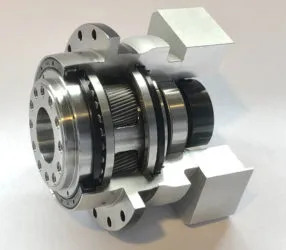
SCARAs are generally faster than comparable Cartesian robot systems. Their single pedestal mounting requires little floor space and makes for easy, unobstructed installation. However, SCARAs can be more expensive than comparable Cartesian systems, and their control software requires inverse kinematics for linearly interpolated movements. This software is usually supplied with the SCARA and is generally transparent to the end user.
The optimal gearbox for a SCARA robot is from the AP series.
Extremely low backlash for accuracy, combined with low mass moment of inertia for high-dynamic control.
This overview of robot types is undoubtedly not exhaustive, and there are many sub-variants and unusual designs. Even so, it should be clear that with its 69 product series, Apex Dynamics always has a suitable solution. Our specialists will be happy to advise you on the right gearbox for your application. Feel free to contact us.
Question about this story? Ask your question
Companies in this story
Keep following this
Get an email when a new story is published. No account needed.
- ThemeMotion with less energy
- SubjectMotion, gears & drives
- CompanyApex Dynamics







