












Optimise a drive in 60 seconds
Machines perform at their best when the drives are perfectly matched to the drive train. This ensures that high-quality products are produced at the highest machine cycle speed, with a minimum number of production errors.
To achieve this, the control loop in the drive controller is configured specifically for the machine. Until now, a drive specialist needed several hours to carry out this task during commissioning. The time required for this manual adjustment depended on the complexity of the motor’s control loop. Now, however, this adjustment can be carried out more quickly, and more effectively.
Highly precise tuning of the drive’s control loop is a basic requirement in many machine applications, for example assembly robots, storage & retrieval machines (SRM) and packaging machines. It is the only way to achieve competitive machine performance. Achieving this precise tuning requires the drive specialist to invest a great deal of time during commissioning. Using Lenze’s auto-tuning function has significantly reduced commissioning time across a wide range of applications.
The conventional approach
The physical models commonly used to represent a machine’s motor control loop are of limited practical use when it comes to optimally setting the control loop of the drive axis. This is because the behaviour of a machine’s physical model differs from that of the actual machine. At present, a drive specialist optimises the control loop settings by carrying out a series of tests on the actual machine. The Ziegler/Nichols oscillation method, dating from 1943, is often used to optimise the control loop. It is easy to apply, does not rely on a model, and delivers robust control performance.
Automating control loop optimisation
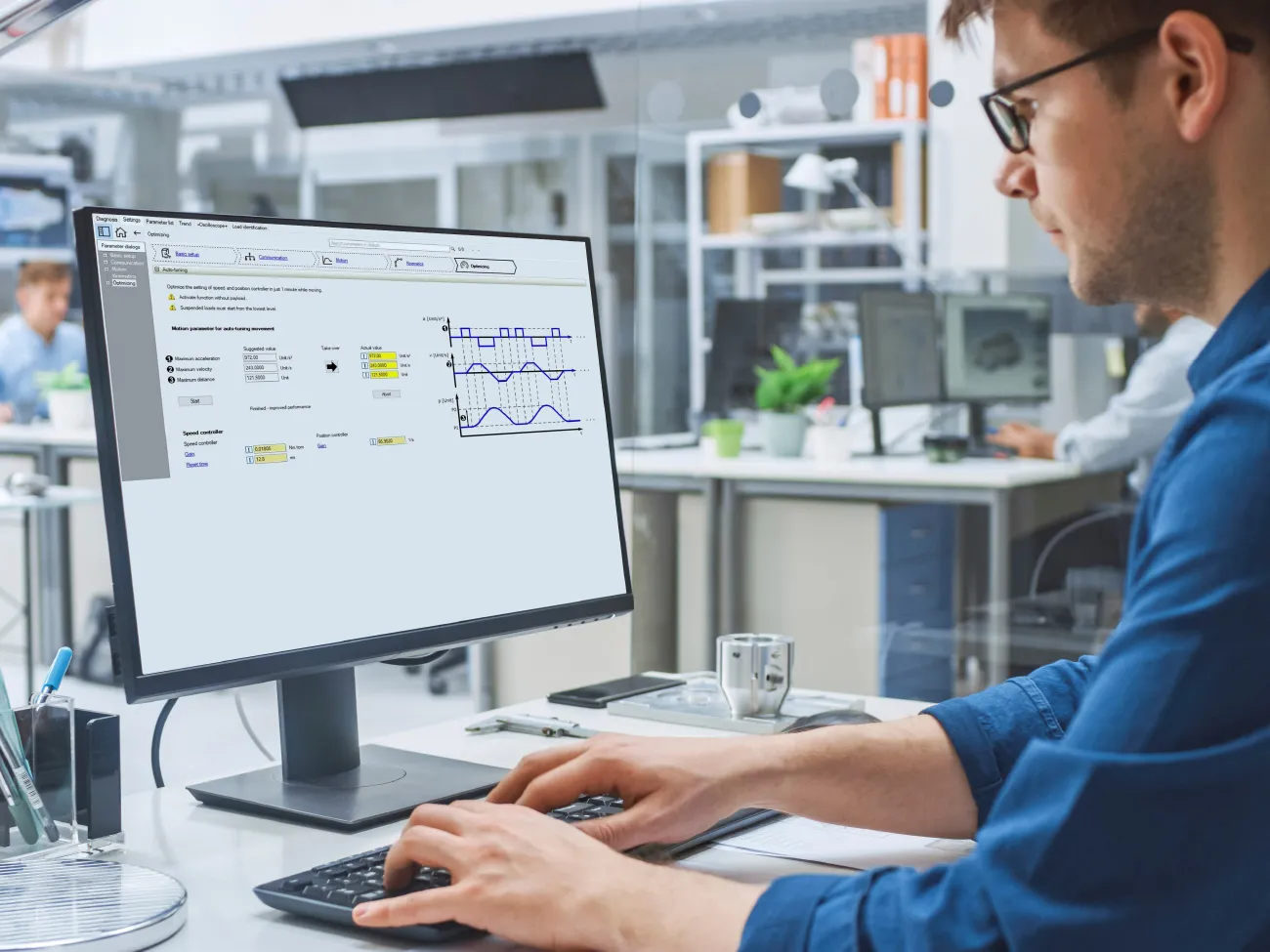
Lenze has now automated the measurement of the motor control loop and the setting of its control loop parameters for Lenze i-series servo drives, significantly simplifying the process. The method is integrated into Lenze auto-tuning. No additional measurement components are needed apart from the servo drive, because during auto-tuning the drive itself acts as the sensor, using the actual values from the position encoder and motor current. Once auto-tuning is complete, the control loop parameter settings are calculated and saved in the controller configuration. The existing physical motor control loop is measured automatically and quickly, and precisely adjusted to the actual machine. Errors that used to occur because of model deviations or during manual adjustment are avoided. This procedure saves time during commissioning, is robust, and delivers reproducible results and optimum machine performance. The auto-tuning function works reliably and safely even with complex control loop challenges, such as gear backlash or variable loads.
Auto-tuning: fast, reliable and safe
The Lenze auto-tuning function can be run using the Lenze tools EASY Starter and PLC Designer. Particular care has been taken to make it easy to operate and provide clear feedback, so that commissioning engineers can use these functions even without specialist knowledge. Feedback from Lenze customers who have already used the process in their machines has been consistently positive. In particular, they highlighted the simple, robust principle and the enormous speed of optimisation as major advantages over the previous manual procedure. The fact that machine output could be improved as well as cycle times also led to a high level of satisfaction. The auto-tuning function has been available since Hannover Messe 2021. Auto-tuning can be run on all i950 and i700 servo drives sold since then. Devices Servo drives supplied before then can be upgraded with the auto-tuning function via a firmware update.
Question about this story? Ask your question
Companies in this story


Keep following this
Get an email when a new story is published. No account needed.
- ThemeMotion with less energy
- SubjectMotion, gears & drives
- CompanyLenze BV
- CompanyHANNOVER MESSE







