












Integrating components into cobot software
Making life easier for the integrator
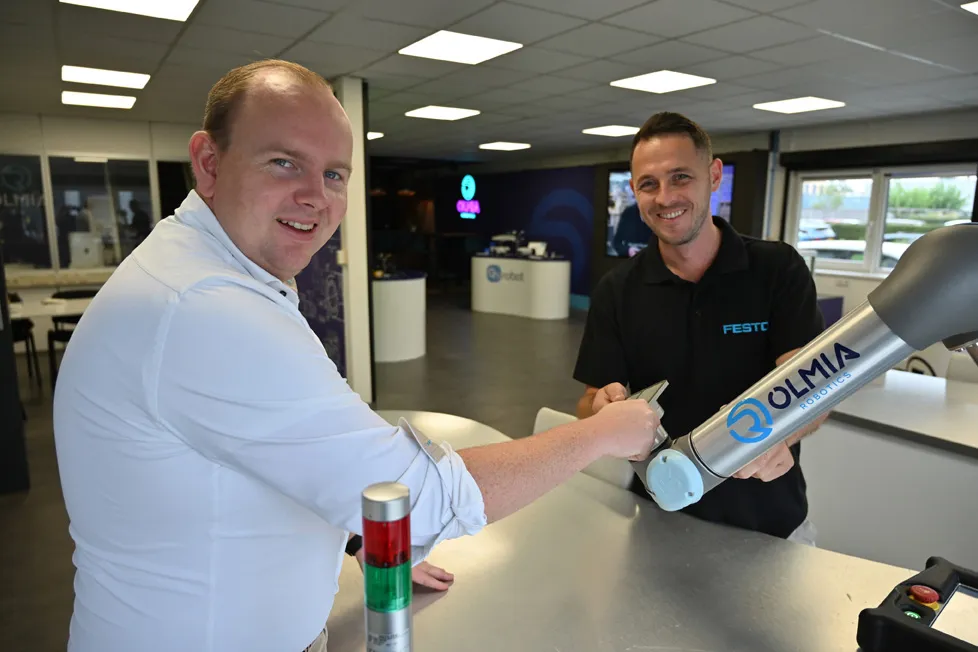
If, as a supplier, you want to take care of everything from A to Z, how useful is it to have an interface that lets products from different manufacturers communicate with one another? In this case, Festo servo solutions with Universal Robots cobots. Olmia Robotics is that supplier, with making things easier for customers as its core mission.
When you use a robot arm, you want to automate a specific task. It is often very useful to have an external movement work in tandem with the robot arm. This could be a linear or rotary movement coordinated with the robot arm’s movement. How useful would it be to control that external movement directly from the robot’s programme? So-called URCaps have been developed for Universal Robots. These Universal Robots Capabilities, or URCaps for short, let you add screens, templates and functions that are not included in the robot’s standard control programme. They are made available in the same way as an app on your smartphone. Jan-Willem Addink of Olmia Robotics explains their added value, as well as the collaboration with Festo.
Customer needs
“At Olmia Robotics, we always start with the customer’s challenge. That challenge often stems from staff shortages or a desire to automate heavy or monotonous work. We are experts in cobots, robots that can work in the same space as people or even collaborate with them without the need for guarding.” A cobot is designed to detect unsafe situations and respond by slowing down or stopping completely. Addink says enquiries often come in with few details. “We then carry out a production assessment and provide an initial proposal with a budget, after which the customer gives us the go-ahead or decides not to proceed. The next step is to develop a proof of concept, because naturally the customer wants to see whether and how something works before making the investment. Then the actual engineering phase begins, and that is when we get in touch with Festo.”
Palletising
Most projects come from the packaging industry. Setting up, packing and palletising boxes is often the first step towards automation with robots. “At a printing company in Sneek, they use as many as a hundred different types of boxes and trays. Some are sealed with tape, while others are folding cartons or open drawers without lids, so vacuum grippers are not an option for handling them. The weight of the full boxes also varies from three to twenty kilos.”
Engineering, testing and implementation, including assembly and commissioning, are carried out at the Tiel site. “We also have training rooms here where we can train operators and maintenance staff. We also get questions about what else the robot arm can do, for example applying labels and inspecting the packaging. We can then provide programming training so that users can configure things themselves. Of course, this also brings CE marking and risk assessment into the picture, so proper instruction is essential.”
A head start
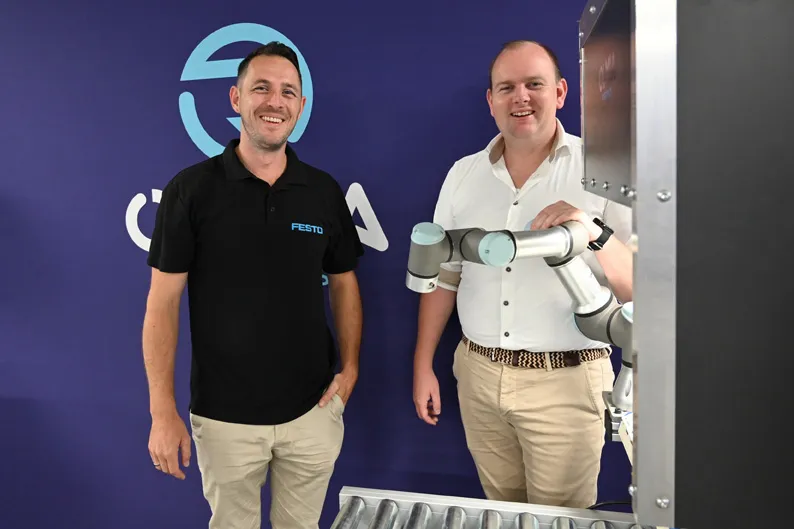
Eight years ago, Olmia was one of the first companies in the Netherlands to focus exclusively on cobots. This gave it a substantial head start over the competition. “The market has grown enormously in recent years. We are brand-independent. We started with Universal Robots, but over the years we have added two other brands so that we can provide the best solution for every requirement. The best solution and the best quality are what matter most to us. Our experience means we can genuinely take care of everything.”
Addink has noticed a clear shift in demand. “At first, customers would buy an arm and a gripper themselves and set about finding out how to get the most out of them. But these days, they simply don’t have the capacity for that, so they come to us for a complete solution. And that’s where we bring Festo in.”
Collaboration
The two companies had crossed paths several times on projects, and Olmia had always used Festo products, but at the time there was no active collaboration. “Festo is a company that always showcases new initiatives and innovations at trade fairs, so we kept a close eye on them because their innovations are a wonderful source of inspiration. We had previously worked together on a project that involved integrating a gripper developed by Festo. That prompted us to get in touch more closely. Festo’s Martin de Deyne came to visit us and explain more about the options and how they work. It was a very good discussion, with lots of questions on both sides. Then came the project at Koninklijke Drukkerij de Vries in Sneek, where the gripper posed a real challenge.
Consulting an expert
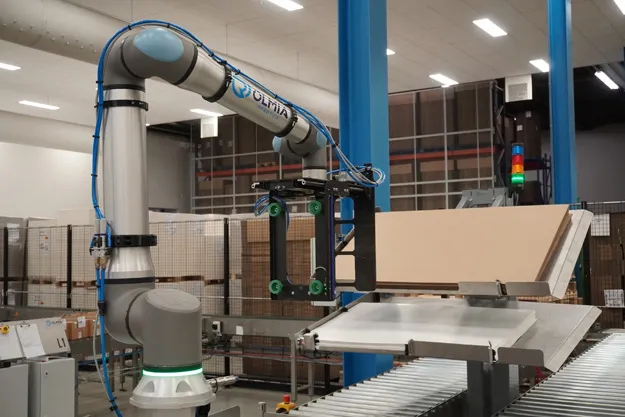
Olmia’s Luuk van Welzen contacted Martin de Deyne to discuss ideas with a Festo expert on hand. “Festo’s people know their products inside out, and it was very useful to talk things through with them. The final solution is a lightweight carbon gripper. The motor and drive stayed well within spec. The maximum lifting capacity is now twenty-five kilos, which is more than enough for this customer.”
When you can use a vacuum gripper, the weight of the gripper is not an issue. But in this case, the best solution was a clamp that also had to open to different widths. That requires technology that needs to be actuated, which adds weight. “If you always needed the same stroke, pneumatics would do the job. But because you need to handle different products here, another solution was needed. We were looking for a lightweight gripper with enough clamping force to stop the product slipping out. It was ultimately developed specifically for this project.”
Success
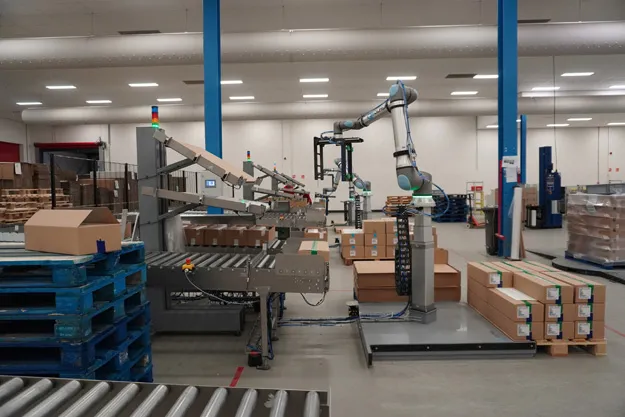
The customer clearly took its time before awarding the contract, as the way the project was commissioned shows. “We received the enquiry via chat. At the time, the customer was unknown to us. Several companies were invited to put forward an idea. We tested our solution here in Tiel, and our knowledge and experience gave us confidence in a good result. We delivered on that promise. The process manager was very enthusiastic!” The people on the shop floor have also come round to the idea. “We often see people on the shop floor approach automation with scepticism at first. But after training on how the system works and what to do, everyone is now enthusiastic. In fact, we are already looking at the next steps!” The cobot does the work of two FTEs. “That doesn’t mean two people have lost their jobs. It means they can do more enjoyable work. There is a staff shortage, after all, so automating tasks does not mean you have to lay people off. Repetitive work is the easiest to automate, but it is often the least enjoyable too, so employees simply benefit.” The solution now in place serves six fixed lines in the printing company. The next step is to look at a movable solution that can be deployed even more flexibly.
URCap
The URCap has made an important contribution to this solution. “The gripper is very easy to control. You often need an intermediate step and have to programme or write software, but that isn’t necessary now. You simply enter parameters during programming, and the possibilities are endless, with millimetre-level precision. The real differentiator here is how easy it is for the user. This URCap makes it very easy to integrate Festo solutions into programmes. For this customer, we built a separate layer on top of the URCap so that the customer’s input is translated directly into commands for the drive. That layer, a template, means the customer can create new patterns directly and very simply.” According to Addink, it is not only very easy for the user. The biggest benefit is for the system integrator, who in most cases configures the URCap for the end user.
Expansion
A new project bringing the two companies together involves modifying an existing standard solution for an end user. “The end user had a kit designed, but it now needed to be slightly larger, with a longer slide for greater reach. The cobot has to serve six stations that are not in a line, so it needs to move between them. That would be a costly modification, so we contacted Martin at Festo straight away to ask about the options. Festo slides can be ordered to size and controlled using the URCap. This makes them very attractive in terms of cost, as well as highly flexible to configure. That’s good for the integrator, because they always want to be able to make adjustments themselves,” Addink laughs. Festo’s slides turned out to be not only cheaper and more flexible, but also much faster than the slide in the existing setup. “Festo’s support is always very quick and good too,” he says. “Martin usually gets back to us within a few hours. We’re very satisfied: our questions are answered quickly and well. The contact is always very pleasant. We are very positive about the collaboration, and you really get the sense that they want to be more than a supplier and work together on projects. Both our engineers and Festo’s engineers are very positive in their interactions.” He gives the example of how the weight of the tooling is crucial with a cobot. “So we often have to look at the weight of the materials used in a solution. They really looked into that in depth.”
A differentiator
This URCap was developed specifically for Festo drives, making it a truly distinctive tool. The Festo URCap works not only with electric grippers, but can be used with any Festo gripper, motor or actuator. “The advantage of URCaps is that they make components very easy to control. Festo is well ahead of the rest in this respect. There is a lot of competition, but they really are an example to others!”
A business enquiry for Festo? Get in touch
Companies in this story

Keep following this
Get an email when a new story is published. No account needed.
- ThemeFrom design to flexible machine
- SubjectMotion, gears & drives
- CompanyFesto







