












Helping customers move towards Industry 4.0
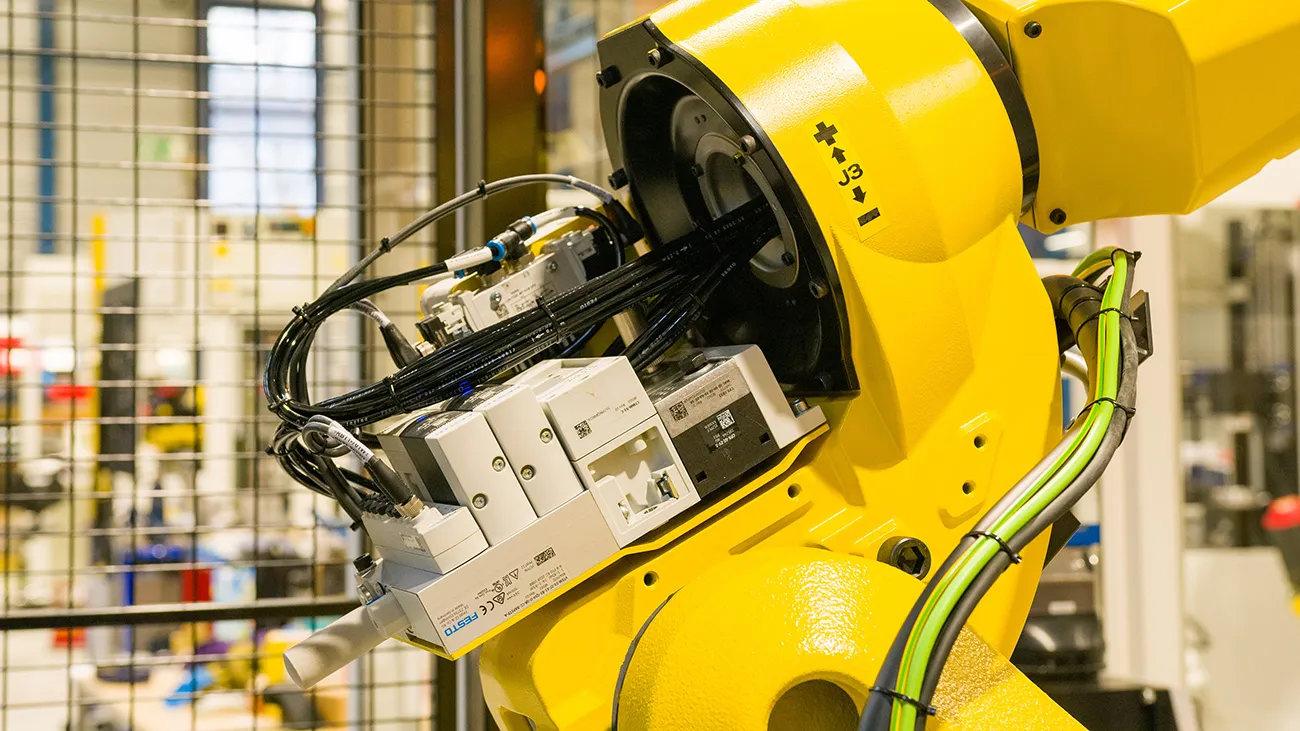
With the aim of taking its automation solutions for CNC machines to the level of Industry 4.0 and beyond, Cellro has taken a close look at the hardware and software of its systems. A major transformation followed, with Festo’s Motion Terminal playing a key role.
Machining companies do not typically turn to automation and digitalisation. Cellro managing director Arnoud de Kuijper has seen this too: “Adoption of Industry 4.0 is still relatively low in those circles. Our mission is to make innovation possible for manufacturing companies.” How can they best be supported? “You have to offer the flexibility customers need, but you also don’t want to reinvent the wheel for every job,” he explains. “So we need standards and a configure-to-order model with lots of variables. That’s the basis for how we now work with robotics, grippers and the rest of our technology.”
Long stroke
As the range of products that Cellro’s systems need to handle continues to grow, changeover times are becoming increasingly important. “When you switch to a different product, you often need a different gripper. If we can optimise and minimise changeovers, that brings major benefits to our customers.”
A long-stroke gripper that can automatically select the required grip size across its entire range is a key part of Cellro’s solution. “It may not cover a customer’s entire product range,” De Kuijper admits, “but it does give you the flexibility to process, for example, a whole product series with a single gripper.”
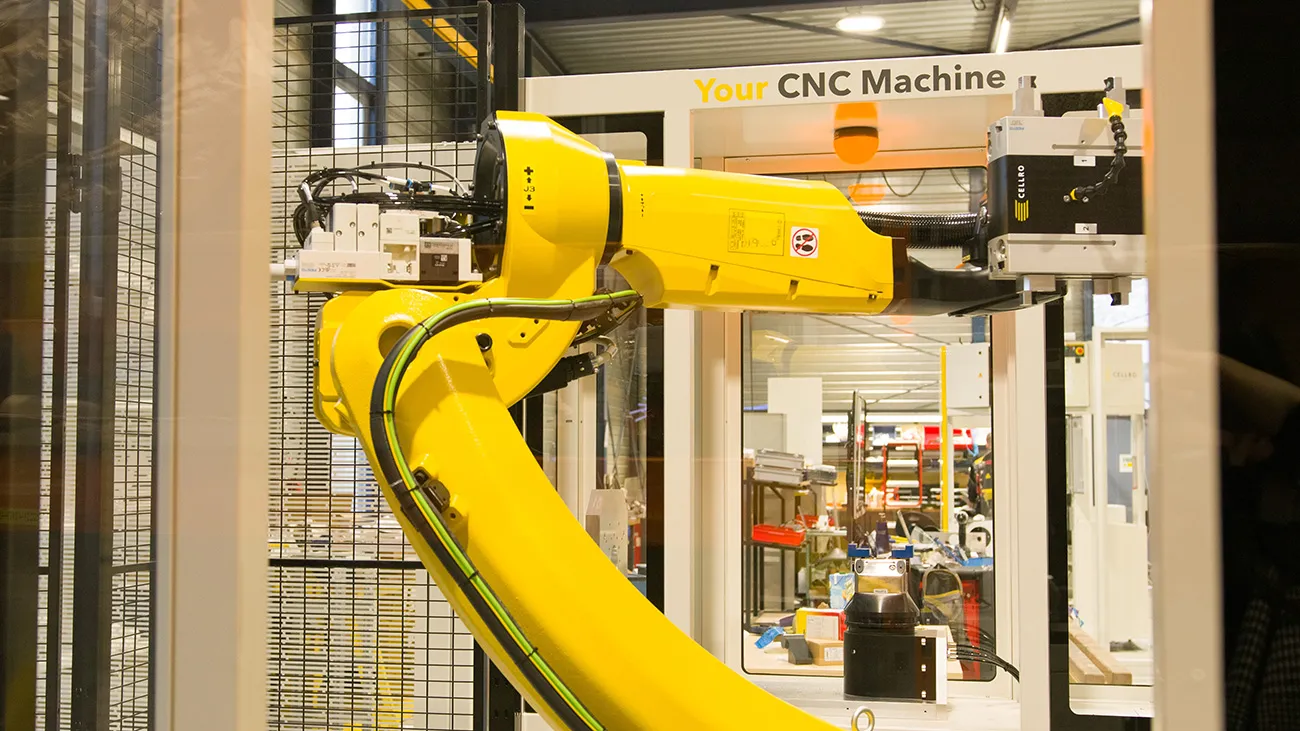
Controlling the long-stroke gripper was not without its challenges. Mounting the valve terminal at the elbow proved to be the ideal compromise. At the wrist, close to the gripper, it gets in the way and adds mass at the point that moves the most. However, if the terminal were mounted at the base of the robot arm, all the cables and lines would pose a challenge, as they would have to run all the way through the moving, rotating arm.
Motion Terminal
The long-stroke gripper Cellro had in mind offers far more functionality. It must not only be able to open and close, but also position its fingers with great precision, for example. “We want to be able to do that to the nearest millimetre,” says De Kuijper.
Cellro therefore called on motion partner Festo for help. Festo suggested replacing its standard valve terminal with the Motion Terminal. “The system is app-based, with pre-programmed functions that let you define all kinds of movements,” De Kuijper explains. “Sensors integrated into the gripper head provide feedback on the position of the jaws, allowing the Motion Terminal to control the movement very precisely.”
Cellro can now position the gripper fingers to the nearest millimetre. This allows the head to pick up objects that are close together. That may sound trivial, but it means a customer can store products closer together and therefore increase production capacity. “We can also set the force and speed very precisely,” De Kuijper continues. “You only need to set a few parameters, and the Motion Terminal takes care of the actual movements. This allows you to generate special motion profiles suited to the objects you want to pick up.”
Adapting to changing conditions
The Motion Terminal can adapt to changing conditions. For example, if a small leak develops between the valve and the gripper, it can be detected by internal pressure sensors. The Motion Terminal then assesses the leak and can compensate for it. The same happens if friction in the mechanics increases or decreases over time. The Motion Terminal’s closed-loop control smooths out these fluctuations.
“The Motion Terminal gives us valuable information that we can use for predictive maintenance,” says De Kuijper. “That fits perfectly with our ambition to move towards full digitalisation. To do that, you need a wealth of information and intelligence. The Motion Terminal is an important step in that direction, and we can build on it. I’m sure we’ll still be on the right track in a few years’ time,” De Kuijper concludes.
Question about this story? Ask your question
Companies in this story

Keep following this
Get an email when a new story is published. No account needed.
- ThemeData from shop floor to decision
- SubjectMotion, gears & drives
- CompanyFesto







