












From sample to shake
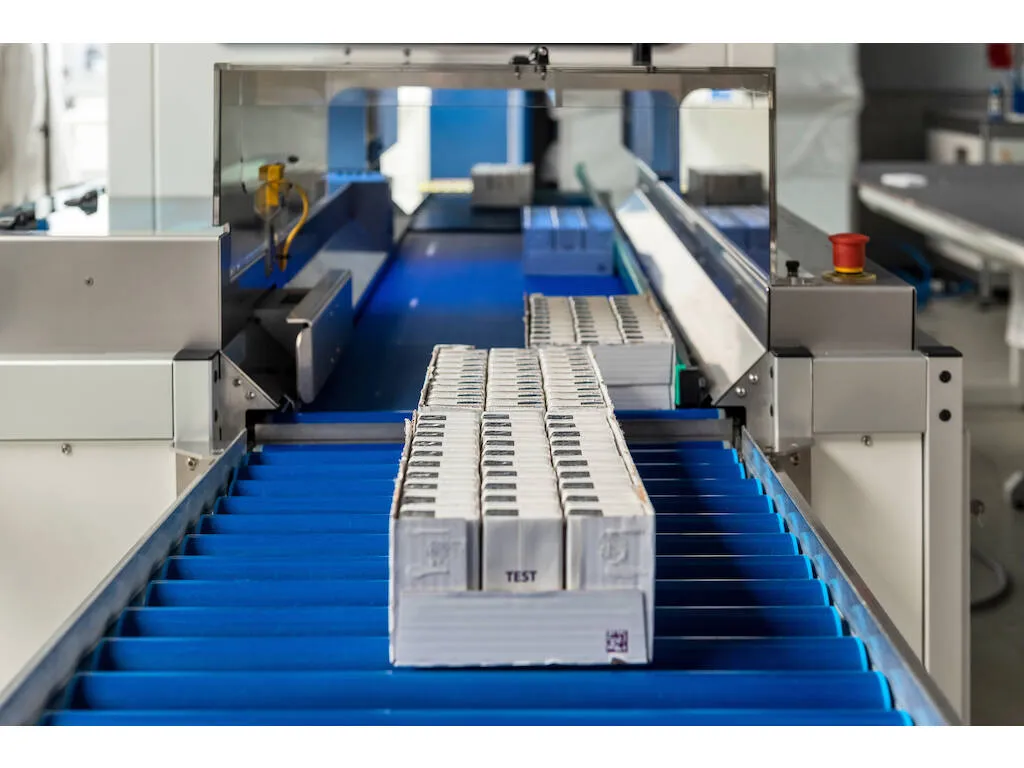
Dairy products are susceptible to contamination. By integrating laboratory techniques into an industrial machine, Synchron Lab Automation enables its customers to carry out this work in-line and automatically. A wide range of Festo components has been used to ensure that all movements and processes run reliably and safely, from a simple cylinder to servo motors and drives, and the VTOI dosing head. The entire system is controlled by the CPX-E control system.
Software developer Synchron Lab Automation, based in Etten-Leur, has specialised in laboratory automation over the past few decades. Owner and managing director Derk Wilten says: “Our standard pipetting platform no longer always met customer requirements, so we developed an industrial solution in which laboratory automation is integrated into a modular industrial machine. To achieve this, we developed a software platform that can control virtually everything. This established and proven foundation enables us to develop customised machines relatively quickly, with a short time to market.”
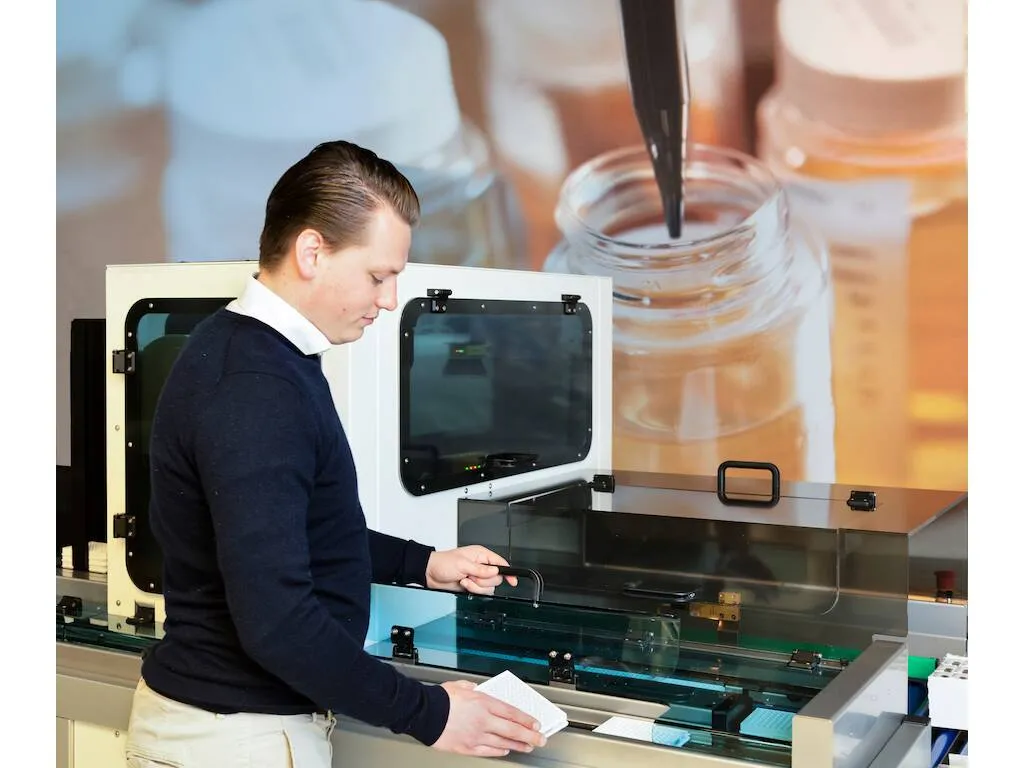
Dairy sampling machine
A great example is the sampling machine, which takes samples from dairy products. Glenn Dukel, technical engineer at Synchron Lab Automation, says: “Dairy products cannot be sold until the batch has been tested. Samples are therefore taken and checked for contamination or other substances. At larger dairy plants, the volumes involved are substantial, so automation makes sense. It helps reduce or even partly eliminate the many manual operations and the associated human errors.” Synchron’s sampling machine is an industrial solution that integrates laboratory technology. Open boxes or crates containing packaged dairy products are loaded at one end of the machine. A conveyor carries them into the machine, where a barcode reader first identifies the product and the relevant parameters. A camera scans the configuration from above to determine the exact position of the packages. If they are positioned so incorrectly that they could cause problems during sampling, they are automatically ejected.
Taking samples
Using the same image, the software determines exactly where the sampling needles need to take their samples. This is a complex step, as each needle must be positioned individually and precisely. The solution is a stepper motor with an integrated CANopen bus controller, with a minimum centre-to-centre distance of 9 mm between the needles. Dukel says: “This uses a Festo servo-driven Z-axis, with the CMMT controller in a master-slave configuration ensuring that the set of four needles moves downwards precisely and simultaneously. The ‘pierce’ needles we developed in-house are strong enough to pierce the caps with force. They are also designed to sample a wide range of package configurations. We have also developed a solution to push any packaging material off the needles if it gets stuck. The needles are, of course, cleaned after every sampling operation to prevent contamination.”
Dosing reagents
After sampling, the needles carrying up to eight samples at a time move to the so-called microtitre plate, which has space for 96 (8 x 12) samples. The plate is removed from the destacker during sampling and scanned. It is then transported towards the pipetting needles. Dukel says: “Two opposing transport movements take place continuously in the machine: the microtitre plate moves from the destacker to the centre, while the boxes of products move from the other side towards the centre, where the pipetting station is located.” Once the sample has been deposited precisely into the designated wells of the microtitre plate, two types of reagent are added. This is done using two Festo VTOI eight-channel dosing heads, specially developed for these microtitre plates. Each microtitre plate is then shaken for a pre-programmed period by a mechanism driven by an EMMT-AS servo motor. This ensures that the sample from the package is thoroughly mixed with the reagents, allowing any reaction to take place.
Control
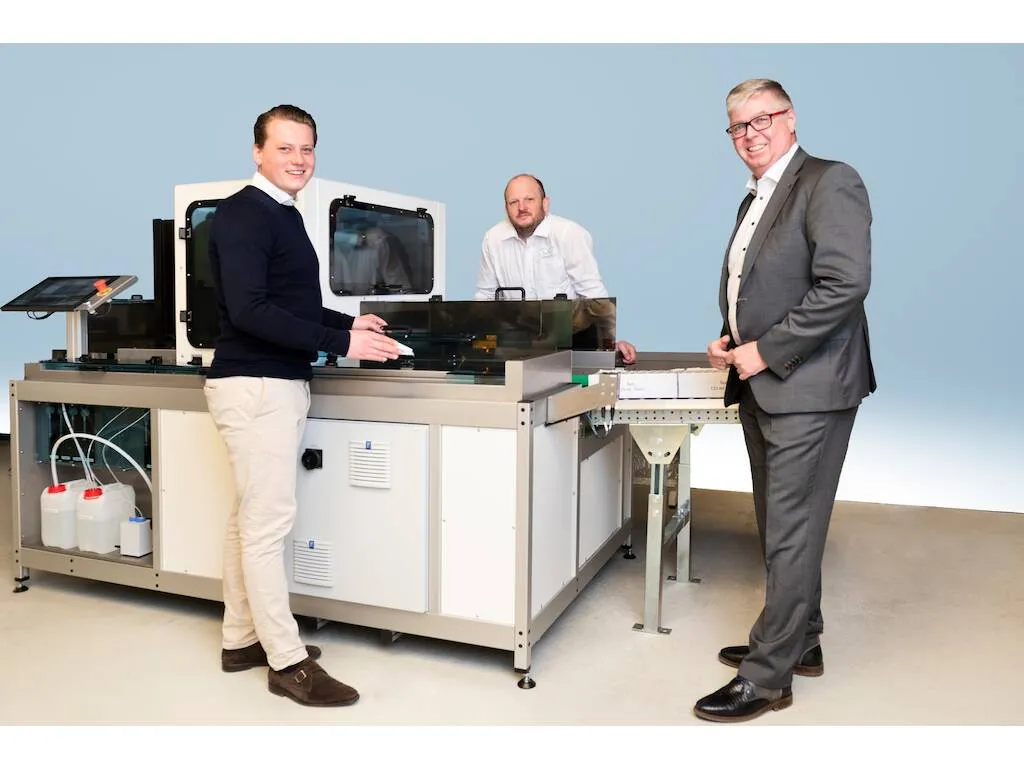
The finished microtitre plate containing the mixed sample is removed manually and taken to the analysis instrument for further processing. The boxes containing the sampled packages are also ejected. Dukel says: “Everything is automatic, with 96 samples processed at a time.” The machine performs many other movements in addition to those mentioned. These include ensuring reliable transport (stoppers, pushers and sliders), bridging differences in height (lift) and securing various components during processing (clamps). All these movements and forces are controlled centrally via Festo’s CPX-E automation system, the heart of the control system. Dukel says: “The CPX-E handles the machine functions and is linked to our software, which provides the flexibility to process the many products and their associated sampling parameters.”
Working with Festo
In addition to using Festo components, Synchron Lab Automation has also drawn extensively on the motion specialist’s expertise. Wilten says: “Festo is an important partner in developing these machines. First, it has a very extensive portfolio, so we can turn to them with any questions about drive and control technology. Our focus is on developing the overarching software, rather than engineering the hardware. Festo provides excellent support in this area. In addition, Festo supplies both components and support worldwide. As a global supplier, we need this to be able to guarantee that repairs can be carried out quickly and faults resolved at these locations too.”
Question about this story? Ask your question
Companies in this story

Keep following this
Get an email when a new story is published. No account needed.
- SubjectMotion, gears & drives
- CompanyFesto







