












From Munich to Cairo without lubrication: sliding instead of rolling with igus’s durable linear carriage
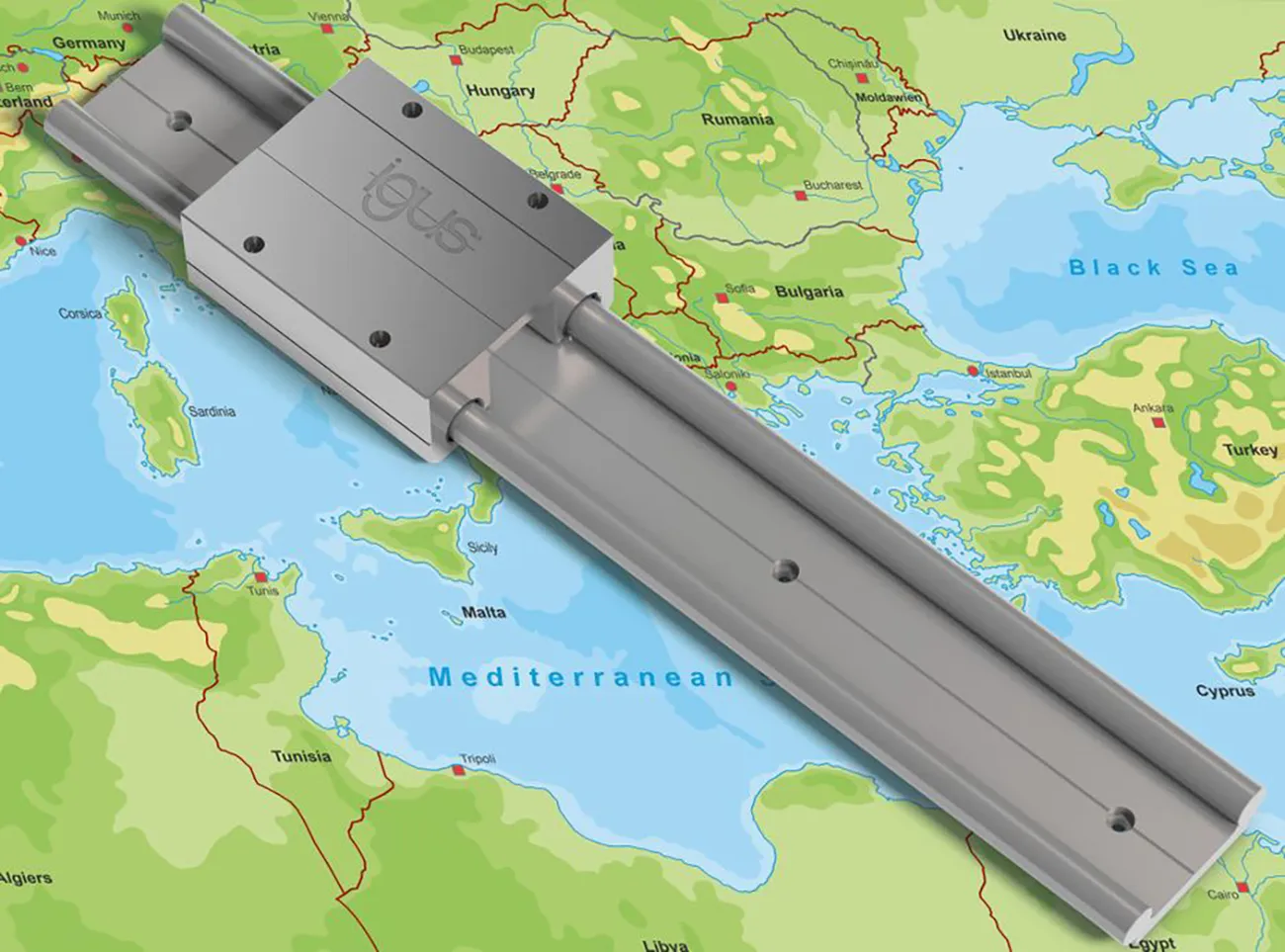
With the T20 from the drylin W series, igus is launching a new linear carriage with the same dimensions as most conventional carriages with ball bearings. This makes a quick 1:1 replacement possible, with no structural modifications. Using drylin W means applications benefit from lubrication-free operation, a long service life, less cleaning and lower weight.
The T20 from the drylin W series makes it even easier to switch from ball bearing guides to sliding linear guides
Whether it is a cabinet sliding door, the seat adjustment on fitness equipment or the bottle dispenser in a drinks vending machine, more and more designers are moving away from conventional ball bearing systems for linear guidance and relying on linear systems from igus’s drylin W series. It is a paradigm shift, driven by the fact that the carriage does not roll but glides very quietly along the rail on high-performance plastic liners. “Durability, freedom from maintenance and lubrication, hygiene and low weight: the benefits of drylin W are so significant that more and more designers are even making complex technical changes to their machines to switch over,” says Michael Hornung, Product Manager for drylin linear technology at igus. “That is an effort we would like to save our designers in future.” The company is therefore launching the new T20 linear carriage. It is a robust, corrosion-resistant aluminium monoblock with iglidur J200 linear plain bearing liners, offering an exceptionally long service life on hard-anodised aluminium rails.
Mounting dimensions identical to those of ball bearing guides
Visually, the T20 linear carriage resembles a conventional carriage with ball bearing rollers. “The carriage has the same dimensions as most ball bearing guides on the market, with the same system height and identical mounting dimensions. This makes it possible to replace the carriage directly on a 1:1 basis, making it easy to switch from rolling to sliding guidance without any design changes.” Until now, similarly quick replacement with linear carriages of the same dimensions was only possible with the drylin T system. In that case, however, users were limited to a T guide rail. “The new T20 linear carriage makes the move from ball bearing guides to lubrication-free, maintenance-free linear technology considerably easier.”
T20 achieves a service life of 2,500 to 18,000 kilometres in testing
The drylin W series is characterised by a high degree of flexibility, allowing users to choose from a range of guide rail designs. One of the most popular is the drylin W standard rail WS-10-40, a robust, hard-anodised, corrosion-resistant aluminium linear guide rail. It features a low-profile design and a torsion-resistant double-shaft geometry, as demonstrated in tests at the igus test laboratory. A linear carriage from the T20 series travelled back and forth along a 1,000-millimetre rail in continuous 24/7 operation, under a load of 250 N and with an acceleration of 10 m/s2. The system achieved a travel distance of 2,500 kilometres in completely dry conditions, equivalent to the distance between Munich and Cairo. With a load of 2 kilograms and a low travel speed, it achieved a travel distance of 18,000 kilometres.
Tribo-polymer liners: low-maintenance, durable and hygienic
As well as a long service life, switching to a linear carriage with high-performance plastic liners offers further benefits. Unlike rolling systems, the liners require no external lubrication. Integrated microscopic solid lubricants ensure low-friction dry operation. The benefit is clear: eliminating lubricants saves time and maintenance costs, and has a positive effect on the life-cycle assessment. The system is also sustainable because the linear carriage’s service life is virtually unlimited, as the liners can be replaced repeatedly with little effort. Cleaning is also straightforward, as the liners simply push dirt off the rail. With rolling systems, by contrast, there is often a risk of dirt mixing with the lubricating oil to form a compound that impairs smooth operation and increases the risk of contamination. “Our range of drylin liners makes it possible to get the most out of every application,” says Michael Hornung. “As well as the aluminium version, we have also developed a stainless steel linear carriage. Combined with double rails made of VA stainless steel and linear liners, for example those made from iglidur A160, a material compliant with FDA and EU requirements, it can also be used in highly hygienic applications requiring intensive cleaning in the food, medical and pharmaceutical sectors.”
A business enquiry for Igus? Get in touch
Companies in this story
Keep following this
Get an email when a new story is published. No account needed.
- ThemeMotion with less energy
- SubjectMotion, gears & drives
- CompanyIgus







