












Electric cylinders: the compact powerhouse taking the lead
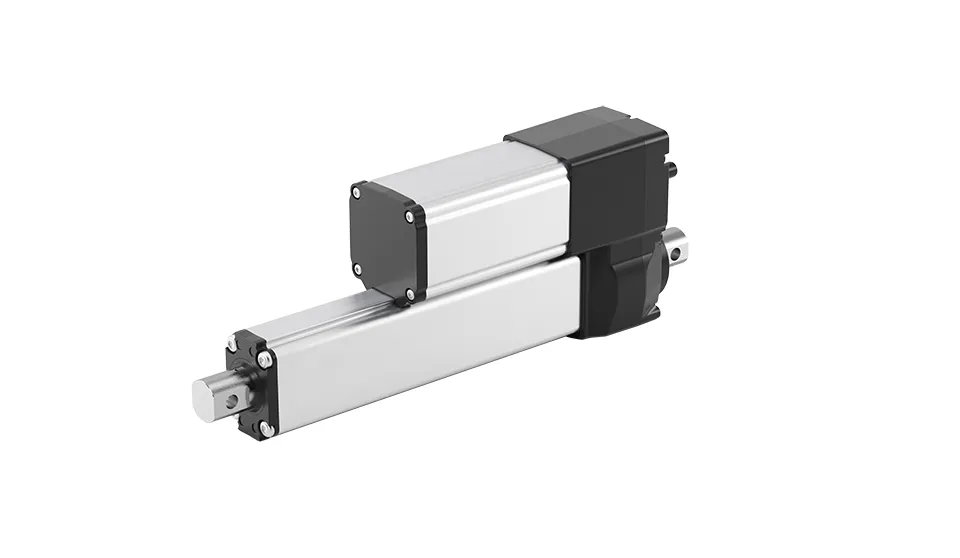
Far more compact and precise, easy to monitor and integrate into a wide range of IoT applications, and, if required, fully waterproof: electric cylinders have a host of advantages over conventional hydraulic drives. This also makes them ideal for a number of new applications.
In industrial environments, electric cylinders are increasingly emerging as a fully fledged alternative to conventional pneumatic and hydraulic columns and drives. “Electric linear actuators are ideal for highly precise movements and positioning, and can also be connected without difficulty to an existing control system,” says project engineer Bob Van Rensbergen. “Think of valves that need to be opened and closed continuously, or applications involving clamping or moving something. To meet this demand, we are offering an increasingly broad range of electric cylinders in different power categories.”
Very low maintenance
From a purely technological perspective, an electric cylinder is, of course, not particularly innovative: essentially, it is simply an electrically driven cylinder. “The main innovation now lies in the sizes in which these cylinders are available, and in the housings and protective enclosures into which they can be integrated. Conventional hydraulic drive systems require a great deal of maintenance, but they also have the advantage of being highly resistant to shock and able to withstand long periods of continuous loading. Our electric cylinders, by contrast, require far less maintenance and are ideal for short operations performed at intervals. Today, the main innovation lies in their size and in the power these small cylinders can now deliver,” he says. “A cylinder just a few dozen centimetres long can move up to 2.5 tonnes.”
Data on demand
Another advantage of the electric cylinder is that it can be monitored with ease, making it particularly suitable for integration into IoT applications, for example. Bob Van Rensbergen says: “Every cylinder we supply comes with a communications module as standard. It can therefore operate stand-alone or be integrated into the machine’s control system, with data fed back to the user or PLC. This makes the system much more intelligent than a conventional hydraulic drive. A cylinder also takes up far less space, so it is much easier to install wherever it is needed.”

“The main innovation now lies in the sizes in which these cylinders are available”
Question about this story? Ask your question
Keep following this
Get an email when a new story is published. No account needed.
- ThemeMotion with less energy
- SubjectMotion, gears & drives







