












Electric actuators with unprecedented resolution
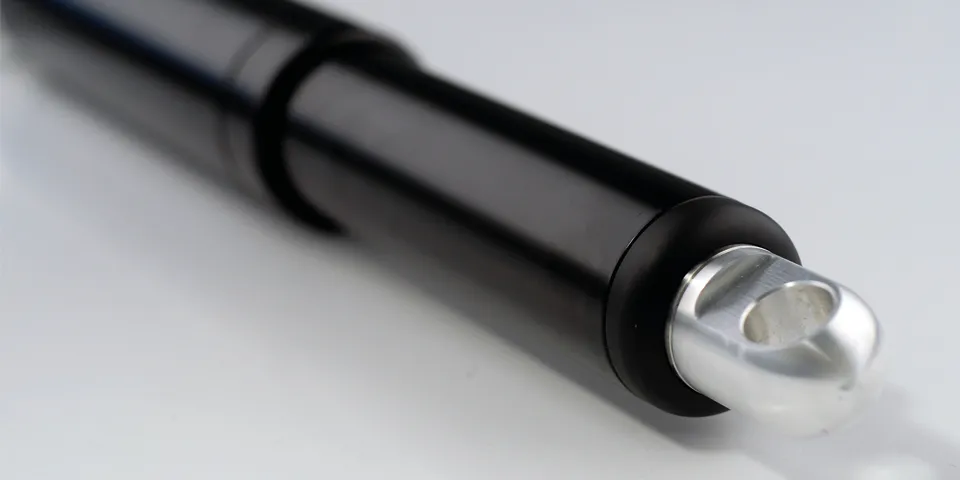
As JVL’s official representative, Rotero has expanded its range of linear actuators with two versions from JVL.
Both versions are based on JVL ServoStep motors and differ in their use of either an enclosed piston rod or an open lead screw. The actuators can be used, among other things, to adjust and set up machines when they switch to a new product.
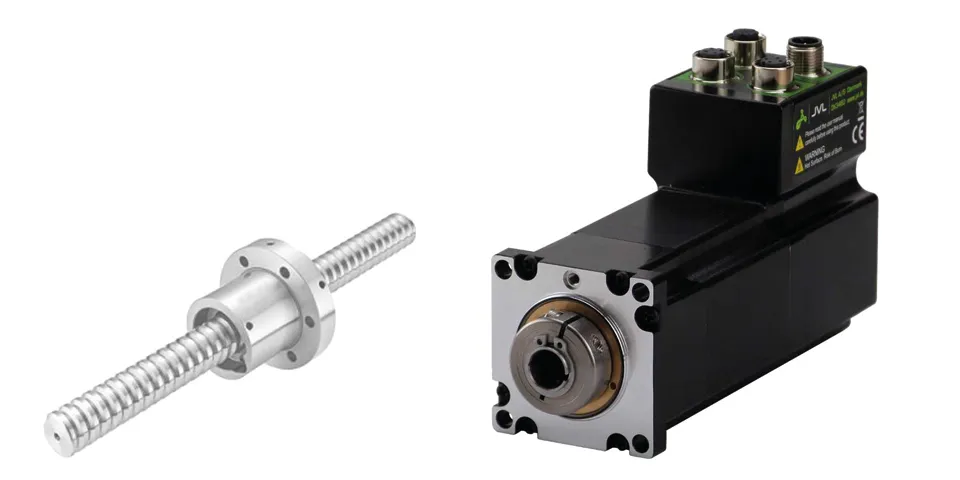
JVL, a specialist in integrated servo and stepper motors, has added two new versions to its ServoStep motor range. These motors can be connected directly to a lead screw and are suitable, among other things, as an electric alternative to handwheels for adjusting and setting up machines.
The first version is an electric actuator with a piston rod, ideally suited to replacing pneumatic actuators. The second is an open lead screw type, developed for companies that design their own guides. They can choose between a plastic nut (polyoxymethylene, acetal or POM for short) for light-duty applications, or a ball screw for fast and precise movements.
A choice of lead screws with different pitches is available. This makes positioning down to the µ range possible. In theory, positioning in tenths of a µm is even possible.
Both versions are available in three frame sizes: with a Nema 17 motor (43mm flange size), a Nema 23 motor (57mm flange size) or a Nema 34 motor (87mm flange size).
Smart, compact and robust
In both versions, the intelligent stepper motors combine the strong performance of stepper motor technology with the precise controllability of servo motors. The motor shaft and bearing combination has been replaced by a hollow shaft mounted in an oversized double-row bearing. Depending on the frame size, this can withstand axial forces of up to 7.100 N. The hollow shaft itself has a clamp that allows direct mounting on the lead screw.
A major advantage of the ServoStep motors is that they integrate all the required components in a single housing: motor, encoder, drive and control electronics, and optional Ethernet or CAN bus. All other industrial Ethernet protocols are also available, including Profinet, EtherNet/IP, EtherCAT, Sercos, ModbusTCP/UDP and Powerlink.
Control
The built-in SMC66 controller offers a superior resolution of 409.600 steps per revolution. This enables the motor to run extremely smoothly at any speed, with a speed resolution of up to 0,01 min-1. It also has eight I/Os, each configurable as a digital or analogue input or output. The I/Os can be used as local or remote I/O for the central PLC, or together with the ePLC in a standalone application.
Finally, the linear actuators can be precisely tailored to a specific application using a wide range of options. These include an absolute multiturn encoder or STO (safe torque off, SIL 3),
Specifications and key strengths
- Fully integrated solution, just add your own lead screw (motors with integrated lead screws are also available)
- Dual ball bearings for a maximum axial load of up to 7.100 N
- Closed-loop control
- Energy-efficient thanks to automatic current control
- Built-in ePLC with eight DIO, 24 V or 0-5 V (12 bit) analogue input with advanced filters
- Ultra-high resolution of 409.600 steps/rev
- Speed resolution of up to ± 0,01 min-1
- Speed, torque and other parameters can be adjusted during operation
- Optional: industrial Ethernet, support for all major protocols: Profinet, EtherNet/IP, SERCOS, EtherCAT, Powerlink and ModbusTCP/UDP
- Optional: CANopen protocol with DS 301 and DSP 401 support. Dual M12 connectors for easy configuration of a CAN bus ring network.
- Optional: STO (safe torque off, SIL3)
Question about this story? Ask your question
Keep following this
Get an email when a new story is published. No account needed.
- SubjectMotion, gears & drives







