












Efficient gantry systems on the rise
Text Piet DebisschopImage Vintiv NV
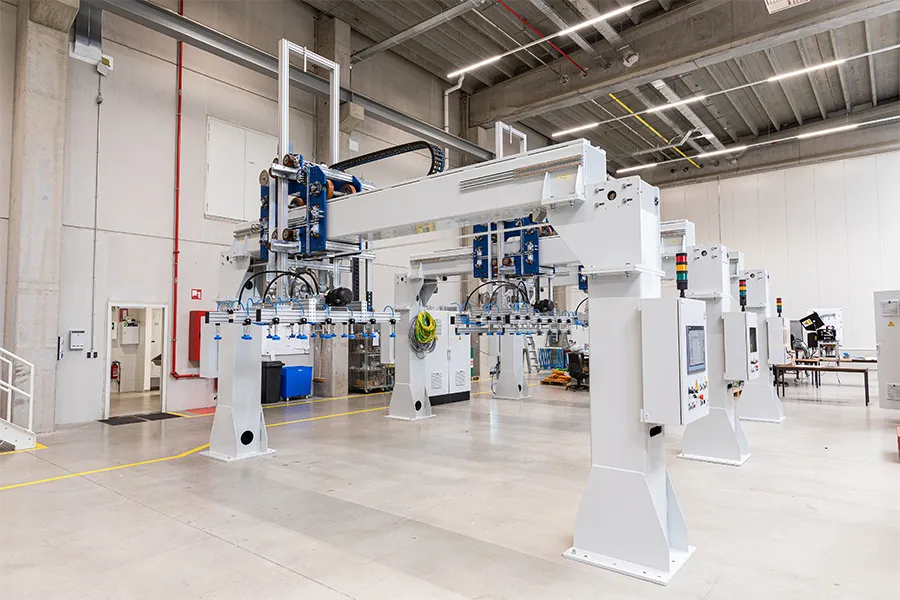
As distant ancestors of the classic six-axis robot, gantry, or xyz, systems still play an important role in automation. Alongside the modular, accessible DNA of these xyz robots, there are a host of other reasons for their continued use. Joris Ceyssens and Timen Flore of machine builder Vintiv explain their various features and showcase a very special gantry project of their own.
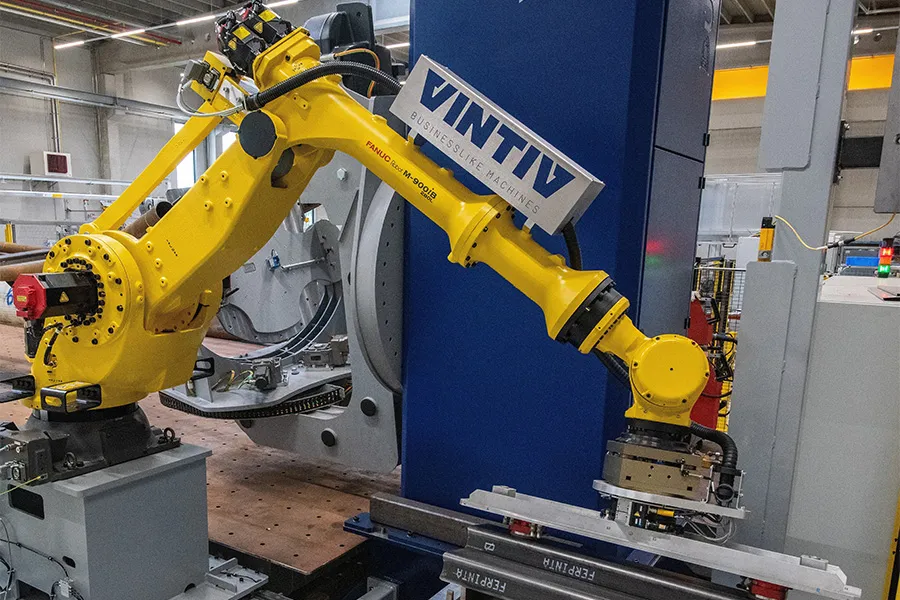
In 2023, the six-axis robot needs no introduction: this reliable machine has dominated automated welding cells, assembly lines and painting systems for decades. We owe much of the affordability of our passenger cars to it. The robot system also excels in high-speed pick-and-place applications, such as in the pharmaceutical, electronics and packaging industries. Its field of application seems almost unlimited.
The xyz robot in a nutshell
The active working area of a classic robot is determined by its installation layout, the arm configuration and the surrounding ergonomics. As a result, a six-axis robot cannot reach certain coordinates that coincide with its own position. In some cases, handling very large objects is also a real challenge. Gantries are an excellent solution for situations like these. And, as the introduction suggests, there is nothing new under the sun. Gantry systems have in fact been around since the last century, and even earlier. The classic example is the ubiquitous overhead crane, while a more recent variant is the now commonplace 3D printer. Every gantry is based on a linear robot topology that moves an end effector to pre-programmed coordinates along the three xyz axes. Unlike a six-axis robot, an xyz machine is easy for users to assemble and configure in a modular way. It is not an integrated, ready-to-use product that you can simply pick from a catalogue.
Typical gantry applications
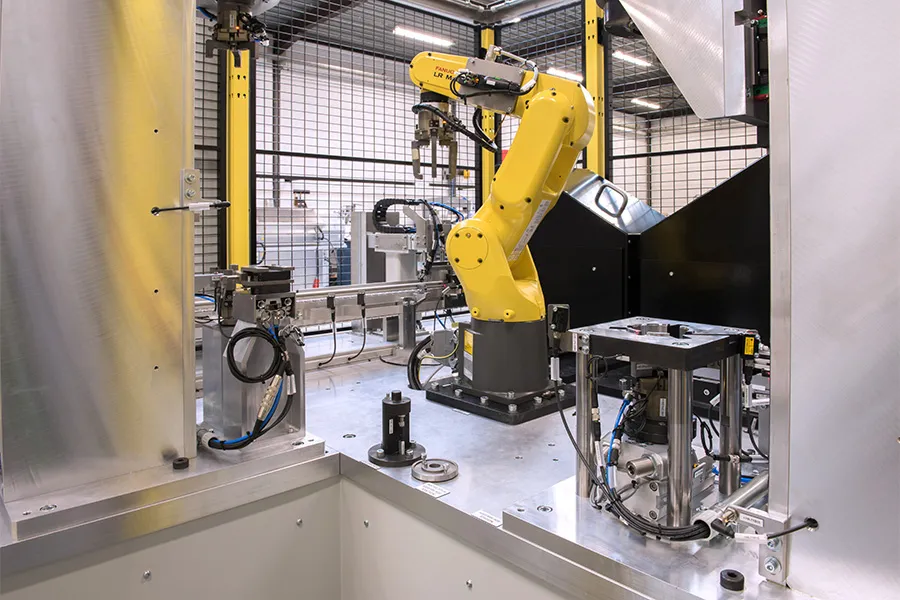
In addition to a wide range of Cartesian-positioned operations, such as CNC machining, PCB assembly and the assembly of medical instruments, gantries are also in high demand in sectors including construction, for tasks such as stacking and destacking building panels and 3D concrete printing. They are also used for automated plasma and laser cutting, as well as all kinds of Cartesian pick-and-place work. The reason is clear: each of these tasks is expected to take place in one or more Cartesian planes, without the need for additional rotations.
Advantages of a gantry over a six-axis robot
- Flexible and scalable
From a proverbial pocket-sized model to a giant spanning an entire production hall, xyz robotics offers virtually unlimited scalability. In some cases, only xy or xz is needed, as the choice of axes is also entirely flexible. The situation is different with conventional robots: each robot supplier offers a particular range of payloads and reaches from which you can choose or configure a model. There is no scope to go beyond that range.
For example, the panel gantry from Vintiv, which we will discuss shortly, is supported by two legs and uses just two axes.
- Space utilisation, operating range and payloads
Where a conventional robot is mounted on a pedestal and can rotate 360° from that position, a gantry is suspended above the working area. This allows it to reach every possible point in that space without becoming an obstacle to itself, a long-standing issue with six-axis robots.
Another factor is the relationship between payload and reach. These variables are directly proportional in conventional robots. In some cases, however, products are relatively light yet bulky. Choosing a conventional robot for such an application would mean excessive payload capacity, making gantries a much more efficient option. In theory, a gantry is less versatile in its movements than a six-axis robot, but in specific cases a rotary motion can be added to the gripper by fitting an extra rotary table.
- Maintenance
Commercial robots, regardless of manufacturer, generally require little maintenance. They are designed to last a very long time. Their main drawback is that customers cannot access the machines if a fault occurs. Repairs have to be carried out by third parties. For this reason, major robot users take out service contracts covering preventive maintenance, overhauls and repairs.
Gantry systems consist of an open metal frame on which all the technical components are mounted. The structure is bare and accessible, allowing customers to carry out maintenance or repairs themselves.
The Vintiv gantry
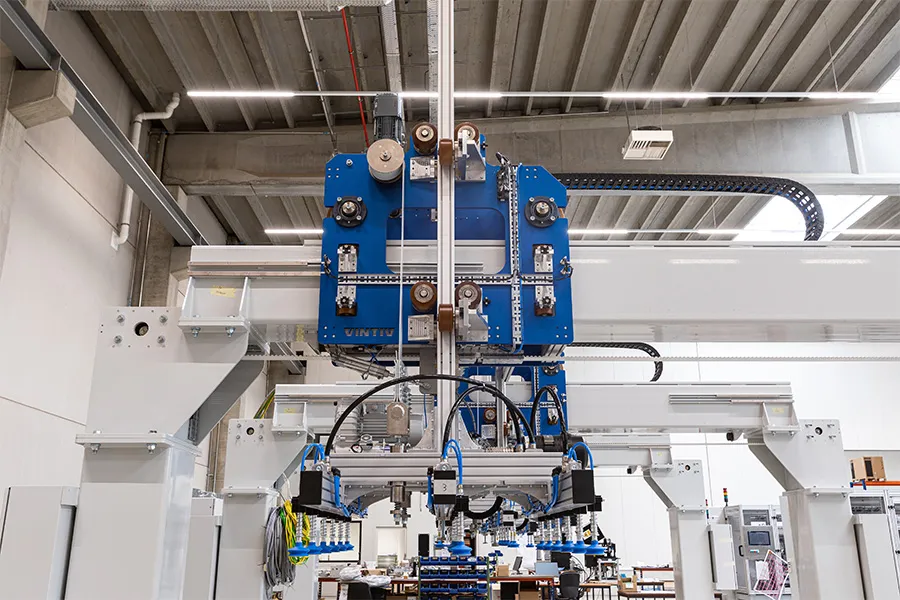
Timen Flore: “We developed this gantry to stack and destack large vinyl panels.” A large, robust steel structure was deliberately chosen for the linear guides. For this application, Vintiv did not want to rely on standard linear guide systems of the kind available commercially. Flore: “It is true that such a gantry could in principle also be built using conventional off-the-shelf components, but for this machine we wanted to anticipate faults, repairs and the difficult alignment work that often comes with them. Our system therefore uses an alternative linear guide, based on a steel structure along which rubber-coated wheels run.”
The movement is driven by a belt and a servo motor with encoder. The wheels are clamped on both sides and, thanks to their rubber tread, cannot slip. This ensures accurate positioning at all times, both for the x-axis movement using the large wheels and for the z-axis movement. The movement axis is provided by an aluminium profile along which wheels run. “This allows us to address several problems at once. At most, a wheel will need replacing from time to time, but never the entire steel structure,” says Timen Flore. In addition, this type of external guide is ideally suited to use in more demanding, dirtier working environments.
A textbook example of how a gantry robot can be used as an efficient, maintenance-friendly and cost-effective alternative. ■
Een zakelijke vraag aan VINTIV? Get in touch
Companies in this story
Keep following this
Get an email when a new story is published. No account needed.
- ThemeRobots on the shop floor
- SubjectMotion, gears & drives
- CompanyVINTIV







