












Efficient drive technology from NORD: the key to lowering TCO
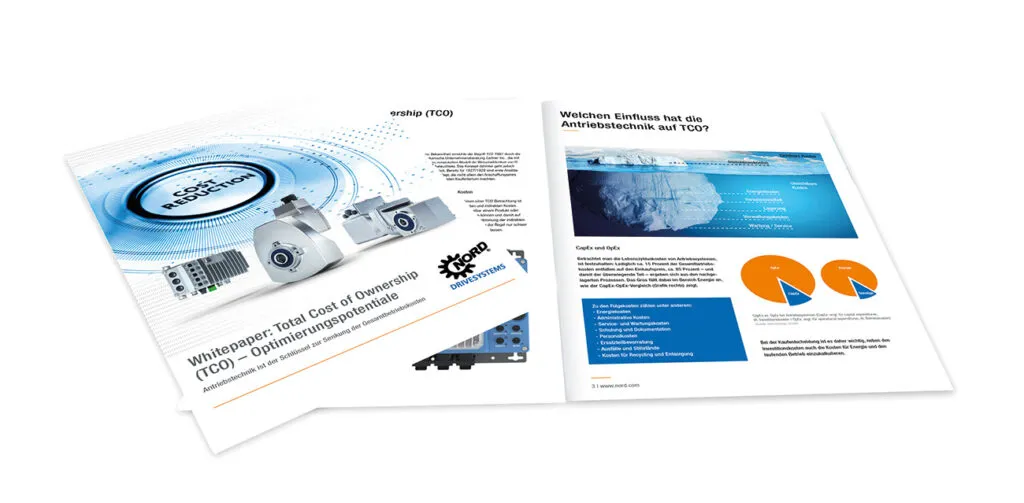
How cost-effective can an investment be? Looking at the life cycle of drive systems, the purchase price accounts for just 15 per cent of the Total Cost of Ownership, while around 85 per cent comes from downstream processes. That is why purchase decisions should take account not only of investment costs, but also of energy and operating costs, i.e. administrative processes, service and maintenance, spare-parts inventories and disposal.
Carefully weighing up all the economic factors is therefore essential to reducing costs and improving efficiency in production. The Total Cost of Ownership (TCO) concept can help.
Energy efficiency and variant reduction
The two main factors in reducing TCO are energy consumption and the number of drive variants used. However, the approaches to optimising energy efficiency and reducing the number of variants are at odds with each other. A system with drives designed for the most energy-efficient operating point delivers optimal investment costs and relatively economical motors, irrespective of their efficiency class. However, the different drive variants must be managed and maintained throughout the installation’s entire life cycle.
While a drive concept focused primarily on saving energy costs results in a large number of variants, variant reduction aims for the opposite: delivering the required torques and speeds across an installation using as few different drive variants as possible. This can reduce costs for administration, service and storage, but energy costs generally rise somewhat. It is therefore important to align these conflicting priorities as far as possible when designing the drive system.
Condition monitoring for predictive maintenance
Condition monitoring and predictive maintenance also play a central role in reducing TCO in Industry 4.0 applications. Periodic or continuous recording of drive and status data enables changes to be detected at an early stage and helps reduce unplanned downtime. The result: greater system availability, less downtime, lower service and material costs, and a longer service life.
NORD’s approach to TCO reduction
NORD DRIVESYSTEMS takes a holistic approach to reducing the Total Cost of Ownership, drawing on a full range of strategies to identify and increase efficiency potential: from its modular system and the use of powerful, durable and energy-efficient technologies to individual TCO calculations and intelligent service and maintenance concepts.
NORD offers drive solutions to reduce life-cycle costs, for example:
with its high-efficiency range (the patented DuoDrive gearmotor, IE5+ synchronous motor and decentralised NORDAC ON / ON+ frequency inverter)
or with its LogiDrive solution space.
Question about this story? Ask your question
Keep following this
Get an email when a new story is published. No account needed.
- ThemeMotion with less energy
- SubjectMotion, gears & drives







