












Choosing the right motor control method
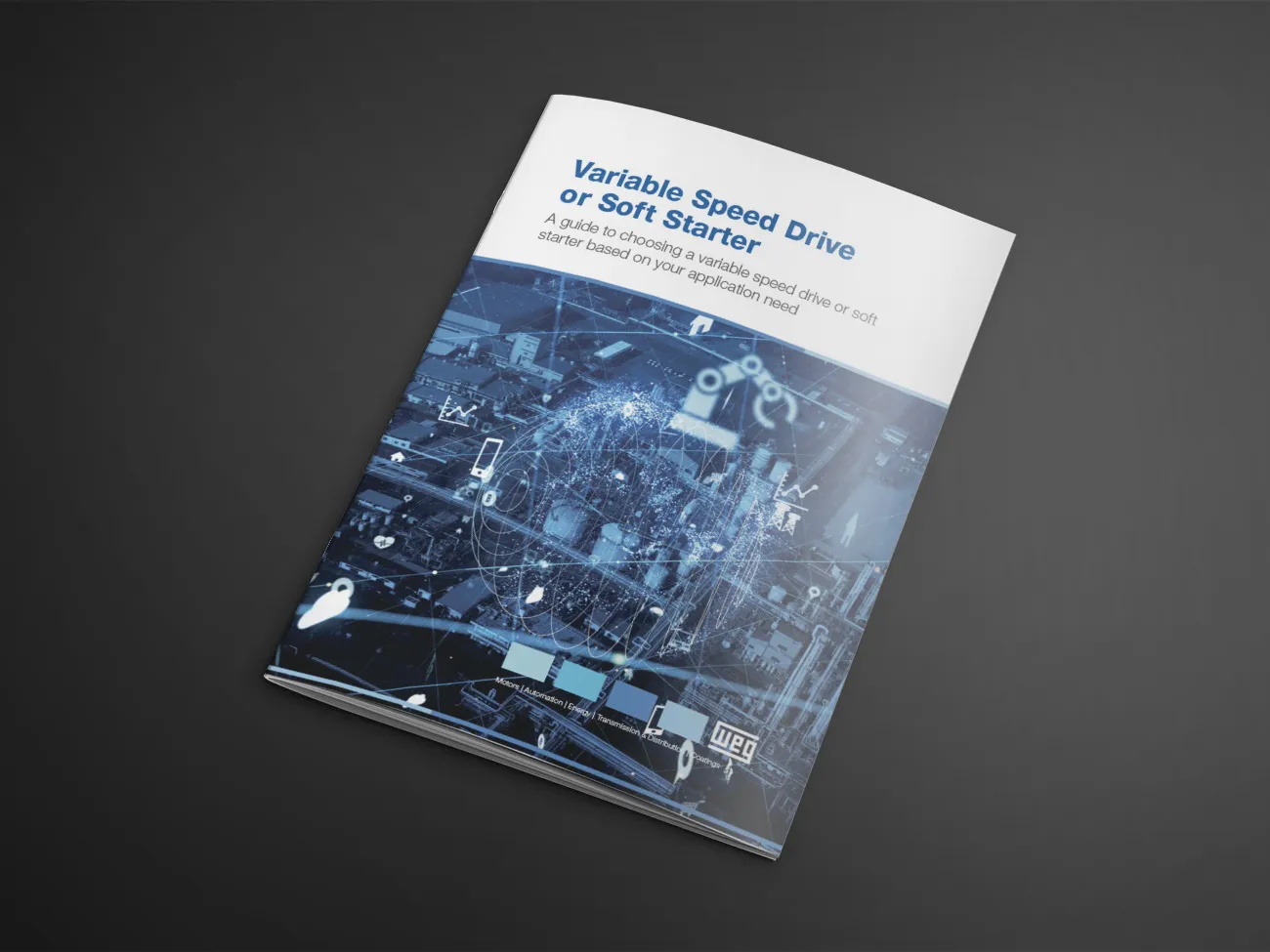
WEG, a leading manufacturer of industrial motors and variable speed drives, has published a white paper explaining how to choose between variable speed drives and soft starters. The free guide, entitled Variable speed drive or soft starter?, helps business managers make an informed purchasing decision and can be downloaded from the company’s website.
Soft starters use semiconductors to temporarily limit the voltage supplied to a motor, helping to control the output voltage. They limit inrush current and the mechanical shock associated with starting a motor, and provide a more gradual acceleration up to maximum speed. A variable speed drive is a motor control unit that protects and controls the speed of an AC induction motor by continuously converting the frequency and voltage of the incoming power supply to a different frequency and voltage. However, it is not always easy for manufacturers to decide which is more suitable: a soft starter or a variable speed drive.
The choice between a soft starter and a variable speed drive depends entirely on your application. The new guide explains which applications are best suited to soft starters and which to variable speed drives, using detailed statistical data and figures.
The guide also discusses the benefits of soft starters and variable speed drives in terms of performance, versatility and energy savings. As more manufacturers begin to consider the environmental impact of their equipment, the guide also explains why variable speed drives can save more energy, sharing practical technical insights. Variable speed drives are also used in applications that require full speed control and application-specific control.
On the other hand, soft starters are often more cost-effective in applications that only require speed and torque control during motor start-up. They are also often the ideal solution where space is limited.
“A number of factors come into play when choosing between a variable speed drive and a soft starter, including the type of application, the mechanical system requirements, and the costs of initial installation and over the system’s entire service life,” says Marek Lukaszczyk, marketing manager for Europe and the Middle East at WEG.
“Soft starters are generally smaller and less expensive than variable speed drives. However, variable speed drives can deliver significant energy savings, reducing the total cost of ownership. They also offer greater functional flexibility. For example, full speed control is essential in pump, fan and conveyor applications, and a variable speed drive can provide this. Variable speed drives can initially cost two to three times as much as soft starters, though, so if your application only requires current limiting during start-up, a soft starter may be a more cost-effective solution.”
For more information about WEG’s range of variable speed drives and soft starters, or to download the white paper, visit www.weg-automation.com.
Question about this story? Ask your question
Keep following this
Get an email when a new story is published. No account needed.
- SubjectMotion, gears & drives







