












Autonomous towing robots speed up materials handling
Text and images maxon Benelux
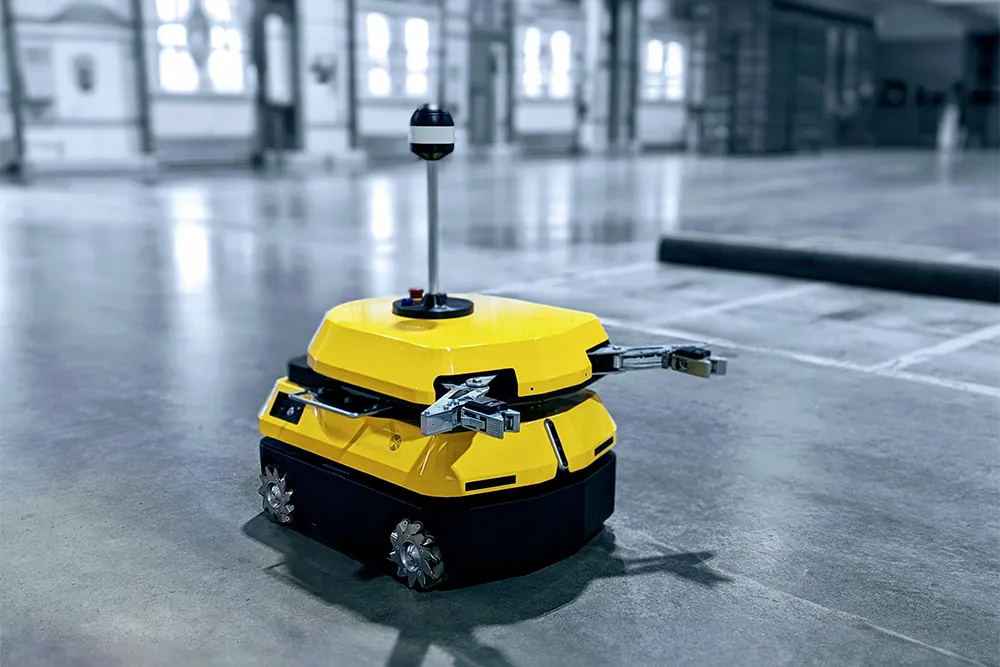
With movement in multiple directions and the ability to couple intelligently to almost any warehouse trolley in less than twenty seconds, these new robots make materials handling faster and safer.
“In 2018, I visited a friend who owned a warehouse where a mix of large and heavy goods was loaded onto both warehouse trolleys and pallet trucks. He showed me how difficult it was to move these trolleys quickly and accurately, and asked me for help. I realised that a specially designed robot could move the different trolleys already in use, overcoming the challenges of size, weight and time,” says Keshav Chintamani, CEO of Tractonomy Robotics, a start-up based in Ghent, Belgium. And he knows what he is talking about. He has a background in robotics research for the space industry.
Keshav discovered that many automated guided vehicles (AGVs) designed to move warehouse trolleys were based on a design that lifts the load from underneath. However, it took the robots time, sometimes even several minutes, to manoeuvre underneath a trolley. If a trolley was not positioned perfectly straight, the AGV had to stop and reset. These robots were often limited in the weight they could lift, and there was a risk of the trolley tipping over.
Researching the options
The research then focused on AGVs that could tow a warehouse trolley. However, these AGVs were either permanently connected to the trolley or used coupling mechanisms that were not very accurate and still took a long time to connect. A robotic gripper arm was then identified as a coupling mechanism that could reliably ‘clip’ onto the trolley. This would allow the new design to adapt to any type of trolley and tow it safely.
To allow free movement, Keshav wanted to combine this coupling mechanism with an autonomous mobile robot (AMR) platform. Laser navigation helps the robot avoid obstacles and enables dynamic, accurate movement. This would help the evolution of AMR warehouse transport to become faster and more efficient.
Freedom of movement
The AMR still had to move around a warehouse with limited space and couple accurately to a trolley positioned in a tightly packed row. By using Mecanum wheels, the AMR could move freely in confined spaces thanks to their omnidirectional design. However, the key step in optimising coupling speed and accuracy, as well as forward movement, was specifying a precise four-wheel drive. “maxon motors are used in many academic research projects because of their performance and reliability, including the space research I have worked on.
So these were the first motors I looked at,” says Keshav.
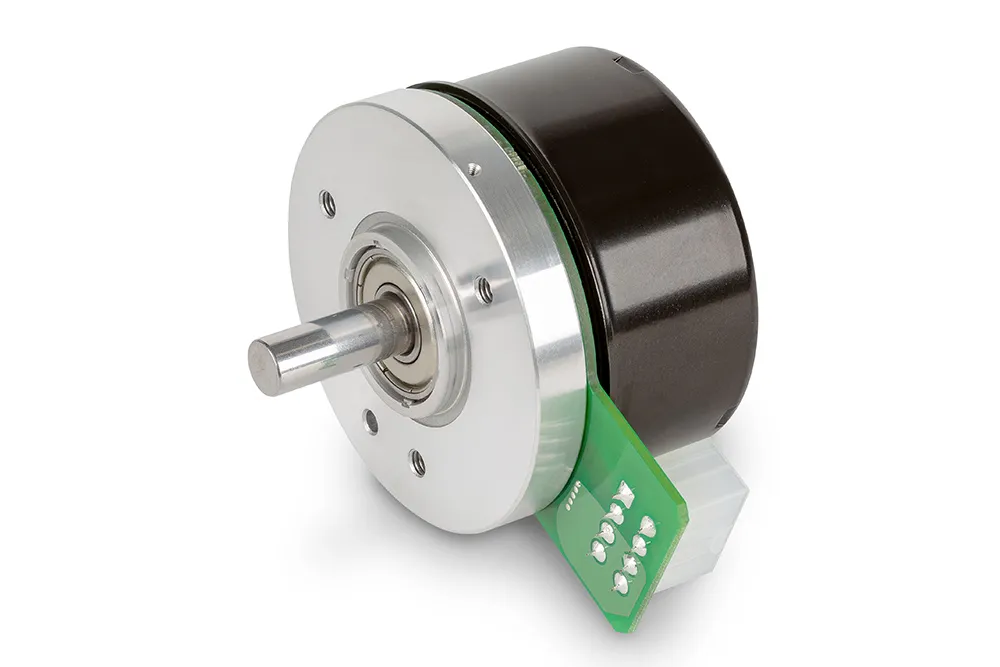
The drive system had to enable the robot to tow heavy loads and generate enough torque to get a load of a few hundred kilograms moving from a standstill. As the AMR had to operate in confined warehouse environments, the first design was just 70 cm long and 50 cm wide. A compact motor was therefore essential. After several trials, a flat, brushless DC motor from maxon, the EC60, was selected for the task. With four motors per robot, one for each wheel, the design also had to be cost-effective for series production, as the motors had to be integrated with high-resolution encoders.
High power density
“We tested these motors in the ATR1 prototype and they were really impressive. They could tow a trolley carrying the weight of three people, and these motors are tiny, just 60 mm wide,” says Keshav.
With the concept proven, Tractonomy Robotics was born, and the inaugural design gave its name to the ATR1: the Autonomous Towing Robot. The ATR1 can tow any type of trolley weighing up to 400 kg at speeds of more than 1 m/s. A dedicated navigation stack allows the robot to couple quickly. The ATR can even detect available spaces and park trolleys there automatically. This navigation system uses cameras and computer vision feedback, while its precise control is made possible by the motors’ rapid response.
“The ATR1 can couple to trolleys accurately and reliably in less than twenty seconds, and position itself in confined spaces thanks to sideways manoeuvres, also known as ‘strafing’, with subtle adjustments to ensure pinpoint accuracy,” says Keshav.
Demand for towing heavier loads
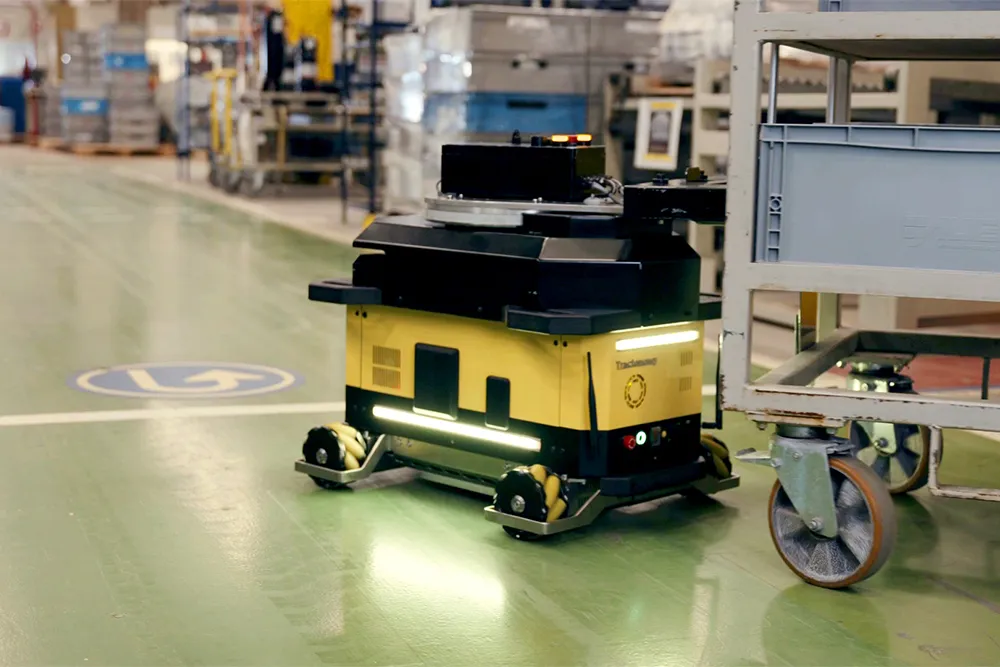
Following trials of the ATR1, Tractonomy Robotics received requests to tow even heavier loads, such as sheet metal weighing 800 kg or more. This demand led to a radical new design: the ATR2, a robot with a unique, adaptive two-arm coupling system that can move a wide range of trolley sizes. Tractonomy plans to produce the ATR2 in a standard-torque version and a high-torque version, with expected towing capacities of 600 kg and 800 kg respectively, and speeds between 1.8 m/s and 2.5 m/s (6.5 km/h to 9 km/h).
The ATR2’s dimensions have increased from 70×50 cm to 90×64 cm to accommodate more batteries and new electronics. However, moving heavier loads while keeping the robot compact required motors with considerably higher torque.
“On the advice of maxon engineers, we were able to use a lower-voltage motor that fits into the overall system while still achieving the peak speed and peak torque needed for the heavier load, with temperatures remaining within the thermal limits,” says Keshav. “Thanks to this important advice, we can offer a single platform suited to a wide range of trolleys and loads using just two types of motor.” When towing heavier loads at higher speeds, braking force becomes all the more important. That is why the ATR2 has an integrated braking system and a 360° safety system that prevents collisions. As the robot operates 24 hours a day, component reliability is also crucial. “These machines travel 15-20 km a day in varying conditions. Faults reduce productivity, so having a reliable solution is very important,” Keshav explains.
Flexible materials handling
The ATR2 is now undergoing operational validation, and Tractonomy is focusing on series production. The AMR is primarily aimed at the manufacturing and distribution logistics sectors, which rely on materials handling technologies, for example factories, large supermarket warehouses and post offices. The robots can also be used to load and unload warehouse trolleys from lorries, and offer a low-cost alternative to traditional logistics trains and conveyor systems, as well as a safer, automated alternative to forklift trucks.
Keshav adds: “We are seeing a growing need for a single type of machine that can take on many different materials handling tasks, as this reduces costs and makes things easier for the end user. With just one robot capable of performing several materials handling functions, Tractonomy provides this flexibility.”
MAXON BENELUX: Stand 137
Een zakelijke vraag aan maxon Benelux? Get in touch
Companies in this story

Keep following this
Get an email when a new story is published. No account needed.
- ThemeRobots on the shop floor
- SubjectMotion, gears & drives
- Companymaxon Benelux







