












Automated sanding
Text Piet DebisschopImage CIBO ROBOTICS
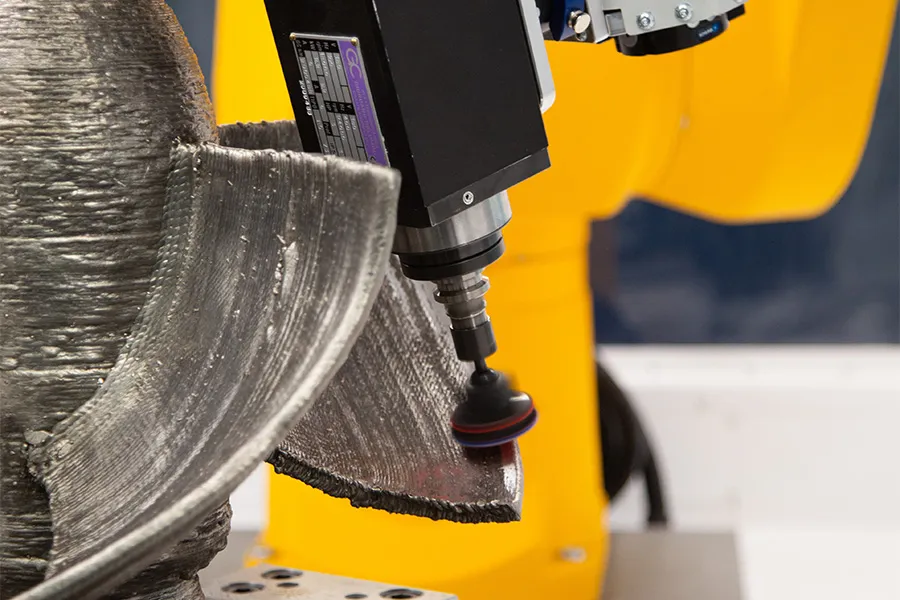
Next year, Cibo will proudly celebrate its 75th anniversary. It is a unique opportunity to reflect on the company’s core DNA, which continues to underpin its work and guide its direction. Although ‘standing still’ is not really part of Cibo’s vocabulary. The company recently made a decisive move to establish an entirely new division: Cibo Robotics is set to set the benchmark for an autonomous, fully automated and, above all, high-quality sanding process unlike any other in the industry. We spoke to Bart Strouven, managing director of Cibo Robotics.
The need
Bart Strouven: “For many years, we have maintained close contact with the end users of our sanding solutions. For some time now, we have been hearing about several clear but striking trends. More and more companies are seeing process expertise in sanding gradually disappear. Sanding specialists are becoming a rare breed, or are simply impossible to find.”
The solution
This issue prompted Cibo to consider a solution, leading to the idea of a fully automated sanding robot. CNC Solutions had already developed such a robot for a customer. CNC quickly realised that it would be difficult to take it to market without extensive application knowledge of sanding. Bart Strouven: “After purchasing our own sanding cell from CNC, we decided to form a partnership to develop the concept further into the product we sell today.”
The design and build were ultimately carried out in collaboration with CNC Solutions. The company’s expertise brought a highly experienced approach, including the use of compensation modules with their own control system, enabling the hardware and software to work together in perfect harmony. Moreover, automation by definition ensures repeatability: every time, it delivers a perfect and fully repeatable sanding result, without damaging the workpiece at any point in the process.
Putting it into practice
Cibo initially purchased its own six-axis robot for preliminary sanding tests. This test set-up eventually evolved into a market-ready sanding robot that operates ‘tool-in-hand’. To this end, Cibo uses six-axis robots from the 160 and 200 series by STÄUBLI. They can handle payloads of 40 and 100 kg respectively. These robots allow for some of the most complex configurations, reaching every angle and side of the workpieces. In principle, all coordinates are accessible, although in exceptional cases the robot’s turntable can be used as a seventh axis, as it can operate in sync with the robot. The robot can also be mounted on a track.
The aim was to maximise standardisation, using components that can be elegantly interchanged between robot cells. This provides better customer support. All hardware developed in-house, meanwhile, was designed specifically for the task in question. Key examples include the compensation unit and a proprietary motor designed specifically to meet all the required speeds and loads. This avoids any gaps between process steps that would require a tool change. This also applies when switching from flat to right-angle sanding, or when moving to a different speed via a ratio change, for example. Cibo Robotics has now successfully completed around ten projects.
Advantages that make the difference
Bart Strouven: “One important advantage of any automated sanding process is that it gets the most out of your abrasives. This is thanks to the tailored parameters, which are continually optimised for the sanding task and, above all, the material being processed.”
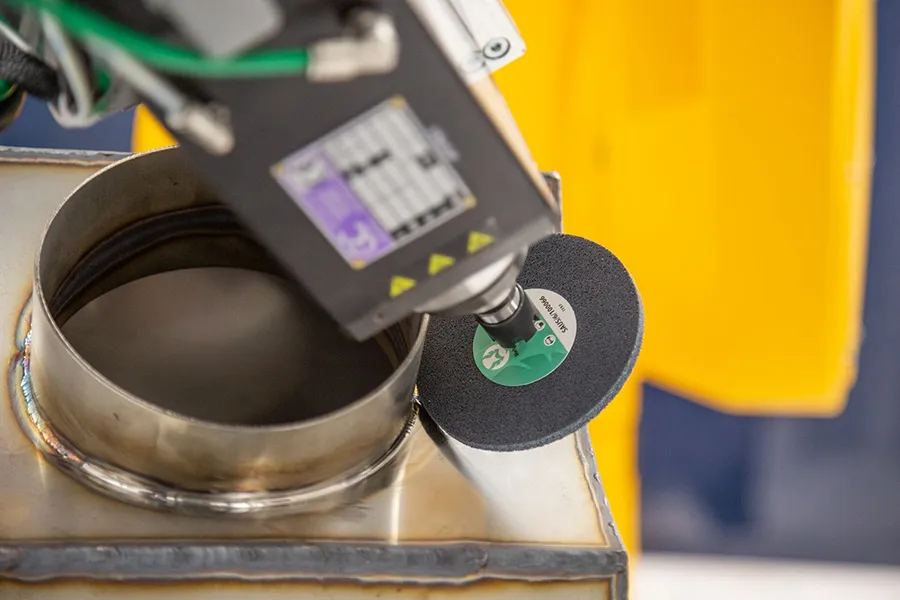
The system can therefore take a multitude of parameters into account simultaneously. High pressure or speed is not always desirable for a good result. Stainless steel, in particular, requires lower speeds, in the range of 5,000-6,000 rpm, rather than the 10,000 rpm used for mild steel.
The same applies to contact forces, which must also be kept sufficiently low. Controlled use of abrasives also delivers a quantifiable improvement in efficiency.
Master-slave system
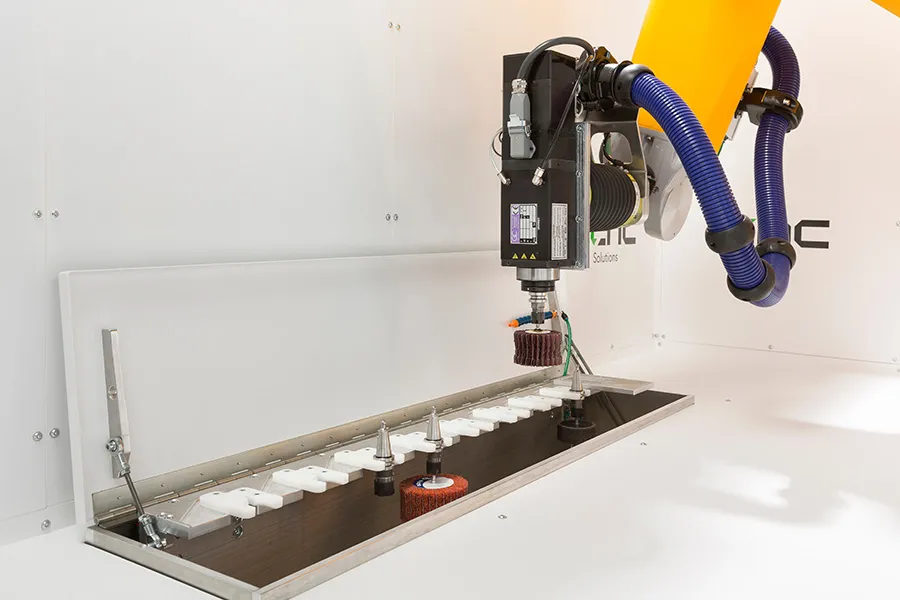
CNC Solutions developed what is known as a master-slave system to control the peripherals required for the sanding process. It essentially consists of a master unit that remains attached to the robot at all times. The various units, including right-angle and straight outputs, extensions with a gear ratio, and so on, automatically click into place beneath it. This alternative was a deliberate choice and is much cheaper than the conventional set-up, in which, for example, a motor has to be changed regularly.
Bart Strouven: “Discs can also be changed beneath the extensions, without having to touch the entire tool. The toolchanger, which holds the abrasive, works a little like the toolchanger on CNC lathes and milling machines. In this case, the abrasive is held in a cone-type holder. This in turn is part of a magazine containing the various ‘slaves’.” The operator can access the magazine while the system is running and change tools without stopping the robot. The magazine is also completely dust-free.
The customer comes first
Bart Strouven: “What we ultimately offer the customer is always the result of a thorough analysis that takes every variable into account. Our goal is to provide a durable solution that will last up to thirty years. The STÄUBLI robots help make this possible: they are hermetically sealed and require very little maintenance. The arms are also pressurised, keeping dust out. In principle, every Cibo Robotics project is unique and tailored to the customer’s requirements. From the outset, we estimate the service life of the respective abrasives. Thanks to the repeatability of the process and the resulting consistent quality, consumption can be calculated very linearly. Cibo has built up a thorough understanding of the standard service life of each abrasive through experience. However, the customer optimises the sanding process and can make immediate adjustments to account for factors such as weld quality or slight changes in the material.”
From a technological perspective, the original problem of experience and know-how in sanding processes is shifted to the design of the robots and automated sanding processes. Many projects therefore present an interesting challenge. However, the company can draw on more than seven decades of knowledge, enabling it to find a suitable set-up time and again.
Question about this story? Ask your question
Keep following this
Get an email when a new story is published. No account needed.
- ThemeRobots on the shop floor
- SubjectMotion, gears & drives







