Why choose EtherCAT for industrial communications?
Text Valérie CouplezImage EtherCAT Technology Group
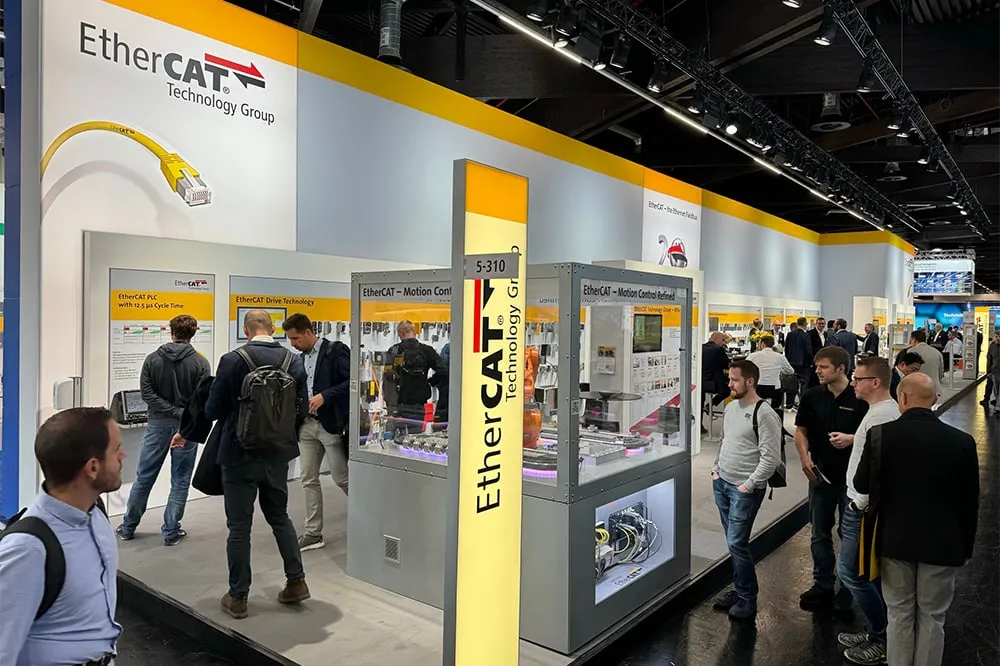
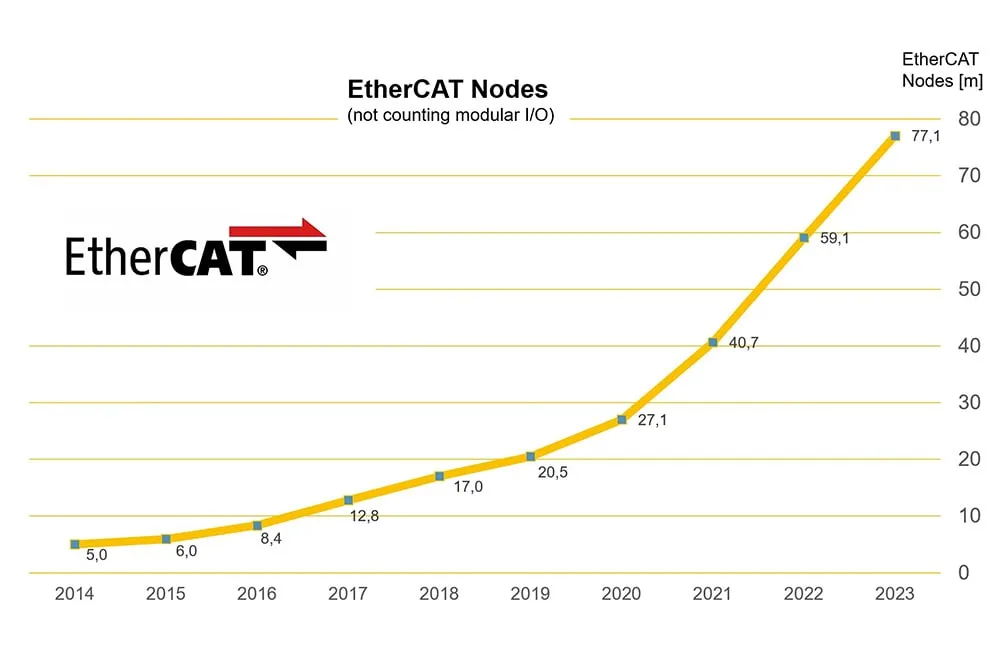
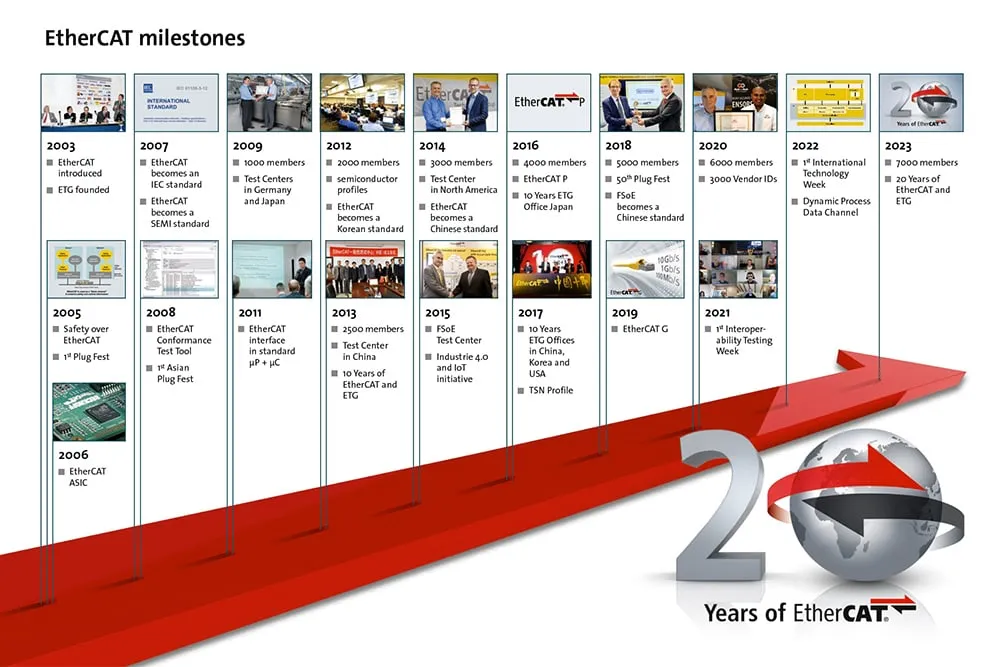
EtherCAT is gaining ground, with more than 7,500 members and 77.1 million nodes worldwide. Its unique operating principle has already won over many engineers. Now, with the advent of IIoT, it has another advantage to offer. EtherCAT is not based on switches and does not depend on the Internet Protocol: the EtherCAT protocol is embedded directly in the Ethernet frame. Since almost all cyberattacks rely on the Internet Protocol for routing, they get nowhere with EtherCAT. Here are the key benefits.
EtherCAT is generally the fastest industrial Ethernet technology, while also synchronising with nanosecond accuracy. This is a major advantage for any application in which the target system is controlled or measured via the bus system. Fast response times reduce delays during transitions between process steps, significantly improving application efficiency. Finally, the EtherCAT system architecture reduces CPU load by 25 to 30% compared with other bus systems (at the same cycle time). When implemented optimally, EtherCAT’s performance delivers greater accuracy and throughput, and therefore lower costs.
Flexible topology
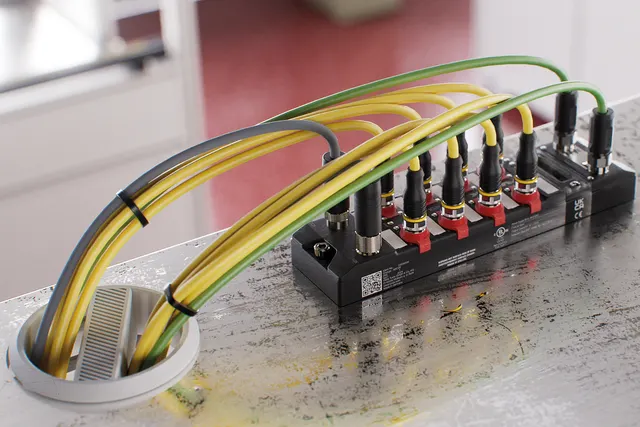
In EtherCAT applications, the machine structure determines the network topology, not the other way around. Conventional industrial Ethernet systems limit the number of switches and hubs that can be cascaded, restricting the overall network topology. Since EtherCAT does not require hubs or switches, these limitations do not apply. In short, EtherCAT offers virtually unlimited network topology options. Line, tree and star topologies, as well as any combination of them, are possible with a virtually unlimited number of nodes. Thanks to automatic link detection, nodes and network segments can be disconnected and reconnected while the system is running, even elsewhere, if the master supports this feature. The line topology can be extended into a ring topology for cable redundancy. All the master needs for this redundancy is a second Ethernet port, and slave devices already support cable redundancy.
This makes it possible to switch off devices while the machine is running.
Simple and robust
Configuration, diagnostics and maintenance all contribute to system costs. The Ethernet fieldbus makes these tasks much simpler: EtherCAT can be configured to assign addresses automatically, eliminating the need for manual configuration. Low bus load and peer-to-peer physical connections improve immunity to electromagnetic interference. The network reliably detects potential faults down to their exact location, dramatically reducing the time needed to troubleshoot. During start-up, the network compares the planned and actual layouts to detect any discrepancies. EtherCAT’s performance also helps
during system configuration, as there is no need to tune the network. Its high bandwidth provides the capacity to transmit additional TCP/IP traffic alongside control data. Since EtherCAT itself is not based on TCP/IP, there is no need to manage MAC or IP addresses or to have IT experts configure switches and routers.
Integrated safety
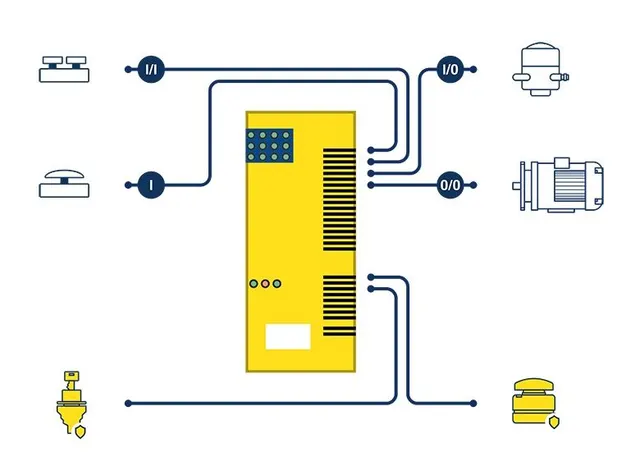
Functional safety integrated into the network architecture? No problem with Functional Safety over EtherCAT (FSoE). FSoE has been proven in operation by TÜV-certified devices on the market since 2005. The protocol meets the requirements for SIL 3 systems and is suitable for both centralised and decentralised control systems. Thanks to the black channel approach and the particularly lean Safety Container, FSoE can also be used with other bus systems. This integrated approach and lean protocol help keep system costs low. In addition, a non-safety-related controller can also receive and process safety data.
Cost-effective
EtherCAT offers the features of Industrial Ethernet at a price comparable to, or even lower than, that of a traditional fieldbus system. The only hardware the master device needs is an Ethernet port: no expensive interface cards or co-processors are required. EtherCAT slave controllers are available from various manufacturers in different formats: as an ASIC, FPGA-based, or as an option for standard microprocessor series. Since these low-cost controllers take care of all time-critical tasks, EtherCAT does not impose any performance requirements on the CPU of slave devices, keeping device costs low. As EtherCAT requires no switches or other active infrastructure components, the costs of these components, along with their installation, configuration and maintenance, are eliminated.
Question about this story? Ask your question
Keep following this
Get an email when a new story is published. No account needed.
- ThemeData from shop floor to decision
- SubjectControl & network