Seamlessly integrated electronic overcurrent protection
Conventional fuses often fall short in 24 V DC applications. They respond too slowly when the overload is limited, with potentially serious consequences.
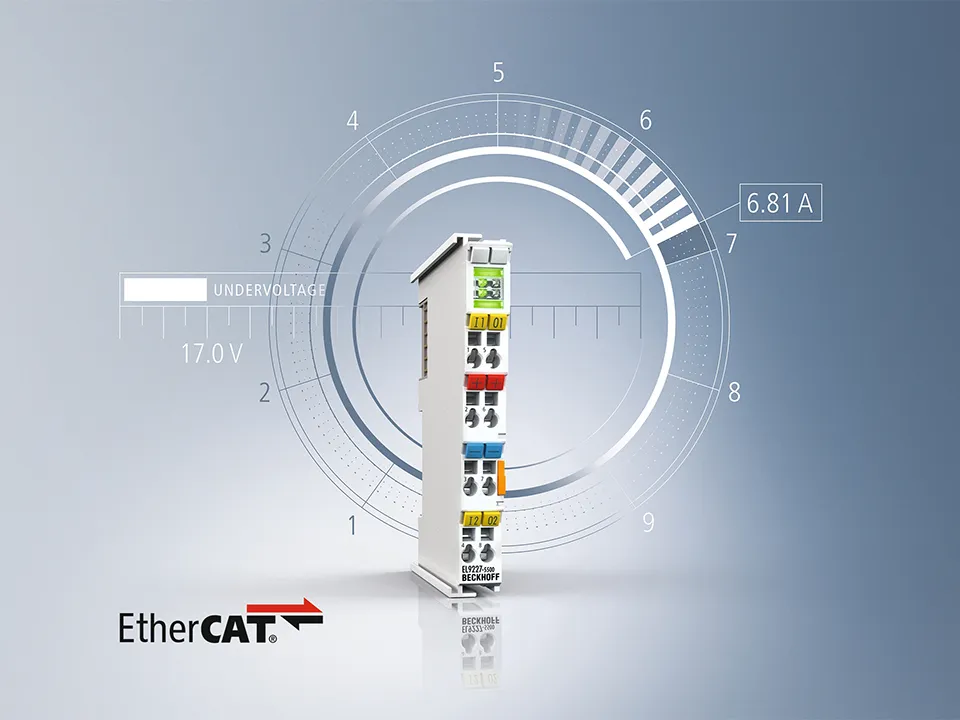
Electronic fuses are the better choice for these applications, thanks to their speed and accuracy. With Beckhoff’s EL922X series, you get more than just electronic overcurrent protection. Using a standard EtherCAT terminal gives you an integrated solution that can also provide extensive insight into your application for efficient, transparent condition monitoring.
24 V DC applications require careful attention to current protection. “If a short circuit occurs in one of the cables, there is a risk that the entire 24 V DC power supply network will fail. A fault on one branch means a fault across the entire network,” begins Philippe Hénin, I/O product specialist at Beckhoff. It is also important to protect the cables. “If too much current flows through them, cables can fail. Monitoring and protecting the current on the different branches also makes it possible to detect abnormal situations that could indicate problems. Overcurrent protection therefore safeguards not only your power supply and cables, but also the operation of your application.”
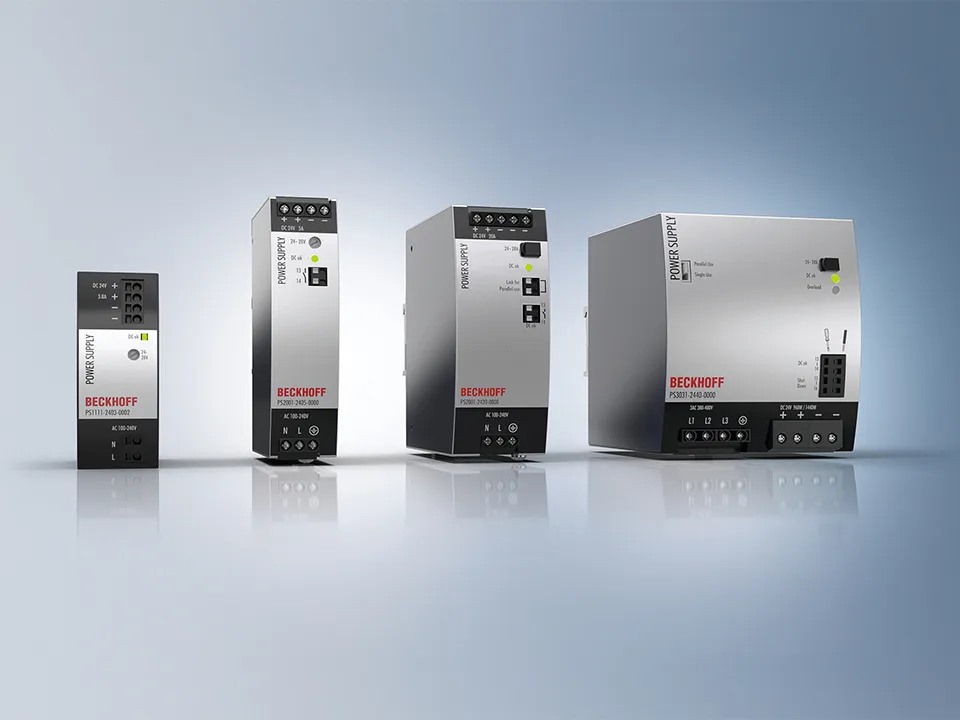
Limitations of conventional fuses
The conventional way to protect 24 V DC applications is to use magnetothermal or thermal fuses. “Magnetothermal fuses, however, were not specifically developed for 24 V DC. This means they respond slowly, especially when the overload is small. A second potential drawback is that the rated current cannot be adjusted,” says Hénin. Thermal fuses have the same disadvantages. “On top of that, if a problem occurs, these fuses melt. In other words, they can only be used once,” says Hénin. “Machine builders are not always aware, however, that better alternatives are available.”
Advantages of electronic fuses
For several years, Beckhoff Automation has offered electronic overcurrent protection in its EL922X series of EtherCAT terminals. “Electronic fuses offer a number of undeniable advantages. First, they are specifically designed for 24 V DC applications. Second, they respond within a fraction of a second and with great accuracy when an overload occurs. Third, electronic fuses allow users to adjust the rated current. The current can be increased or decreased to suit the application, all with the same fuse,” says Hénin, summing up their main benefits.
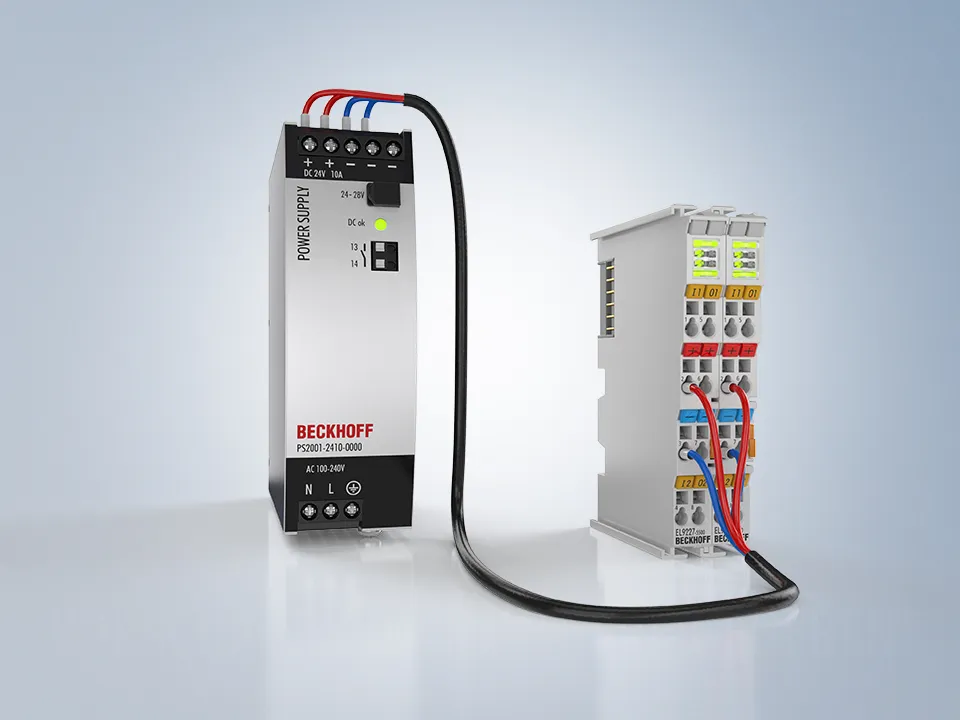
Integrated solution
Beckhoff would not be Beckhoff if it did not add a whole host of benefits to make operation even easier. “We provide overcurrent protection in the form of a standard EtherCAT terminal. It can be installed directly in the I/O island, so no external fuse is needed. The terminal can also power the I/O island, supplying both the internal electronics and all connected 24 V DC consumers, even when the EtherCAT network is not yet operational. This means less space is needed in the control cabinet, installation is quicker and installation costs are lower. Because the terminal is fully integrated into the fieldbus, it is much easier to set up current protection. Other solutions require either digital I/Os for basic functions or a separate fieldbus gateway for more advanced functions to enable communication between the controller and the fuse. The EL922X terminals eliminate unnecessary wiring and complex configurations,” Hénin points out.
Smart extra functions or basic version
For users who only need the basic functions, Beckhoff offers the EL9221 (one channel, one protected output, adjustable or fixed rated current) and EL9222 (two channels, adjustable or fixed rated current). Beckhoff has also added smart extra functions in the EL9227 series. Hénin explains: “The EL9227 terminal has two current-protected outputs, which can be adjusted on two channels or set to a fixed rated current per channel. The LED buttons allow you to reset directly on the island, switch the current protection on and off, or set the rated current.” Another useful feature is the additional status information they provide. “The extra data they capture gives machine builders the information they need to implement condition monitoring. When a problem occurs, it is important to know exactly what went wrong so it can be prevented in future. That is precisely the reliability our electronic fuses offer. What’s more, it is a fully integrated solution, which offers nothing but advantages in terms of installation and operation,” Hénin concludes.
Question about this story? Ask your question
Companies in this story

Keep following this
Get an email when a new story is published. No account needed.
- SubjectControl & network
- CompanyBeckhoff Automation