The machining of tomorrow: a new automation solution that runs smoothly
Texte Valérie Couplez | Photos Beckhoff Automation
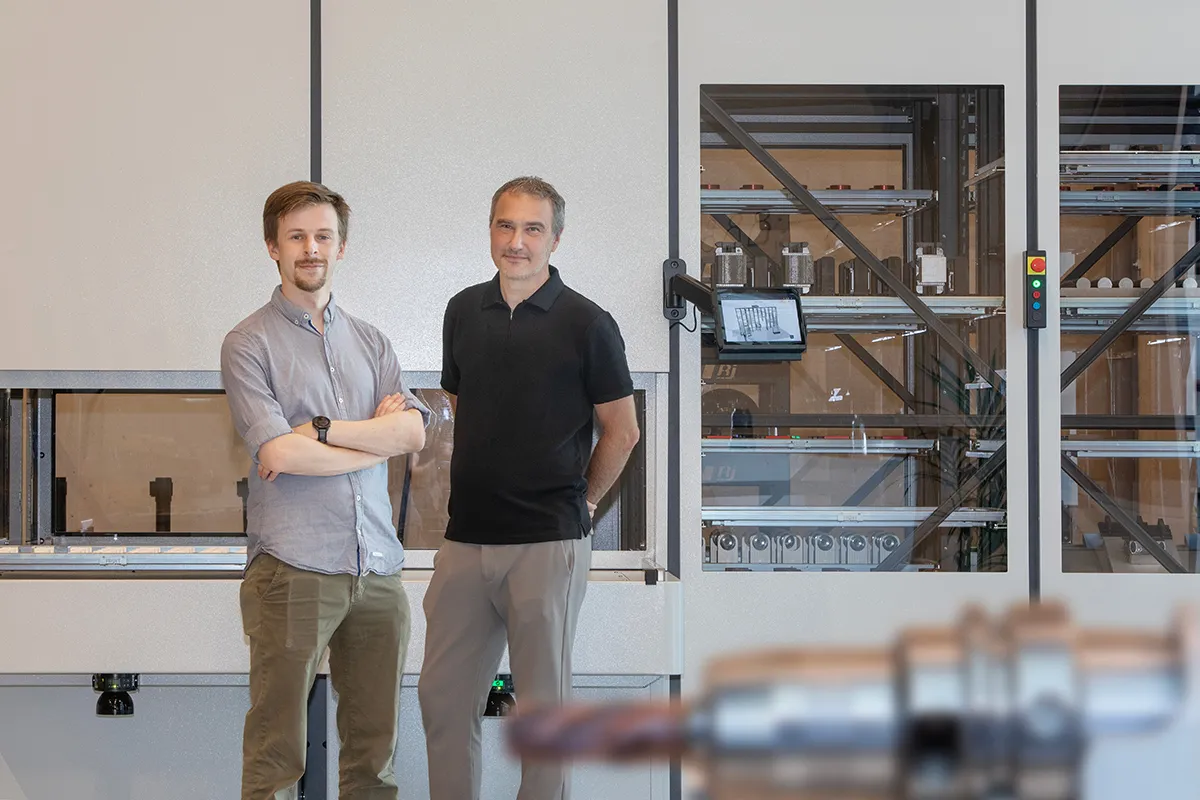
Over the past ten years, few machine builders have attracted as much international attention as RoboJob. With its automation solutions for machine tools, the company has made automation accessible to every workshop. Its latest product, the “Wall”, shows what Industry 4.0 looks like in metalworking. A central warehouse where raw materials, finished parts, tools and clamping devices are automatically stored, all controlled flawlessly by Beckhoff technology.
RoboJob’s new headquarters in Heist-op-den-Berg, where the company has found more space to build its systems, are the clearest evidence of its growth. The company now has more than 2,000 active robots in the metalworking industry worldwide. “And to think that we started out as a machining company ourselves,” says marketing director Steven Craenen. The turning point came eighteen years ago, when the company’s director could not find a suitable solution for automating production. “We faced the same challenges metalworkers are up against today: shrinking margins and a shortage of technically skilled staff. Starting with the question of how to make production faster and more efficient despite these constraints, including for the local SME, we began developing automation solutions. Not heavyweight systems designed for large production runs, but flexible, user-friendly automation that makes an immediate impact.”
Automation pioneers
And with great success. The Mill-Assist and Turn-Assist have established a strong reputation both nationally and internationally. In addition to Heist-op-den-Berg, RoboJob now also has a presence in Germany and the United States, with around 100 employees in total. Its portfolio continues to grow. “In fact, it’s simple: wherever you are in the world, whatever the size of your company, the challenge is always the same. We try to provide a simple, accessible answer. When we embarked on this journey in 2007, automation was not yet as widespread as it is today. We were pioneers because our founder and current CEO, Helmut De Roovere, was convinced it would become essential in machining. Today, we are telling that story again with the Wall. It is our vision of what the factory of the future will look like. It may not yet be relevant to most companies, but it shows the direction we are heading in,” says Steven Craenen.
At the heart of production
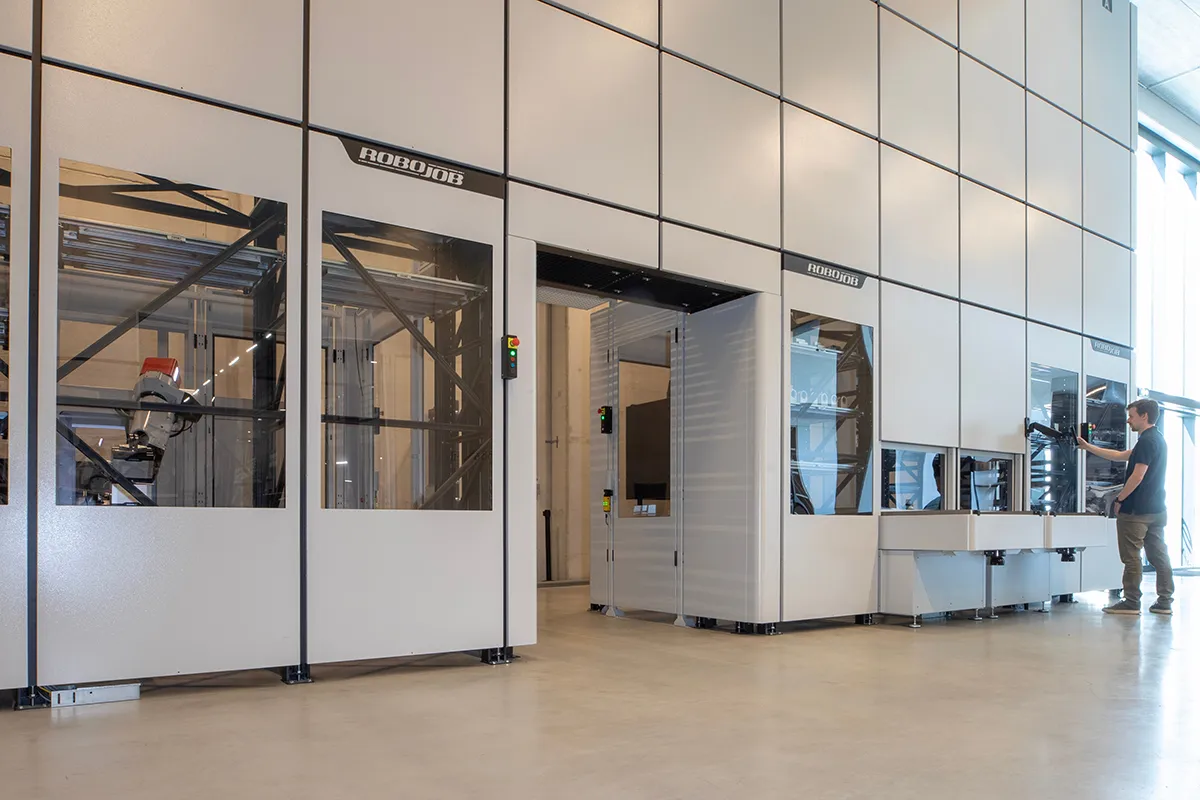
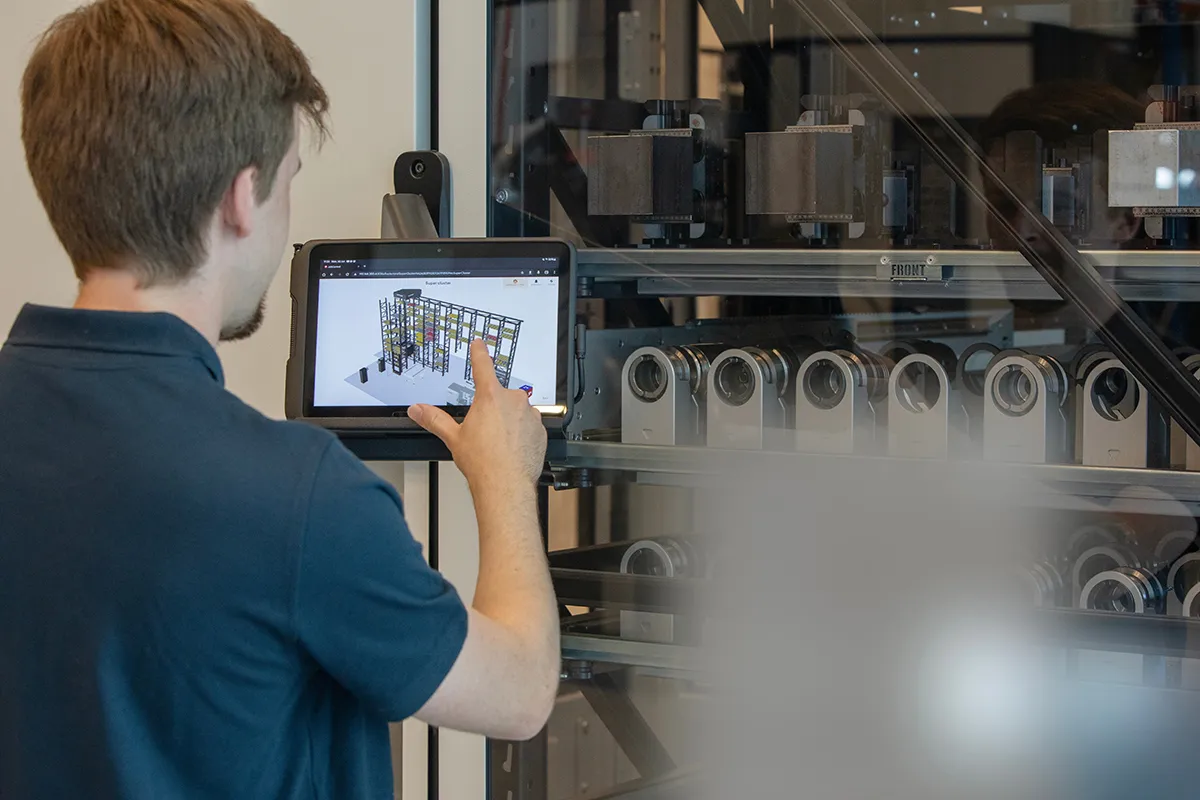
Calling the Wall an automated warehouse would do it a disservice. In reality, there is much more to it, and inside it. Sam Haeverans, electrical engineer at RoboJob: “It will form the heart of production. At the touch of a button, the operator starts the process. Everything needed to complete the job is prepared (raw materials, tools, clamping devices) and set up in the connected CNC machine. The job is finished? The parts are then stored in the Wall for later use or further processing, or an AGV collects the job and takes it to dispatch. The possibilities are extensive, which calls for a new way of thinking about your production. That is why we opted for a modular concept that can grow in line with your automation needs. We are convinced that the next efficiency gains will come from eliminating material handling. And that is exactly what our Wall does.”
The brains of the solution
The Wall can only serve as the heart of production thanks to an effective brain that coordinates everything. Although users work in the familiar RoboJob Jobcontrol software environment, a Beckhoff PLC (CX9020) performs this role behind the scenes. The choice and collaboration came about after the coronavirus crisis, when other manufacturers were short of components. “Beckhoff was able to supply what we needed to fulfil our orders. That opened the door, and the service did the rest,” sums up Sam Haeverans. For existing products, it is a simple change: only the PLC is involved. RoboJob, however, is building its new standard products on a complete Beckhoff architecture. In the case of the Wall, the key components are the AX5000 drives. Each module needs three units to control every axis: to retrieve products from their compartments using telescopic arms (or return them) and to move them horizontally and vertically to their final destination.
Easy to use on the outside, complex on the inside
The solution is built around four components. The Wall’s frame is made from standard Stow racking profiles. Guide rails at the top supply power to the hoist (the shuttle that moves over the racking). The hoist operates the “trayslider” (tray slide) using cables. The trayslider is sized to handle a single tray. This makes it easy to add modules one by one until you reach the size required for your production. A passage is always left clear at the bottom for a forklift or mobile robot, to minimise the impact on the workplace. Simple? “In theory, perhaps, but in practice it takes a great deal of expertise to make it work in a user-friendly way,” says Sam Haeverans with a smile. “Especially given the flexibility we had in mind. That meant the hoist had to move just as easily whether the tray held 5 or 500 kilos, and regardless of exactly where the weight was positioned on the tray. We also called on Beckhoff to develop a fully integrated safety concept. After all, the Wall interacts with operators.”
Safety first
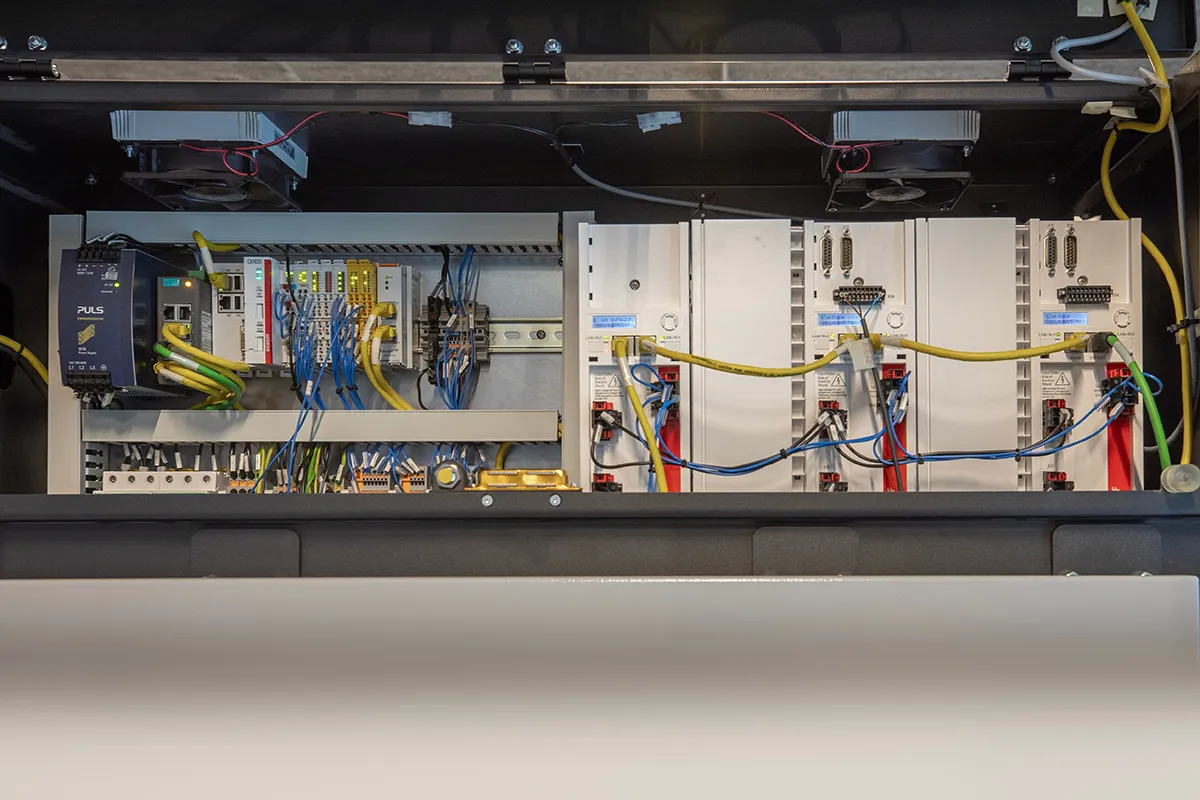
The safety concept may have been the biggest challenge. Each operator station and robot has its own PLC and safety controller (EL1918), each controlling its own safety circuit. This includes at least one emergency stop, but may also include a safety scanner or light curtain. “The challenge was to create a modular system in which the different safety controllers could interact without requiring additional programming each time,” explains Enzio Cominotto, sales engineer at Beckhoff. “To do this, we used the Fail Safe over EtherCAT (FSoE) protocol in combination with EAP (EtherCAT Automation Protocol). In Safety over EtherCAT communication, the transport medium is considered a ‘black channel’, which means the FSoE protocol can be transmitted over any communication technology, in this case via an Ethernet network with optical communication to the lift.”
Encoders for load distribution
The second challenge was to solve the problem of uneven loading. The lifting platform is suspended from two cables. These can stretch by different amounts depending on how the load is distributed across the platform. For smooth operation, however, the lifting platform must remain perfectly level at all times, including when accelerating or decelerating. Sam Haeverans: “That is why we opted for additional encoders, on top of the motor encoder, to measure how much the suspension cables stretch. An inclination sensor detects an unevenly distributed load. The question then was whether to read the encoders via an external card or directly on each servo drive as a secondary encoder. We chose the latter, because the position control loop then runs in the drives themselves, allowing us to use a slightly less powerful PLC.”
Maximum flexibility
Sam Haeverans: “For every technology choice, we thought carefully about how we could maximise flexibility. By pooling our ideas with the Beckhoff team, we validated the concept very quickly. From there, we were able to continue on our own, while still being able to call on help from a Beckhoff employee whenever we needed it.”
Een zakelijke vraag aan Beckhoff Automation? Get in touch
Companies in this story
Keep following this
Get an email when a new story is published. No account needed.
- SubjectServices & solutions
- CompanyBeckhoff Automation