Industrial multicloud: strong advantages with a well-considered approach
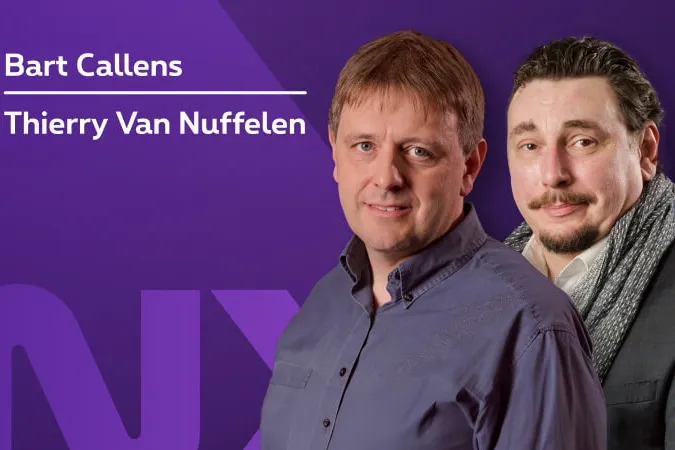
More and more industrial companies are opting for multicloud. This allows them to tailor their cloud infrastructure to their specific needs. However, combining cloud solutions also poses challenges in terms of management, integration and security. Proximus NXT experts Thierry Van Nuffelen and Bart Callens explain how to manage this complexity.
A cloud model fully aligned with your business creates the ideal framework for deploying automation, IoT and smart manufacturing projects. Several factors come into play when choosing the most appropriate cloud strategy: performance, security, monitoring, scalability and cost optimisation. To bring these elements together, multicloud, a combination of different public clouds, possibly complemented by a private cloud or on-premises infrastructure, is an attractive option for many industrial companies.
Flexibility and performance
“The reason companies combine several public clouds is simple,” explains Thierry Van Nuffelen, Product Manager Cloud at Proximus NXT. “Each hyperscaler, such as Amazon Web Services (AWS), Microsoft Azure or Google Cloud Platform, offers specific services. For some industrial applications, for example in real-time data analytics, IoT, energy management or AI, there is sometimes only one provider that is genuinely suitable, or one provider proves a better fit than the others.”
A multicloud approach can also help optimise costs. “If one provider increases its prices, a company can easily move certain workloads to another cloud offering comparable services. Medium-sized and large organisations in particular have the scale needed to make this flexibility cost-effective.”
Defining a strategy
A well-considered strategy is essential. According to Thierry Van Nuffelen, there are two main approaches: a hyperscaler-centric approach or a distributed multicloud strategy. “With the first option, the organisation chooses one public cloud as its central hub, then builds on it with components, or stacks in the jargon, from other clouds. This approach improves operational efficiency. However, it limits the freedom to make full use of the tools offered by all providers.”
The second option is based on a distributed architecture, in which tools work compatibly across several public clouds, and often private clouds too. “This allows you to get the best out of each cloud every time.”
Security: beyond configuration
Moving to multicloud also changes the security landscape. Bart Callens, Product Manager Cybersecurity at Proximus NXT, explains: “For applications and operating systems running in your own data centre, for example, you are responsible for patching. In a SaaS or PaaS environment within the public cloud, this responsibility is largely taken on by the provider. The focus then shifts more towards configuration security.”
The main challenge with multicloud is maintaining consistent security across the different clouds. “You can set up a separate security stack for each cloud, but that requires specialist expertise for every environment. One alternative, for example, is to use Azure Cloud Security Posture Management (CSPM), which can detect misconfigurations not only in Azure, but also in AWS and Google Cloud Platform. Another option is to add a security middleware layer that spans all the clouds in use.”
Management, expertise and collaboration
The technical complexity of multicloud calls for new approaches to management. “In an organisation that works mainly with Azure, business needs may, for example, require the use of AWS or Google Cloud for a specific industrial application,” explains Thierry Van Nuffelen. “This requires additional expertise, both in functional terms and in security.”
When sufficient expertise is available in-house, one option is to use a cloud management platform that spans several clouds to manage the multicloud environment. “If your company does not have the necessary skills in-house, you can draw on Proximus NXT’s expertise. We can also take full responsibility for managing and maintaining your multicloud.”
Modular support
The support offered by Proximus NXT also delivers real added value in terms of security. “With the persistent shortage of specialist security professionals, many industrial companies are choosing to bring in external expertise,” says Bart Callens. “We provide not only licences and tools, but also manage security controls, on site and in the cloud, whatever multicloud strategy you choose.”
Proximus NXT offers a modular service at operational, tactical and strategic levels: from providing security controls to taking full responsibility for GRC (Governance, Risk & Compliance), as well as delivering SOC (Security Operations Centre) services.
Would you like to find out how your company can make the most of the benefits of a multicloud infrastructure with Proximus NXT?
Question about this story? Ask your question
Companies in this story
Keep following this
Get an email when a new story is published. No account needed.
- ThemeSafe and compliant machinery
- SubjectControl & network
- CompanyProximus NXT