How much artificial intelligence is already built into machines?
Texte Valérie Couplez | Photos Lenze
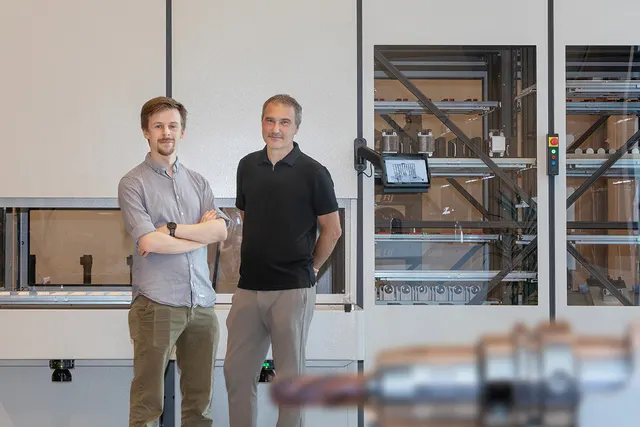
Since ChatGPT, artificial intelligence has been everywhere in the media. But what does it actually look like in industry? And to what extent is it already being used to make machines smarter? Dr Johannes Kühn, Head of Control Technology, Motion Control and Robotics at Lenze, explains where we are today.
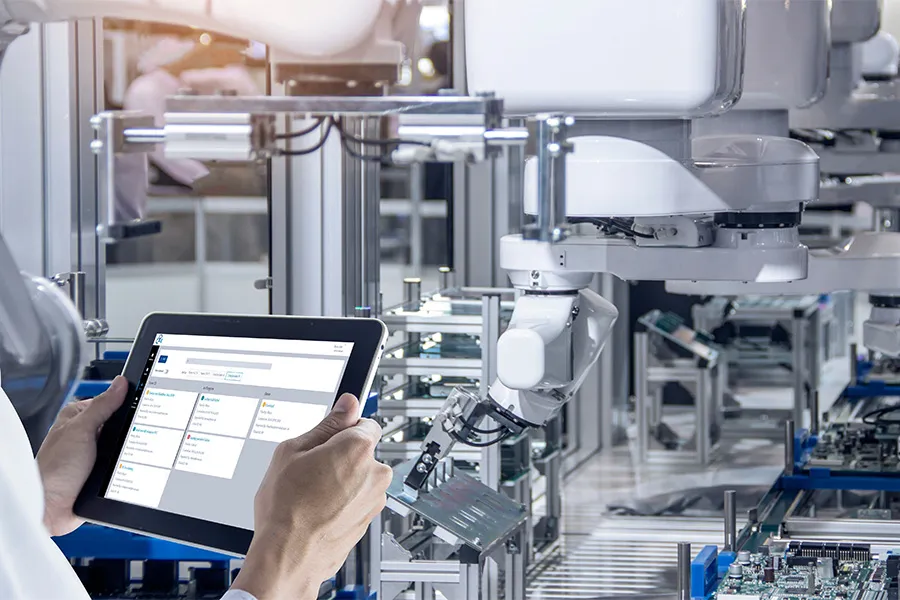
“Artificial intelligence has not yet made its way into production itself, at the heart of machines,” Mr Kühn says at the outset. Apart from image recognition, which almost always relies on artificial intelligence, machines are built and controlled on the basis of physical models. “That is hardly surprising. Reliability and consistency are the watchwords, leaving little room for risky experimentation. Machine learning, the most widely used form of artificial intelligence in industry, is actually one of the least powerful methods. It is based on mathematics that has been around since the 1970s. These are statistical methods: classifying data and making decisions based on historical data. The reason this method is being used more and more today is that there is enough computing power to make such predictions. The method has its limits, because it is not possible to train a model to handle completely new situations. It only knows what it has learnt. A mechanical engineer cannot afford that. And that is also where self-driving cars reach their limits, for example.”
In processes surrounding manufacturing
That does not mean that artificial intelligence has yet to make its way into industry. Quite the opposite.
“Today, applications can be found across all related processes and departments,” Mr Kühn explains. “And if you look a little further afield, for example at marketing or inventory management, they are even commonplace. So artificial intelligence has the potential to make a difference. If we can accurately predict how many products we need, we can allocate resources more efficiently. In this respect, artificial intelligence will play a crucial role in our journey towards carbon-neutral production. But not by developing a smarter, more energy-efficient powertrain. It is too early for that.”
Lenze, for its part, uses artificial intelligence in its condition-monitoring and predictive-maintenance tools. “These are areas where artificial intelligence is booming. Components generally behave in the same way throughout their service life and are exposed to the same loads and wear. We can therefore learn a great deal from their behaviour, helping to prevent unplanned downtime and optimise maintenance performance.”

Smart data is better than lots of data
Although artificial intelligence is all about data, Mr Kühn believes the engineer’s role in all this remains particularly important.
“It all starts with collecting data. As long as you have enough data, you can get to work and draw the right conclusions. But with smart data, we can make even better decisions. That is the engineer’s job: finding the right needles in the data haystack. From a purely statistical point of view, we could today establish a correlation between the number of Arctic foxes in Antarctica and the number of unemployed people in Germany. But a decline in the Arctic fox population does not mean that unemployment will also fall. That is meaningless data. The smarter we make our data, the less powerful the artificial intelligence algorithms need to be.”
Know-how makes the difference
This is also how Lenze sets itself apart. “We use our motor as a sensor to collect data for our customers. But the possibilities for measuring and processing torque in the drive are virtually unlimited. If artificial intelligence had to process all these signals, it would require too much computing power and cost too much. So you need to extract only the data that tells you about the condition of the motor. And that starts with knowing the hardware and the applications. That is why Lenze is better,” Mr Kühn adds with a broad smile. “This knowledge, for example, gives us the foundation for effective motor condition monitoring.”
But of course, it all starts with the data. Lenze incorporates it into its Drives Datahub software, which provides direct access to ready-to-use drive data via various communication interfaces. From there, users can monitor their own machines in dashboards or in Nupano. “Artificial intelligence is therefore already a useful new tool for machine builders. But it will still be some time before it really reaches the heart of the machine. And let’s not forget that not every problem can be solved with a screwdriver,” Mr Kühn concludes.
A business enquiry for Lenze? Get in touch
Companies in this story

Keep following this
Get an email when a new story is published. No account needed.
- ThemeHigh-performance drives and precise motion
- SubjectServices & solutions
- CompanyLenze